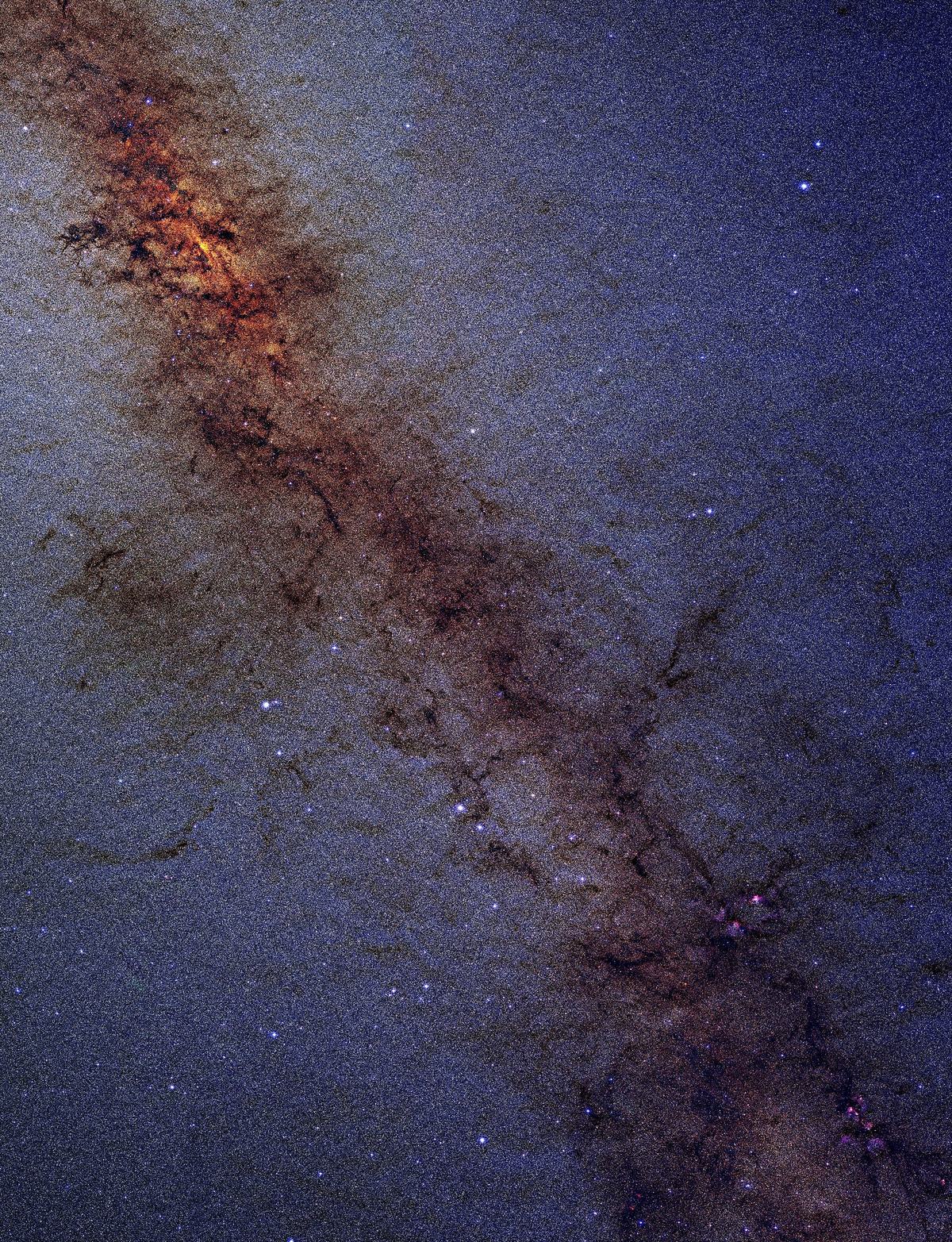
Every star in the night sky is slowly circling something nobody can see. At the center of the Milky Way sits Sagittarius A*, a supermassive black hole weighing 4.297 million times as much as the Sun, and the strange geometry of how it beams energy out into space may mean one of its jets is aimed directly at our solar system.
Sagittarius A* — astronomers just say "Sgr A star" — cannot be photographed directly, since no light escapes it. Everything we know comes from watching how gas, stars and radio waves behave near it. Decades of that detective work turned a faint radio hiss into one of the best-studied objects in the galaxy, worth a Nobel Prize and a picture taken with a telescope the size of Earth itself.
A Radio Hiss Nobody Could Place
In April 1933, engineer Karl Jansky was hunting down the source of static that interfered with transatlantic phone calls when he traced a radio signal to the direction of the constellation Sagittarius, toward the middle of our galaxy. He had no way of knowing he had stumbled onto the galactic center itself.
It took another four decades for anyone to isolate the exact object. Astronomers Bruce Balick and Robert Brown pinned down a compact radio source there on February 13 and 15, 1974, using a linked pair of radio dishes at the National Radio Astronomy Observatory. That precision — locating a single point buried in a much larger, brighter radio glow — is what eventually let later teams connect the dot to a black hole rather than just an unusually loud patch of sky.
The Cloud That Never Delivered Its Fireworks
Astronomers spotted a wisp of gas called G2 falling toward Sagittarius A* and predicted its nearest pass, a moment named peribothron, would arrive around May 2014. Telescopes across the world turned to watch, hoping to catch the black hole ripping the cloud apart in real time.
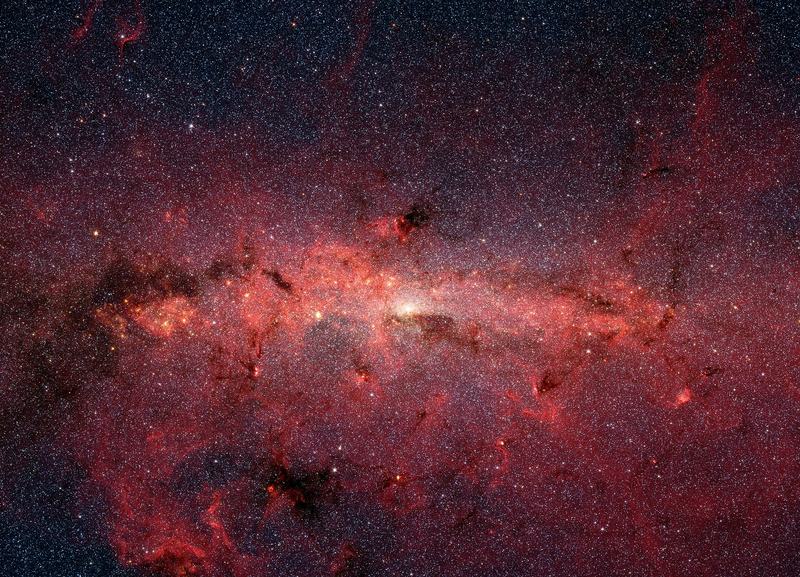

The show never really started. Follow-up observations found that the material swirling into Sagittarius A* stayed remarkably steady through the encounter, showing no sign of disruption from G2's arrival. The anticlimax was itself useful: it told researchers the black hole's feeding pattern is more resilient to a passing cloud than models had assumed, a constraint that still shapes how scientists simulate matter falling into black holes elsewhere.
Flares That Had Nothing to Do With the Cloud
While everyone waited on G2, Sagittarius A* threw a tantrum of its own. On September 14, 2013, the Chandra X-ray Observatory caught a flare 400 times brighter than the black hole's normal, quiet glow — a burst nearly 3 times stronger than the previous record-holder, set in early 2012. Weeks later, once things had calmed back down, Chandra logged a second outburst, this one 200 times brighter than usual, in October.
Because both flares happened well before G2's predicted closest approach, they could not have been triggered by the cloud everyone was watching. The leading explanation is far stranger: something smaller and closer, possibly a stray asteroid, straying too near the black hole and being torn apart. Either way, the flares are a reminder that Sagittarius A* does not need a dramatic gas cloud to make headlines — it can do that on its own, unpredictably, on an ordinary week.
Watching Gas Race the Speed Limit
The GRAVITY instrument at the European Southern Observatory caught something nobody had directly witnessed before: clumps of gas tracing a loop around Sagittarius A*, just outside the event horizon, at roughly 30 percent of light speed — the nearest anyone had watched matter travel before it fell past the point of no return.


That measurement only worked because GRAVITY cheats. It fuses the light collected by four separate telescopes at the Very Large Telescope into one virtual instrument with the resolving power of a mirror 130 meters across, far larger than any single dish could ever be built. Combining scopes this way is what turns a smear of light 26,000 light-years away into a traceable orbit.
The Star That Put Einstein to the Test
The same GRAVITY instrument, paired with a sibling called SINFONI, spent years tracking a star known as S2 as it swung past Sagittarius A* on a wildly elongated orbit. When S2 made its closest pass, researchers measured, for the first time in an environment this extreme, exactly the light-stretching and orbit-shifting effects general relativity predicts near a massive body — not the simpler physics of Newton's gravity.
S2 is no longer even the closest known contender. As of 2020, a star called S4714 holds that record, swinging within about 12.6 AU — roughly Saturn's distance from the Sun — while moving at around 8% of the speed of light. Tracking stars like these, on orbits fast and tight enough to feel relativity's fingerprints, is how astronomers weighed Sagittarius A* without ever seeing it.
An Object Smaller Than a Coin Held Across a Galaxy
Long before anyone photographed Sagittarius A*, radio astronomers were closing in on its true size. A 2019 study combining the Atacama Large Millimeter Array with a worldwide network of radio dishes found that its radio emission comes from a patch of sky just 300 millionths of a degree across, with a shape so even it looks almost perfectly round.
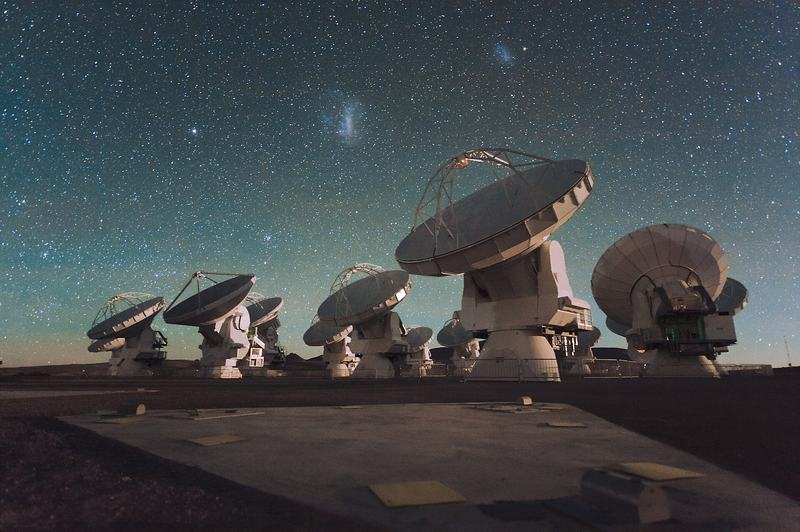

Getting a fix that sharp took decades of incremental progress: the very first observations of Sagittarius A* at the specific radio frequency used in that 2019 study had been made 26 years earlier, using only a handful of telescopes rather than a globe-spanning array. Each generation of instruments shaved the blur down further, a slow sharpening that eventually made an actual picture possible.
A Beam That May Be Aimed at Us
That same 2019 study turned up something unsettling: the emission region is so small and so symmetrical that the source may actually be pointed close to directly at Earth. Rather than viewing Sagittarius A* from the side, the way we typically view distant radio sources, we might be looking almost straight down one of its jets, like staring into a flashlight instead of watching its beam pass by. It is a reminder that our galaxy's black hole is not a passive backdrop; its geometry actively shapes what we are able to measure from here.
Proof, Then a Picture
The theoretical case that Sagittarius A* had to be a black hole built for decades on exactly this kind of orbital and radio evidence. The Nobel committee agreed: in 2020, Reinhard Genzel and Andrea Ghez split a quarter share each of the Physics prize, honored for pinning down that the object at our galaxy's center was too compact to be anything but a black hole.
Two years later, theory met image. On May 12, 2022, the Event Horizon Telescope Collaboration released the first picture of Sagittarius A*, a glowing ring of light bent around a dark center some 26,000 light-years from where we are standing. Humanity had only managed this once before, capturing the supermassive black hole inside the galaxy Messier 87 back in 2019 — making this the first confirmed picture, not just theoretical proof, of the object sitting at the heart of our own galaxy.
Sources
- NASA: Chandra Detects Record-Breaking Outburst from Milky Way's Black Hole
- ESO: Best View Yet of Dusty Cloud Passing Galactic Centre Black Hole
- ESO: Most Detailed Observations of Material Orbiting Close to a Black Hole
- Phys.org: Revealing the Black Hole at the Heart of the Galaxy
- Wikipedia: Sagittarius A*