Here is the strangest job application in physics: the man whose equations made black holes thinkable spent part of his career arguing against them. In 1939, Albert Einstein took his own general theory of relativity and tried to use it to prove that black holes could not exist.
The universe declined to cooperate. Within a lifetime, astronomers had weighed one, heard two of them collide, and finally photographed one. A black hole is a region where gravity wins outright — whatever crosses the boundary stays, light included — and the story of how we came to believe in them is full of bets, doubts and one very well-placed asterisk.
The Idea Arrived in a 1784 Letter
The earliest version of a black hole predates Einstein by more than a century, and it came by post. John Michell, an English astronomer and clergyman, worked out that a star with the Sun's density but 500 times its radius would swallow its own starlight: at the surface, the speed needed to escape would be greater than the speed of light itself. He published the calculation as part of a letter in 1784.
Michell's "dark star" was built on the wrong physics and still landed on the right idea — a mass so concentrated that light cannot leave it. It took the better part of two centuries for the concept to stop sounding like a mathematical prank.
The Loudest Doubter Wrote the Equations
Einstein's 1939 attempt to rule black holes out is one of science's great ironies: the theory he was defending kept quietly insisting on them. The matter was settled — mathematically, at least — in 1965, when Roger Penrose proved that general relativity predicts singularities inside every black hole. They were not a fluke of tidy, symmetric models that would vanish in the messy real universe. They were the rule.
That result turned black holes from a curiosity into a prediction. What was still missing was a real one, hanging in the sky, that astronomers could point at.
A Bet Stephen Hawking Hoped to Lose
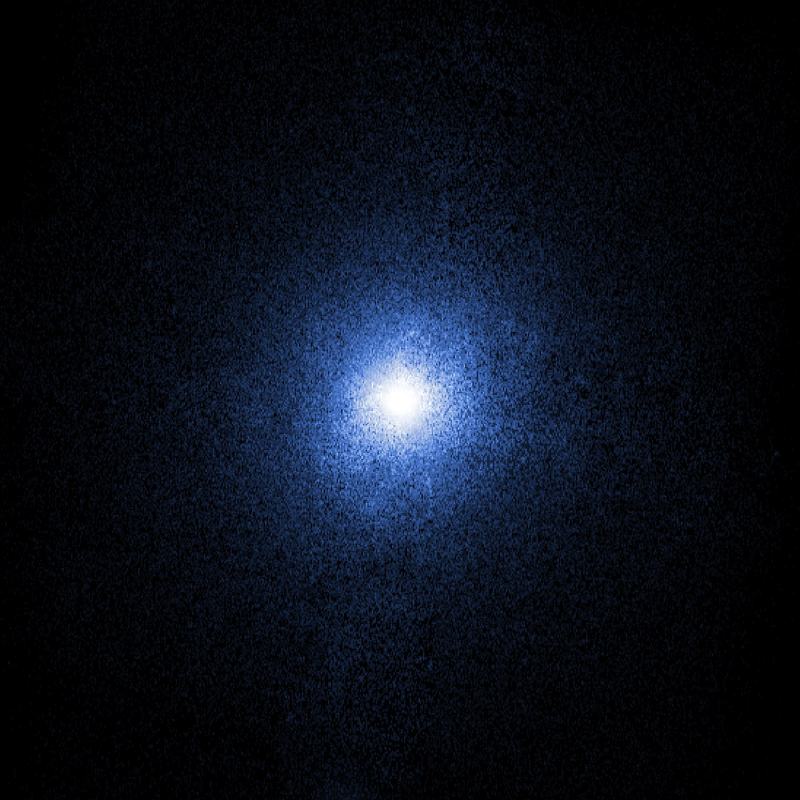

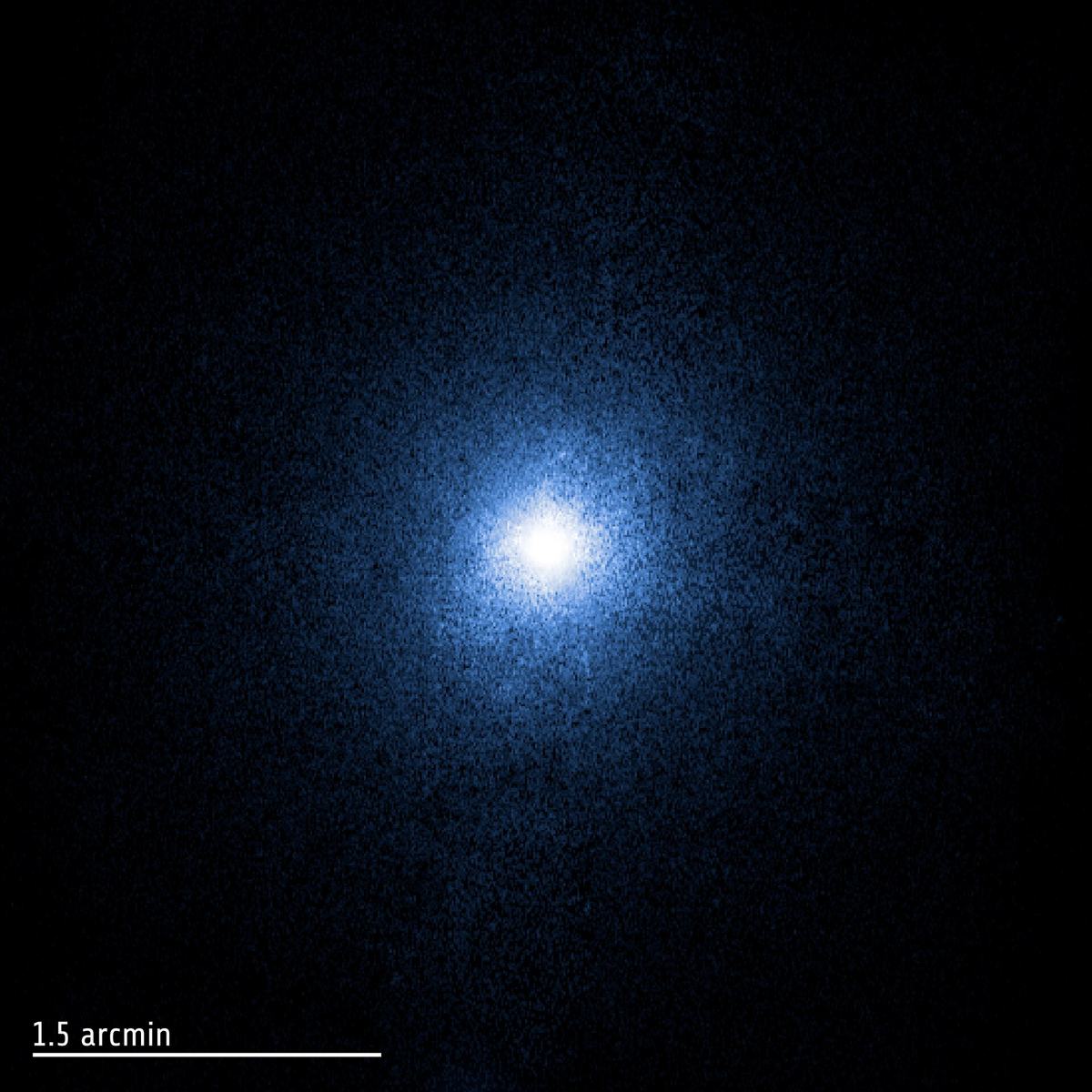
The pointing began with Cygnus X-1, a fierce X-ray source in the constellation Cygnus. By 1971, several research groups had independently identified it as the first black hole candidate to win broad acceptance. The object refused to behave like any ordinary star, and the case kept getting stronger.
Strong enough, in fact, to gamble on. In 1975, Stephen Hawking and Kip Thorne struck a friendly wager over whether Cygnus X-1 really contained a black hole — and Hawking, who had spent years working on black hole theory, deliberately bet against it, so that losing the bet would at least mean winning the physics. He conceded in 1990, once the observations left little room for doubt. Today the compact object in Cygnus X-1 is estimated at about 21.2 times the Sun's mass — an object no ordinary star we know of could explain.
Black Holes Are Not Entirely Black
Hawking's consolation prize was bigger than the bet. In 1974 he showed that quantum field theory forces black holes to glow — faintly, like a black body, at a temperature set by their surface gravity. This is the effect now called Hawking radiation, and it means a black hole can, in principle, slowly evaporate.
In practice, none of them are shrinking yet. Even the smallest observed class, stellar black holes, currently take in more mass from the cosmic microwave background — the thin afterglow of the Big Bang — than they give up through Hawking radiation. The books, for now, only fill up.
The Day Spacetime Rang Like a Bell
For a hundred years, every test of black holes was indirect. Then, in late 2015, the LIGO and Virgo collaborations caught the first direct detection of gravitational waves — an event named GW150914, and simultaneously the first black hole merger ever observed.
The signal's fine print is staggering. The two black holes that spiralled together were roughly 30 and 35 times the mass of the Sun, and the collision happened about 1.4 billion light-years from Earth. A ripple in spacetime crossed that distance and still registered on instruments here. Hundreds of similar detections have followed, but GW150914 was the moment black holes stopped being silent.
Portraits of Two Monsters
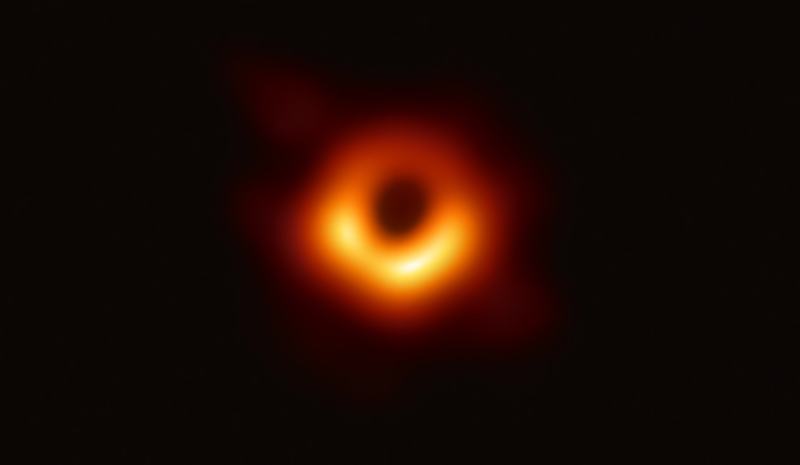

Hearing black holes was not enough; astronomers wanted to see one. On 10 April 2019, the Event Horizon Telescope published the very first direct image of one — the supermassive giant at the core of the galaxy Messier 87, glowing like a ring of embers around a hole in the sky.
The sequel was closer to home. In 2022, the same collaboration released an image of Sagittarius A*, the black hole at the centre of our own Milky Way, reconstructed from data collected back in 2017. Two portraits, two galaxies, one identical physics — the strongest visual evidence yet that event horizons are real places, not theoretical bookkeeping.
The Heavyweight Next Door
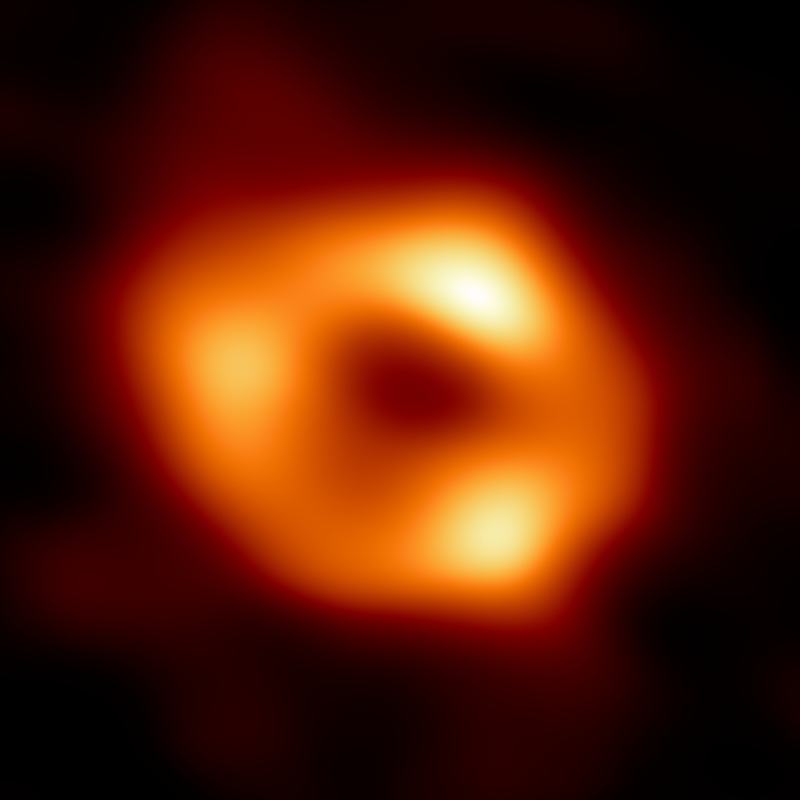
The first image of Sagittarius A, captured by the Event Horizon Telescope collaboration. Photo: EHT Collaboration, Wikimedia Commons, CC BY 4.0*
Sagittarius A* is the black hole we know best, and the numbers are wonderfully precise. Its mass comes out at 4.297 million solar masses, pinned down to within 0.012 million — accounting so exact it would flatter a bank. It sits about 26,000 light-years away, and its measured size works out to 51.8 million kilometres — about 32.2 million miles — across.
That figure deserves a comparison. Earth orbits 150 million kilometres from the Sun, and Mercury dips to 46 million kilometres at its closest. Park Sagittarius A* where the Sun is, and its shadow would reach past Mercury's orbit — a single object wider than the inner Solar System's first lane.
An "Exciting" Name and a Restless Appetite
The asterisk in Sgr A* is not a footnote. Robert Brown slipped it in back in 1982: the radio source struck him as "exciting", and physicists mark the excited states of atoms with asterisks. It may be the only object in the sky named after a mood.
The name still fits. In 2013, astronomers watching with the Chandra X-ray telescope caught Sgr A* throwing a flare 400 times brighter than its usual quiet murmur. Even a mostly dormant black hole, it turns out, occasionally reminds the neighbourhood who owns the centre of the galaxy.