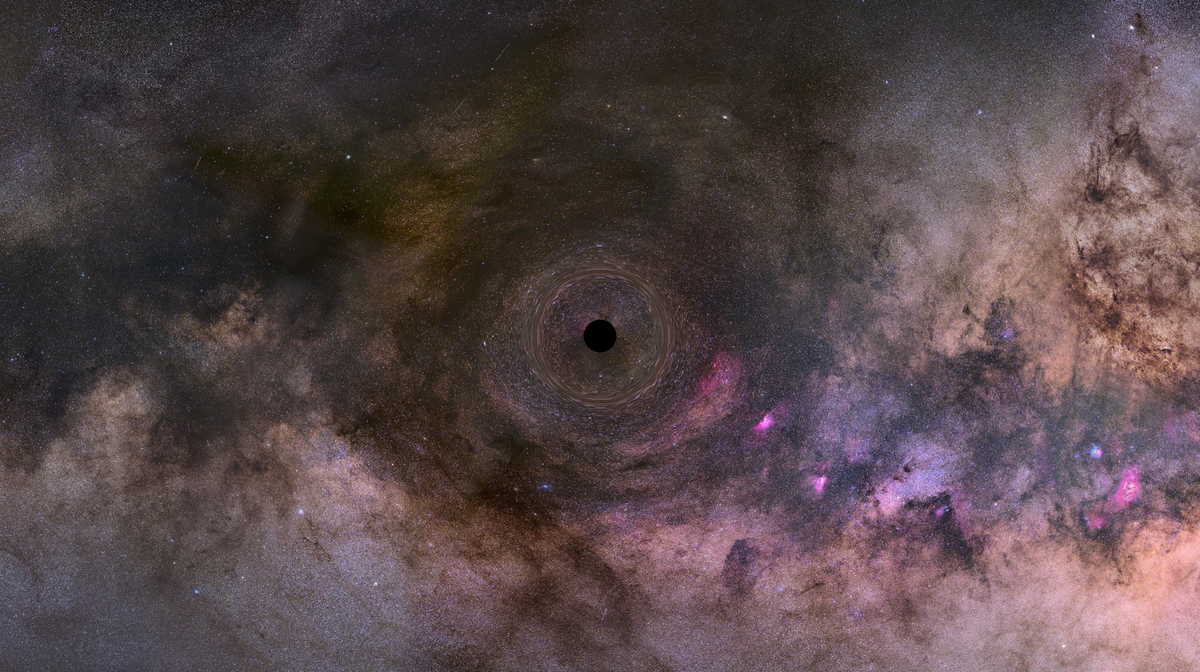
An event horizon has no material to touch, no color, no thickness — and yet it is the most absolute boundary in the universe. Cross it, and not even a beam of light pointed straight back the way you came can escape. Nothing marks the spot except the math describing it.
That combination, an edge that is both everywhere-nothing and utterly final, is what separates a black hole from every other object in astronomy. Planets and stars have surfaces you could, in principle, stand on. An event horizon is a boundary in spacetime itself, and the rules on the two sides of it are not the same rules.
The story of how physicists came to understand that boundary runs from an 18th-century letter to a 2019 photograph, and it keeps turning up ideas stranger than the black hole itself.
An Edge Predicted Before Anyone Had the Word for It
The first sketch of the idea came in 1784, when the English clergyman and astronomer John Michell proposed that gravity near a sufficiently massive, compact object could be strong enough that even light could not escape it. There was no general relativity yet, no name for the boundary Michell had described — just the arithmetic of an escape velocity that outran light itself.
The name arrived generations later, and mid-century, almost as an afterthought. Physicist Wolfgang Rindler coined the term "event horizon" in the 1950s, borrowing the word "horizon" for something that hides events rather than land. A more rigorous definition followed in 1958, when David Finkelstein used general relativity to describe the horizon as a boundary beyond which nothing that happens can ever affect an observer on the outside. That phrasing is still the one physicists use: the event horizon isn't defined by what's inside it, but by what can never get out.
A Radius You Can Calculate on a Napkin
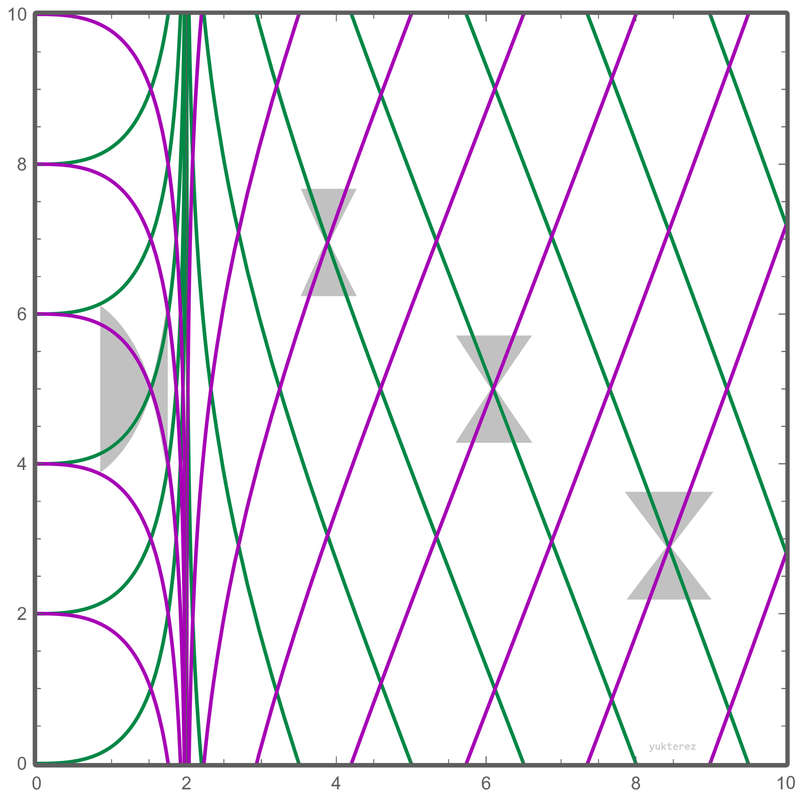

However abstract the definition sounds, the size of an event horizon is one of the simplest numbers in physics to compute once you know an object's mass. This is the Schwarzschild radius, named for the German astronomer Karl Schwarzschild, who worked out the solution in 1916, within months of Einstein publishing general relativity itself.
Plug in any mass and the radius pops out, which makes for some vivid comparisons. Compress the Sun to its Schwarzschild radius and it would need to fit inside a sphere about 3.0 km (1.9 mi) across. Do the same to Earth and the sphere shrinks to roughly 9 mm (0.35 in) — smaller than a marble. The Moon's version would be about 0.1 mm (0.004 in), a boundary you could lose on a fingertip. None of these bodies is remotely dense enough to actually form a horizon; the number just describes how far they are from it.
At the other end of the scale, the Schwarzschild radius of the supermassive black hole at the center of the Milky Way works out to approximately 12 million kilometres — a boundary that would comfortably swallow the orbit of Mercury.
More Water Than Any Ocean, Just Before It Collapses
The Schwarzschild radius formula holds a genuinely strange implication: because it scales with mass while an object's physical size scales with the cube root of its volume, low-density material can cross its own horizon boundary if there's simply enough of it. Work out how much ordinary water you could gather before the whole mass collapsed under its own gravity, and the answer is a sphere with a radius of about 400920754 km, roughly 2.67 AU — wider than the distance from the Sun to the asteroid belt.
That is the same reason the very largest black holes are, on average, less extreme than the small ones. The volume enclosed by the event horizon of the most massive black holes has an average density lower than that of ordinary main-sequence stars. A horizon marks where escape becomes impossible, not where matter is packed to its limit — and for an object big enough, "impossible to escape" and "thin as a star" can describe the same place.
You Would Never See Anyone Actually Fall In
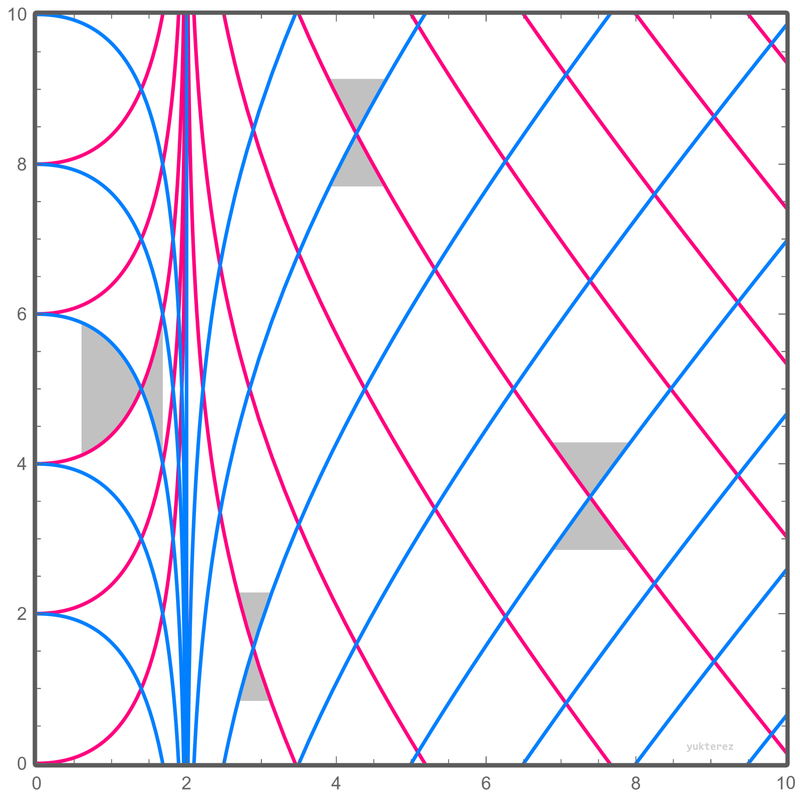

Here is the part that trips up even careful readers: an event horizon is one-way to cross, but from the outside, no one ever gets to watch the crossing happen. Objects sent toward an event horizon never appear to actually reach it from a distant observer's point of view, because the light carrying that final image never manages to reach the observer at all. The falling object appears to slow, dim, and fade toward the horizon forever, without ever visibly arriving.
Whether the fall itself would be survivable depends entirely on scale. A human astronaut would only survive falling through an event horizon in a black hole with a mass of approximately 10,000 solar masses or greater — anything smaller, and the tidal forces near the boundary do the damage first, long before the horizon itself is reached.
The Point of No Return, Stretched to Its Limit
That damage has a name: spaghettification. Near a black hole, the difference in gravitational pull between an object's near side and far side becomes so extreme that nothing can resist being stretched along the direction of the fall. A small black hole does this well outside its horizon, which is exactly why a low-mass one is lethal long before an astronaut gets anywhere close to the boundary itself.
Scale the black hole up, though, and the geography changes. For a supermassive black hole, the point where spaghettification would begin lies within the event horizon itself, so an astronaut could cross the boundary without noticing any stretching at all — even though falling toward the center afterward remains inevitable. It is possible, in other words, to pass the point of no return and feel completely fine about it, for a while.
Photographing a Silhouette No One Can See
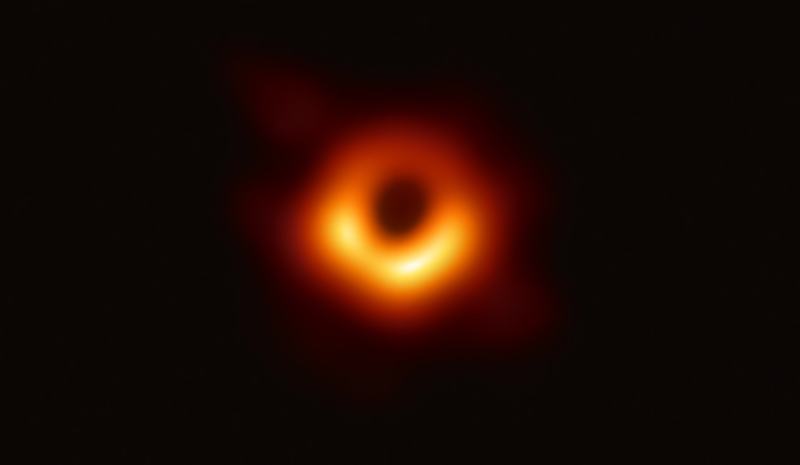

An event horizon emits no light of its own, so no telescope can image it directly — what astronomers can catch is its silhouette against the glowing, superheated gas swirling just outside. That silhouette is what the Event Horizon Telescope, a global network of radio dishes working as one instrument, set out to capture. The first-ever image of a black hole, at the center of the galaxy Messier 87, was published by the Event Horizon Telescope Collaboration on April 10, 2019, spread across six scientific publications at once.
The numbers behind that image are startling on their own. The telescope measured that black hole's mass at 6.5±0.7 billion solar masses and the diameter of its event horizon at approximately 40 billion kilometres (270 AU), about 2.5 times smaller than the glowing shadow the image actually shows — the shadow is inflated by the way light bends around the horizon before reaching Earth. On 12 May 2022, the same collaboration unveiled a second portrait: the supermassive black hole at the center of our own Milky Way, Sagittarius A*.
Both images depended on resolution that had no precedent. Since 2018, the Event Horizon Telescope has imaged at a wavelength of 870 micrometres (345 GHz), reaching an angular resolution of 19 microarcseconds — the sharpest of any ground-based telescope, and roughly what it would take to read a newspaper headline on the surface of the Moon from Earth.
A Faint Glow at the Very Edge
Even the most absolute boundary in physics turns out to have a loophole, at least in theory. Hawking radiation is released just outside a black hole's event horizon, according to a model of quantum effects developed by Stephen Hawking in 1974. The horizon itself still lets nothing back out — the radiation is a separate quantum process happening right at its threshold, not light escaping from behind the boundary.
It's a reminder that the event horizon, for all its finality, isn't the last word on what a black hole does. It's simply the line past which the universe stops keeping you posted.