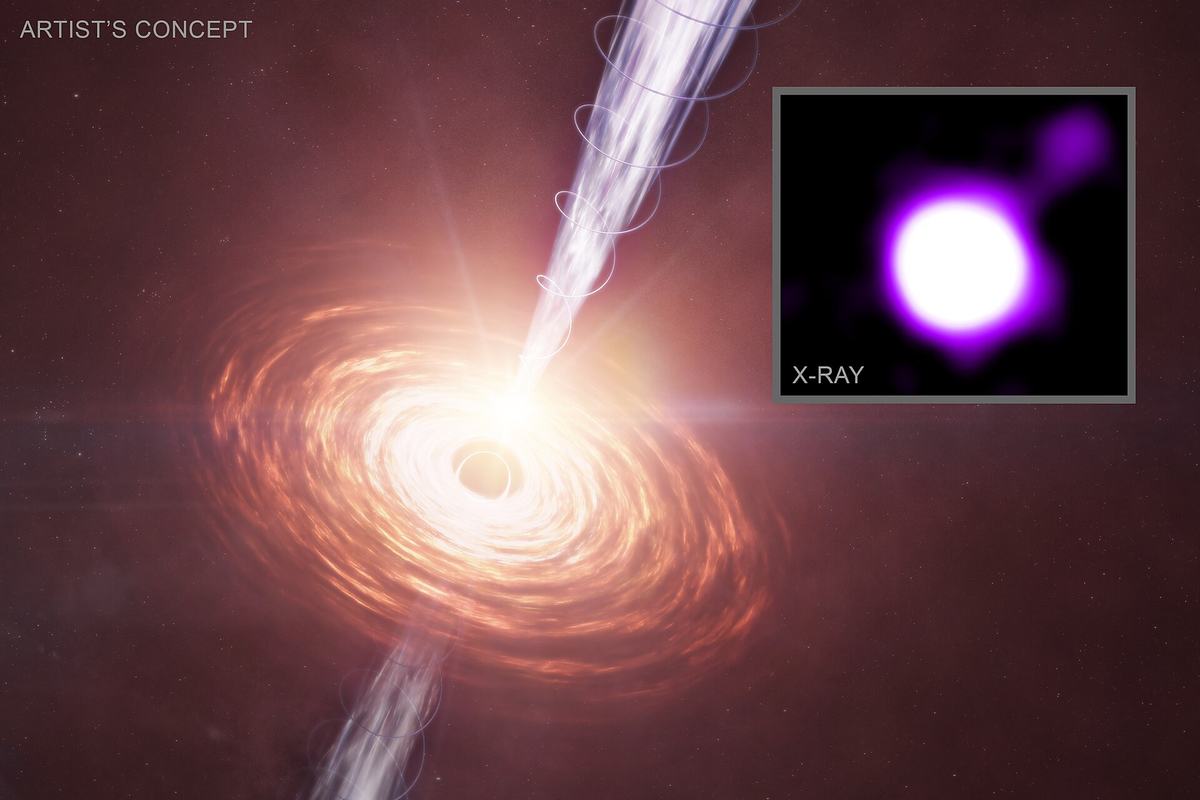
Puff up a black hole enough and it stops feeling extreme. Take one that weighs about a billion Suns: stretch its boundary out and it spans roughly the same distance as Uranus circling the Sun, nearly 19 astronomical units across. Nothing about falling past that boundary would feel violent, either — you would drift through it long before gravity's pull tore you apart.
That gentleness is one of the odder truths about supermassive black holes, the class of black hole that sits at the center of essentially every large galaxy, including our own. They are not scaled-up versions of the black holes left behind by dying stars; they are a different beast entirely, one whose origin story is still being pieced together and whose record holders keep getting reset.
What Counts as "Supermassive"
Astronomers classify a black hole as supermassive once it clears roughly 100,000 solar masses, and the biggest known examples run into the billions. As a category, supermassive black holes span everything from the low hundred-thousands up through objects billions of times heavier than the Sun. The reason falling into one of the biggest members of that range feels so calm comes down to geometry: bulk up the boundary and the pull across a human body barely changes near the edge, unlike the fierce stretching a smaller black hole would inflict close in.

The Record Holders
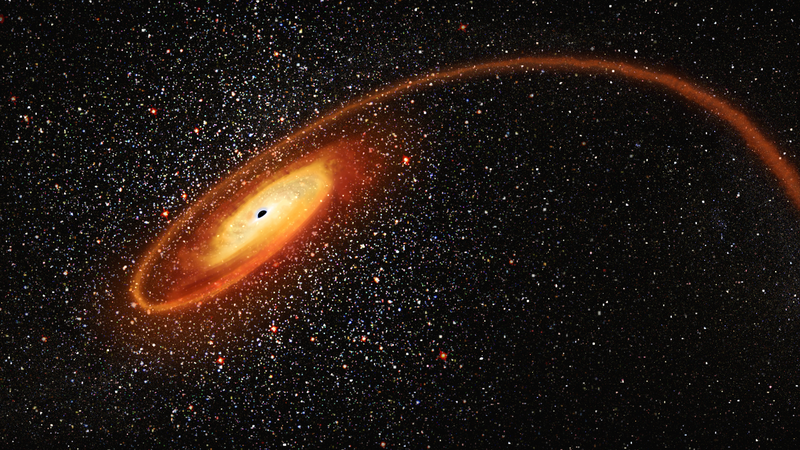
A handful of named black holes dominate the leaderboard. The ones anchoring TON 618, NGC 6166, ESO 444-46, plus NGC 4889 are routinely cited among the heaviest ever measured. Beyond even those, a 2020 study floated the idea of "stupendously large black holes" — hypothetical objects topping 100 billion solar masses — and pointed to the black hole inside the galaxy Phoenix A as a candidate for that tier. Nobody has confirmed one yet, but the fact that theorists needed a new label at all says something about how far the mass scale keeps stretching.
How These Giants Put On Weight
Two processes do essentially all the heavy lifting. The dominant one is simple accretion: gas swirling inward and falling onto the black hole, which is both the most efficient and the easiest-to-spot way any black hole gains mass. The second is more dramatic. When two galaxies collide and merge, the black holes each one carried to the center can settle into a long-lived orbiting pair before eventually combining into a single, heavier one. Neither process is fast on human timescales, but over billions of years they can turn a modest seed into one of the giants described above.
A Mystery Radio Signal Started It All
The trail that led to supermassive black holes began not with a black hole at all but with a puzzling radio source. In 1963, astronomer Maarten Schmidt was trying to make sense of the object cataloged as 3C 273, and the following year physicists Edwin Salpeter and Yakov Zeldovich offered an explanation: matter spiraling onto an enormous compact object could account for the strange behavior these radio sources displayed. That idea — an engine fed by infalling gas rather than nuclear fusion — turned out to describe exactly what a supermassive black hole does.
Catching One at the Center of Another Galaxy
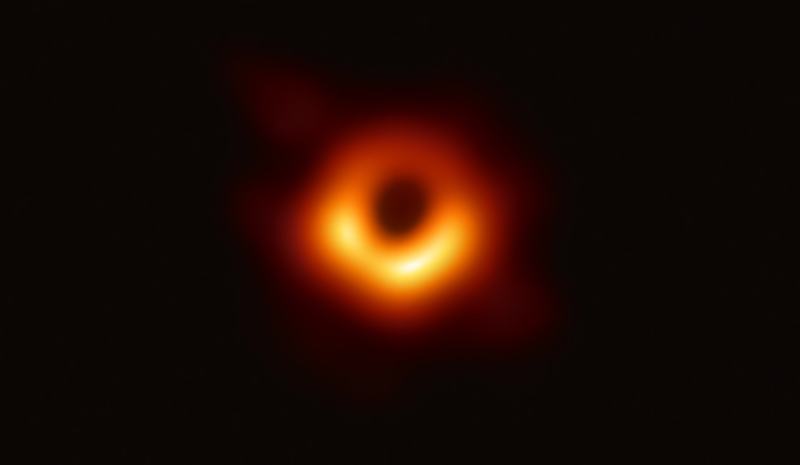
For over a decade the idea remained indirect evidence and educated inference. That changed in 1978, when astronomers detected the telltale dynamical signature of a massive dark object at the heart of the galaxy Messier 87, with an early mass estimate around 5 billion Suns. Decades later, the same object became the very first black hole ever photographed: the Event Horizon Telescope Collaboration released its now-famous image of the glowing ring around Messier 87's black hole on April 10, 2019, turning a mathematical inference into a picture.

The One at the Center of Our Own Galaxy
The Milky Way keeps its own supermassive black hole, known as Sagittarius A, and it has been measured with unusual precision: the current best estimate puts its mass at 4.297 million Suns. Work confirming its nature earned Andrea Ghez and Reinhard Genzel a share of the 2020 Nobel Prize in Physics, awarded for discovering the supermassive compact object at our galaxy's center. In May 2022, the Event Horizon Telescope team followed up its Messier 87 image with a picture of Sagittarius A itself, capturing the glow of hot gas swirling around its event horizon. Sitting some 26,000 light-years away, that event horizon spans about 51.8 million kilometers — roughly a third the distance from the Sun to Earth, scaled up to galactic remove.
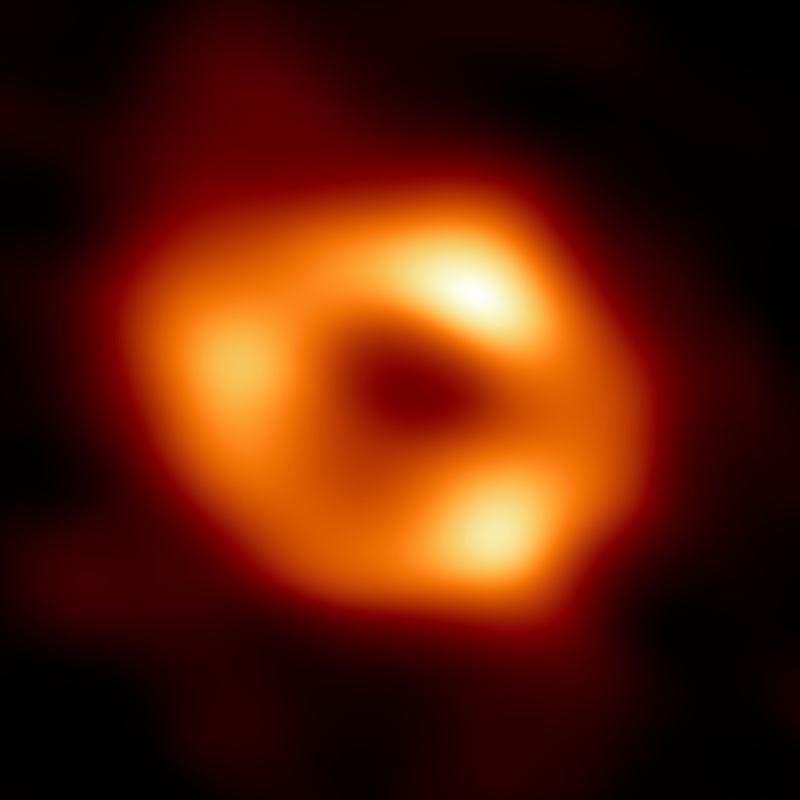
The Event Horizon Telescope's image of Sagittarius A, the Milky Way's own supermassive black hole. Photo: EHT Collaboration, Wikimedia Commons, CC BY 4.0*

Quasars: A Supermassive Black Hole Caught Feeding
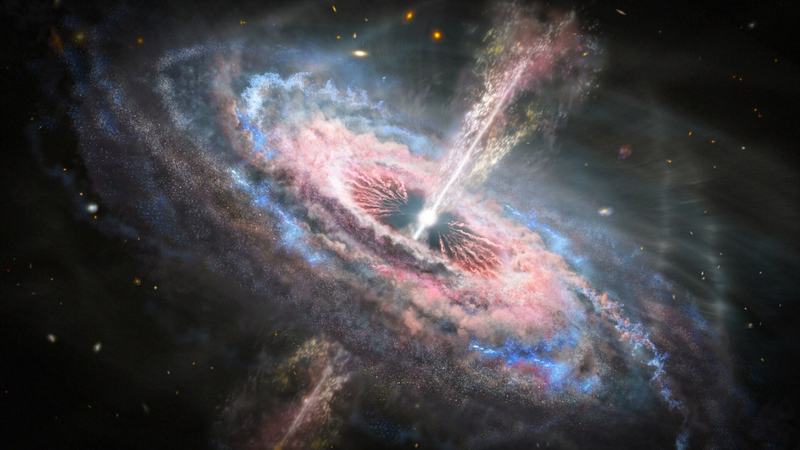
Not every supermassive black hole sits quietly. When one is actively pulling in large amounts of gas, the surrounding disk can outshine the rest of its host galaxy by a wide margin — the most extreme examples, called quasars, put out thousands of times more energy than an entire galaxy the size of the Milky Way. The nearest known quasar isn't especially far as these things go — roughly 600 million light-years from us — whereas the current distance record for an active galactic nucleus sits at redshift 10.1, putting it about 31.6 billion light-years away in comoving distance. Between those two extremes lies most of what astronomers know about how supermassive black holes behave when they are actively growing rather than sitting dormant.
The Current Distance Record
The search for the earliest, most distant supermassive black holes is still very much active. A study published in August 2025 pointed to an object called CAPERS-LRD-z9 as the current distance record-holder among supermassive black holes, sitting at redshift 9.288 — meaning its light left home when the universe was only about 3 percent of its present age. Finding a fully formed supermassive black hole that early remains one of the harder puzzles in the field, since it leaves relatively little cosmic time for one to grow from a stellar-mass seed into something so large.