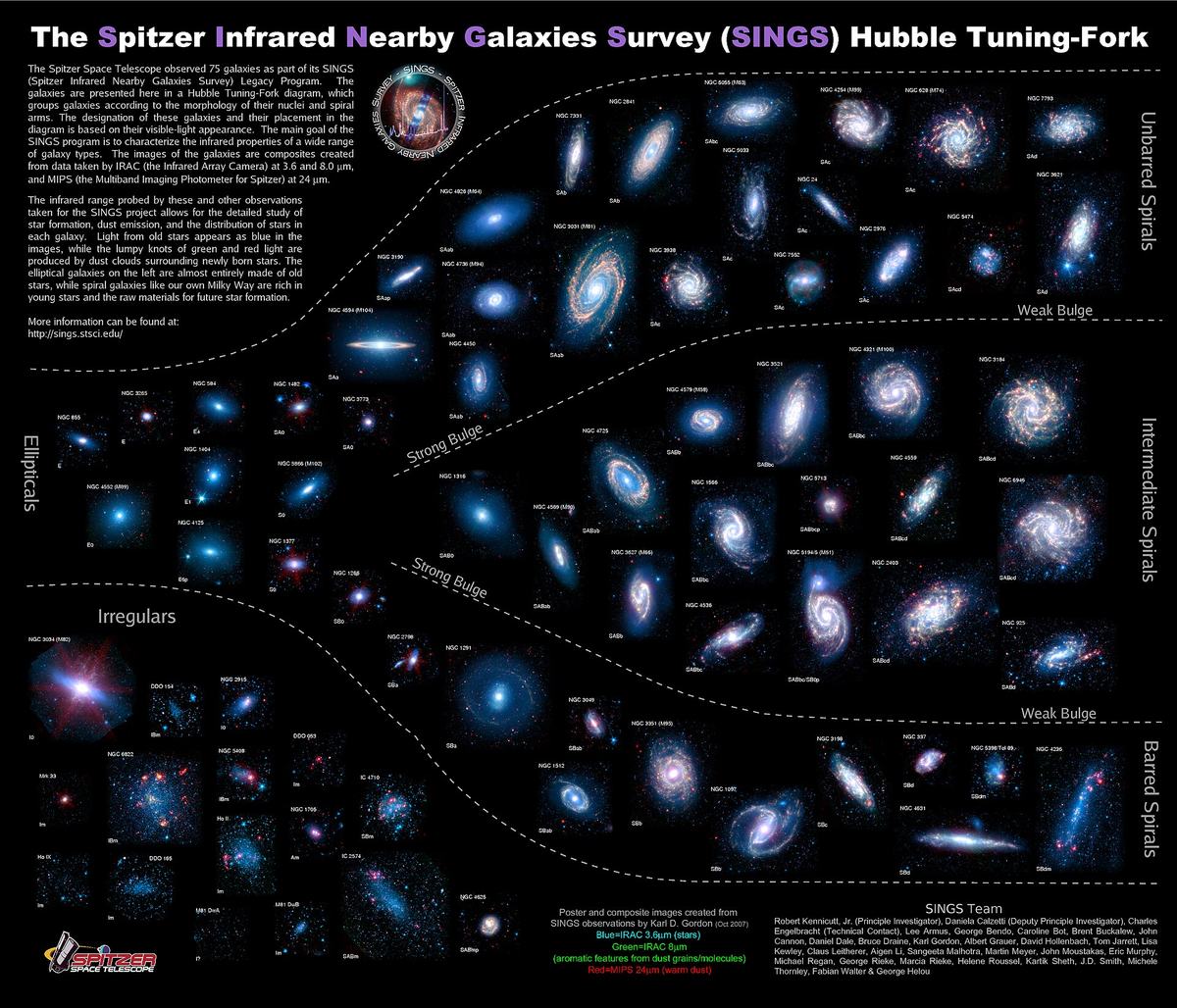
Astronomers still cannot say exactly how many galaxies exist. The working estimate is somewhere between 200 billion (2×10^11) and 2 trillion, and that range itself tells a story: every time telescopes have gotten better at picking out faint, distant smudges of light, the count has jumped.
A galaxy, at its simplest, is a gravitationally bound collection of stars, gas, dust and dark matter. But "galaxy" covers an enormous range of objects. Galaxies average an estimated 100 million stars, and run from dwarfs with less than a thousand stars up to supergiants with one hundred trillion stars, each orbiting its galaxy's center of mass. This article looks at galaxies as a class of object — how they are classified, how big they get, what holds them together, and which one currently holds the record for farthest away.
How Many Galaxies Are Out There
The Hubble Deep Field, an extremely long exposure of a relatively empty patch of sky, gave astronomers their first real handle on the question: it provided evidence for about 125 billion (1.25×10^11) galaxies in the observable universe. That number looked authoritative for years, mostly because it came from the deepest image space telescopes had ever produced.
Then, in 2016, a study led by Christopher Conselice of the University of Nottingham, published in The Astrophysical Journal, combined many additional sources of data and pushed the estimate to at least two trillion (2×10^12) galaxies in the observable universe out to redshift z=8 — about ten times more than are directly seen in Hubble images. The gap between the two figures is not a mistake in either study; it reflects how many galaxies are too faint, too small or too far away for even a landmark image like the Hubble Deep Field to resolve individually.
From Dwarfs to Supergiants
Most galaxies are 1,000 to 100,000 parsecs in diameter, or roughly 3,000 to 300,000 light-years, and they are separated from their neighbors by distances on the order of millions of parsecs. That gap matters: a typical galaxy's own width is measured in thousands of light-years, but the empty space between it and the next galaxy is measured in millions.
Within that 1,000-to-100,000-parsec range sits an enormous spread of populations. A dwarf galaxy can hold under a thousand stars, while a supergiant can hold on the order of a hundred trillion — a difference of roughly eleven orders of magnitude in star count between the smallest and largest galaxies known.
Most of a Galaxy You Can't See
Stars and glowing gas are what make a galaxy visible, but they are not what make up most of its mass. Most of the mass in a typical galaxy is in the form of dark matter, with only a few percent of that mass visible in the form of stars and nebulae. In other words, the bright disk or bulge that shows up in a photograph is a thin visible layer over something far more massive that gives off no light at all.
The clue that gave this away came from motion, not light. In the 1970s, astronomer Vera Rubin found a discrepancy between the observed rotation speed of galaxies and the speed predicted from the visible mass of their stars and gas alone. Stars far from a galaxy's center were moving faster than the visible matter could explain — exactly the kind of mismatch that points toward a large reservoir of unseen mass holding the galaxy together.
A Sorting System Hubble Didn't Invent
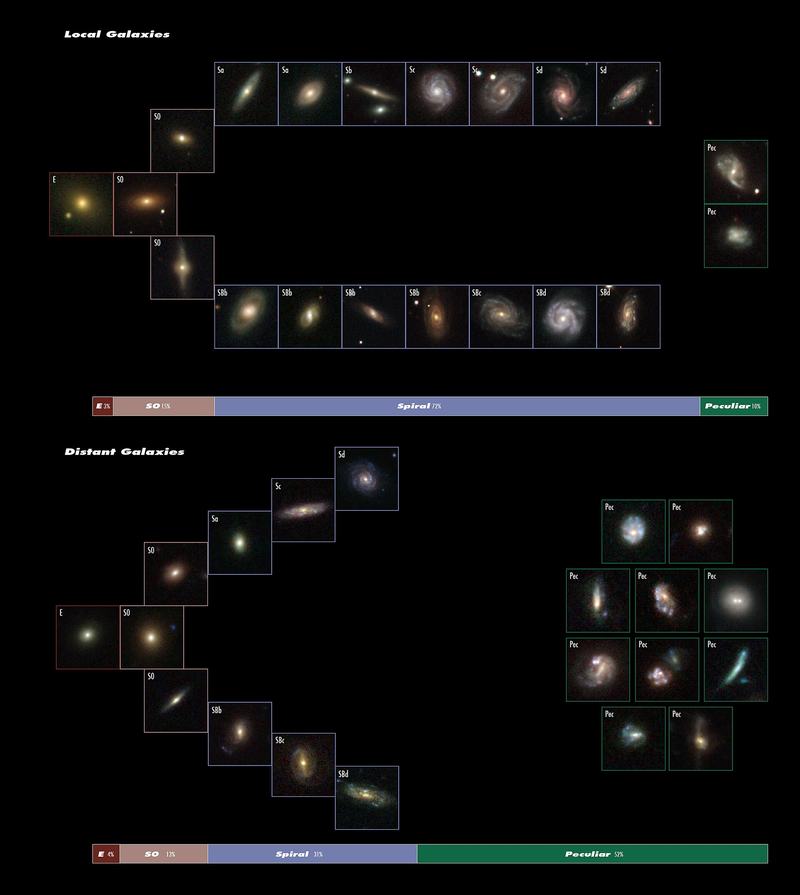
Most galaxies get sorted using the Hubble sequence, a morphological classification scheme for galaxies published by Edwin Hubble in 1926. Despite carrying his name, it was invented by John Henry Reynolds and Sir James Jeans; Hubble popularized and published the scheme rather than originating it.
.jpg)
The sequence's elliptical branch has its own internal scale. Elliptical galaxies are rated from E0 up to E7, following a convention in which the class number is ten times the galaxy's ellipticity, rounded to the nearest integer — so a nearly circular galaxy on the sky reads as E0, and a flattened, elongated one reads as E7.
Between the elliptical branch and the two spiral branches of the classic tuning-fork diagram sits a third group. At the center of the Hubble tuning fork, where the two spiral-galaxy branches and the elliptical branch join, lies an intermediate class of galaxies known as lenticulars and given the symbol S0 — neither clearly elliptical nor clearly spiral, but a shape in between.
The Biggest Shapes in the Cosmic Zoo
Ellipticals also produce the largest galaxies known. The largest galaxies are supergiant ellipticals, also called type-cD galaxies — a separate designation from the ordinary elliptical class, reserved for the true giants.
Even setting the supergiant class aside, ordinary elliptical galaxies alone cover a huge range: they vary greatly in both size and mass, with diameters ranging from 3,000 light-years to more than 700,000 light-years, and masses from 10^5 to nearly 10^13 solar masses. That upper end of the range is well over 200 times wider than the lower end.
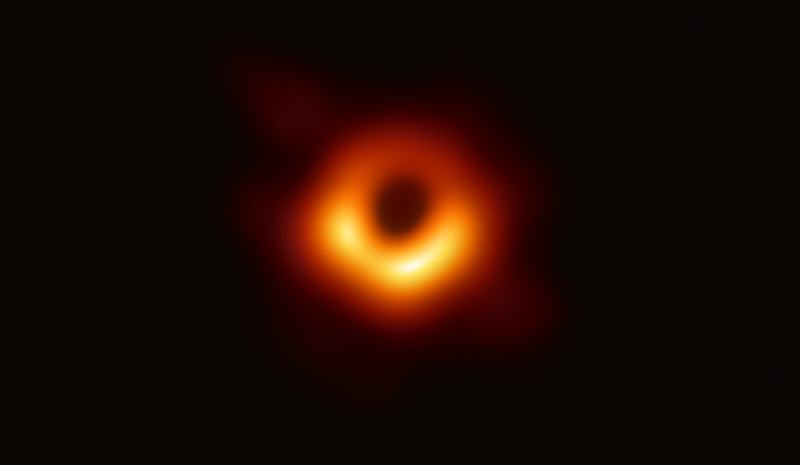
One elliptical galaxy earned a different kind of record. M87 (NGC 4486) is home to the supermassive black hole that became the first black hole ever imaged, by the Event Horizon Telescope — turning a galaxy already notable for its size into the source of the first direct picture of a black hole's shadow.

When a Galaxy's Core Lights Up
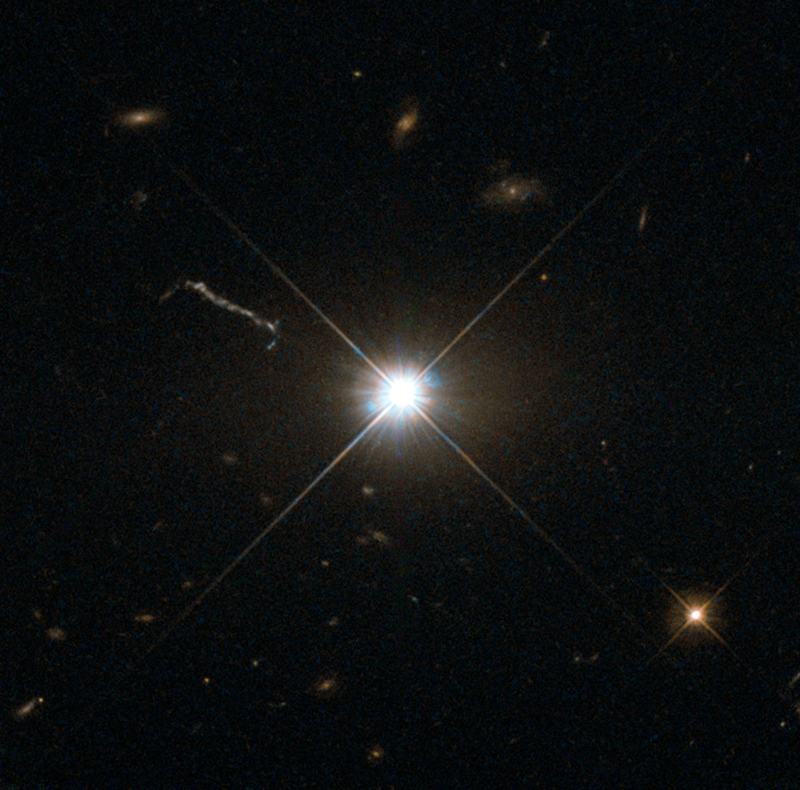
Not every galactic nucleus sits quietly. Some blaze with radiation, and the most extreme cases are quasars. Distances among known quasars vary enormously: the nearest known quasar, Markarian 231, is about 581 million light-years from Earth, while others have been discovered as far away as UHZ1, roughly 13.2 billion light-years distant — a gap of more than twenty-two times the distance.
.jpg)
Radio waves reveal a different kind of extreme galaxy. Alcyoneus is a radio galaxy with the largest observed radio emission of any known galaxy, its lobed structures spanning 5 megaparsecs, or 16×10^6 light-years. For comparison, another similarly sized giant radio galaxy is 3C 236, with lobes 15 million light-years across — meaning Alcyoneus's radio lobes alone stretch further than many entire galaxy clusters.
Bound Together in the Billions
Galaxies rarely exist in isolation; most belong to larger structures held together by gravity. A galaxy cluster typically contains 100 to 1,000 galaxies, hot X-ray-emitting gas and large amounts of dark matter, with total masses of 10^14 to 10^15 solar masses and diameters from 1 to 5 megaparsecs.
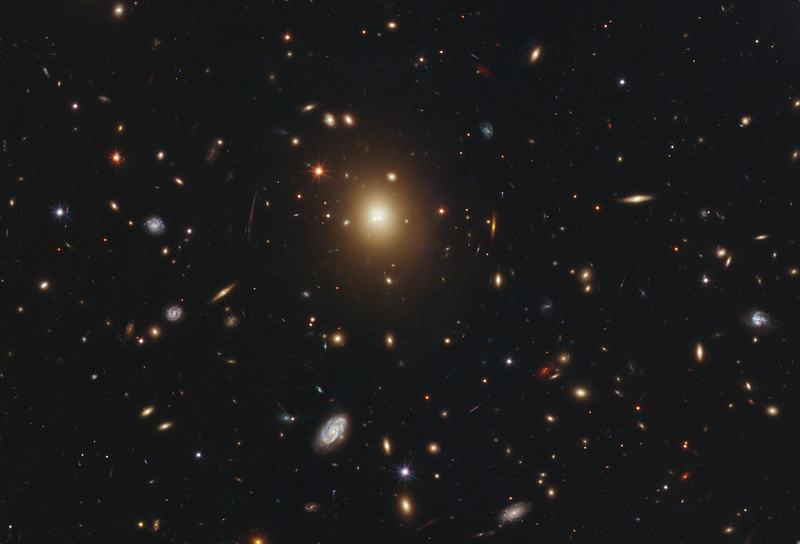

For decades, clusters held the title of the biggest things in the universe: they were believed to be the largest known structures in the universe until the 1980s, when superclusters were discovered and dislodged them from the top spot.
The gas that fills a cluster is anything but cold. The heated gas of the intracluster medium has a peak temperature between 30 and 100 million degrees Celsius — hot enough to shine in X-rays, which is how astronomers spot much of it in the first place.
The Farthest Galaxy on Record
Distance records in astronomy tend to be short-lived, and GN-z11 is a good example of why. Discovered with the Hubble Space Telescope and announced in a 2016 paper, GN-z11 held the title of the oldest and most distant galaxy yet identified in the observable universe, with a spectroscopic redshift of z = 10.957, corresponding to a proper distance of approximately 32 billion light-years — until the James Webb Space Telescope found JADES-GS-z13-0 in 2022 and took over the record.
That six-year reign is a reminder of the same pattern seen in the galaxy-count estimates: every generation of telescope pushes the known universe's edges further out, and the current record holder is only ever the most distant galaxy anyone has found so far, not necessarily the most distant one that exists.