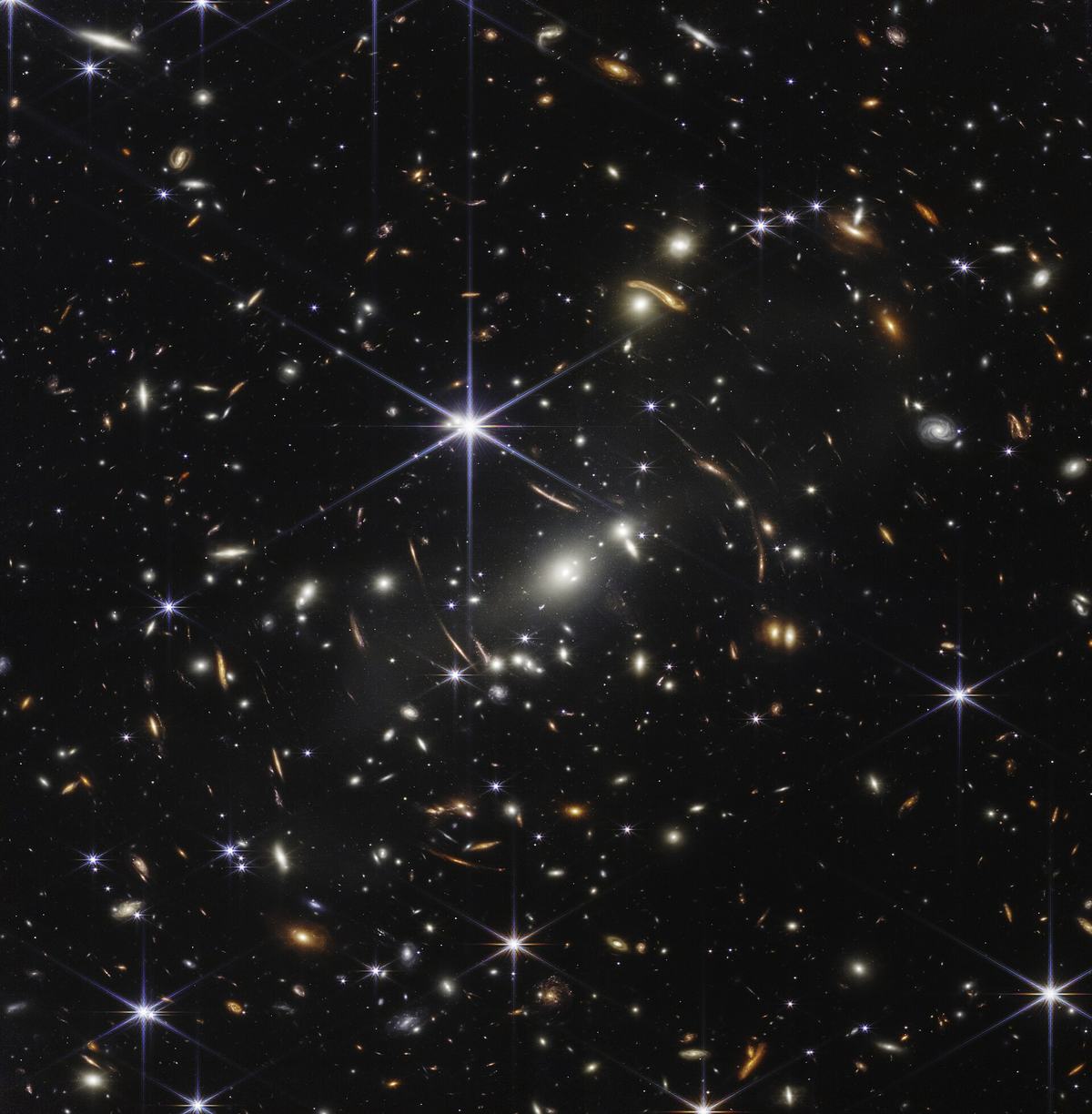
Webb's first released picture packs thousands of galaxies into one small frame. Some of that light left its source as long as 13 billion years ago. That single image sums up why the James Webb Space Telescope exists.
Webb is the largest telescope ever placed in space, built with instruments sensitive and sharp enough to pick out objects too ancient, too far away, or too dim for the Hubble Space Telescope to register. Getting there took a spacecraft that unfolds itself in flight, a sunshield the size of a tennis court, and an orbit chosen specifically so nothing warm ever gets in the way of the view.
What follows is less a tour of pretty pictures than a look at the engineering choices behind them: where Webb sits, how cold it has to be, what nearly went wrong with its mirror, and what it has found so far.
Webb's First Deep Field: A Single Pixel of Sky
The picture that introduced Webb to the public is called Webb's First Deep Field, and it is packed with far more than it looks. Among the thousands of galaxies crammed into that tiny patch of sky, some are estimated to be as old as 13 billion years, meaning their light set out not long after the universe itself began.
That density is the point of a deep field: instead of aiming at one target, the telescope stares at an apparently empty patch long enough for faint, distant light to accumulate. It's a strange kind of record: not the biggest or the brightest picture, but a look back across most of cosmic history in a single exposure.
A Permanent Address a Million Miles Away
Unlike Hubble, which circles Earth a few hundred miles up, Webb doesn't orbit our planet at all. It orbits the Sun, keeping station near a gravitational balance point called the second Lagrange point, or L2, roughly 1.5 million kilometers, about 1 million miles, from Earth.
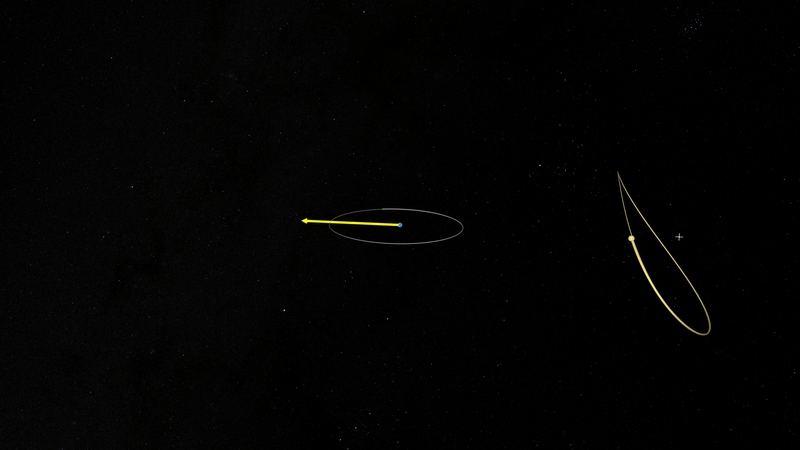
That distance isn't arbitrary. The neighboring Lagrange point, L1, sits the same 1.5 million kilometers away on the near side, toward the Sun, and it's already a busy neighborhood: solar observatories including DSCOVR, WIND, SOHO, and ACE all keep watch from there. Webb needed the far side instead, where Earth, the Moon, and the Sun stay conveniently out of its sightline.
That positioning pays off constantly. Hubble slips into and out of Earth's shadow every 90 minutes, interrupting its view on a strict schedule. Webb's distant perch gives it an unbroken line of sight, so it can run science operations continuously, day and night, with no shadow to dodge.
A Month-Long Coast, Thanks to a Precise Launch
Getting to L2 wasn't instant. The trip took about 30 days from launch to the start of Webb's operational orbit, yet the telescope covered the distance to the Moon's orbit, roughly a quarter of that journey, in just 3 days. The rest of the trip was a long, slow coast against gravity's pull.
That coast turned out cheaper than planned. Webb's Ariane 5 rocket placed it on such a precise trajectory that the telescope needed to burn only a small amount of its onboard fuel to correct course toward L2. Saved fuel translates directly into mission time, and engineers now expect Webb to keep operating well beyond the 10-year lifetime originally planned for it.
Cold Enough to Catch the First Starlight
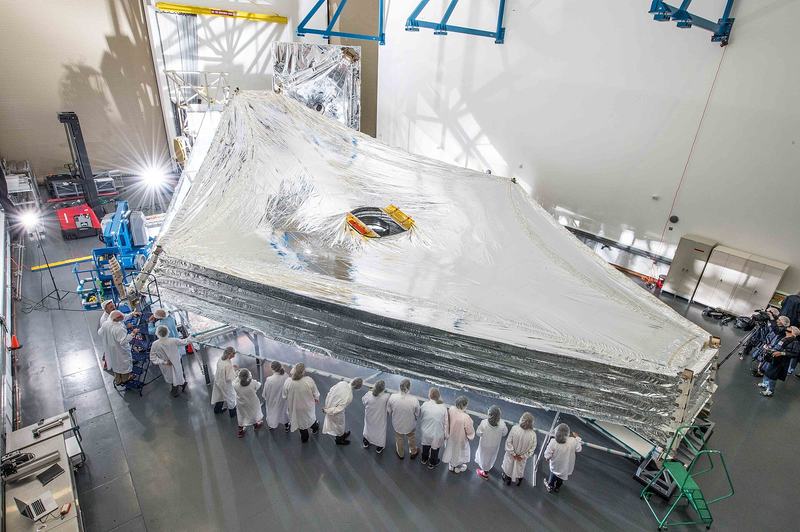
Faint infrared light from the earliest galaxies is easy to drown out, and the biggest source of interference would be the telescope itself. A sunshield built from five separate layers blocks that problem by keeping Webb's instruments chilled to minus 388 degrees Fahrenheit, cold enough that the observatory's own warmth never swamps the signal it's trying to detect.

One instrument needs to run even colder than that. MIRI, Webb's mid-infrared instrument, operates at just 7 kelvins, a few steps above the coldest temperature achievable, so it can register the longer, weaker infrared wavelengths that the telescope's other detectors can't reach.
Unfurling a $10 Billion Origami
Webb launched on Christmas Day aboard that Ariane 5 rocket, but reaching orbit was only half the job. Folded to fit inside the rocket's fairing, the $10 billion telescope spent its month-long cruise unfolding itself, reconfiguring mirrors and support structures into the shape they would hold for the rest of the mission. Every one of those steps had to succeed with no astronaut nearby to fix a mistake.
That price tag, and that reliance on a flawless robotic deployment, explains why engineers describe the mission's early weeks as some of the tensest in NASA's recent history. A single jammed hinge or misfired latch could have ended the mission before it produced a single image.
A Mirror That Had to Learn to Focus
Unfolding correctly was only step one; the mirror segments then had to align with each other precisely enough to act as a single surface. At first they didn't: the 18 individual segments each produced their own blurry image of the same target star, rather than one sharp point of light.
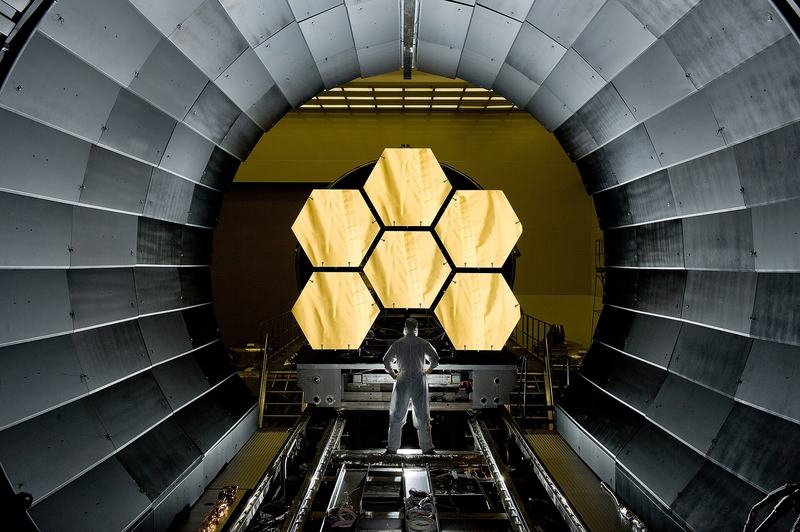

Fixing that took a technique called dispersed fringe sensing, which compared images from 20 different pairings of mirror segments to correct most of the misalignment in a step engineers call Coarse Phasing. The mirror wasn't finished taking hits after that, either. In May 2022, a dust-mote-sized micrometeoroid struck one of Webb's mirror segments, cataloged as C3, in an impact between May 23 and 25 that turned out to be the fifth and largest such strike since launch. Engineers had to compensate using one of the mirror's built-in actuators, a fix reported that June.
Named for a Man Who Never Saw It Fly
The telescope's name predates its hardware by decades. It honors James E. Webb, who served as NASA's administrator from 1961 to 1968, a stretch that covered the Mercury, Gemini, and Apollo programs and the buildup to the Moon landings. Webb ran the agency during its most famous era but died long before any of his namesake's hardware left the ground.
Peering Back to the Cosmic Dawn
The deep field was only an opening act. In May 2024, Webb identified the most distant known galaxy on record: JADES-GS-z14-0, whose light set out only 290 million years after the Big Bang, placing it at redshift 14.32. That's a snapshot of the universe in its early infancy, well before most galaxies had time to form.
Around the same period, researchers using Webb data reported evidence of an actively growing black hole in a galaxy called GHZ2, spotted at redshift 12.34 when the universe was under 400 million years old, the most distant black hole found so far. Finding a black hole that mature so early challenges assumptions about how quickly these objects can grow.
An Instrument Built to Read 200 Objects at Once
Spotting distant galaxies is one thing; reading the chemical fingerprint of their light is another, and that's the job of NIRSpec, Webb's near-infrared spectrograph. It can capture the spectra of up to 200 separate objects simultaneously, all within a patch of sky measuring just 3.4 by 3.6 arcminutes.
That multiplexing is what lets Webb build large catalogs of early-universe galaxies efficiently rather than one target at a time. Paired with the deep imaging capability that produced Webb's First Deep Field, it turns a single pointing of the telescope into a dataset that can occupy astronomers for years.