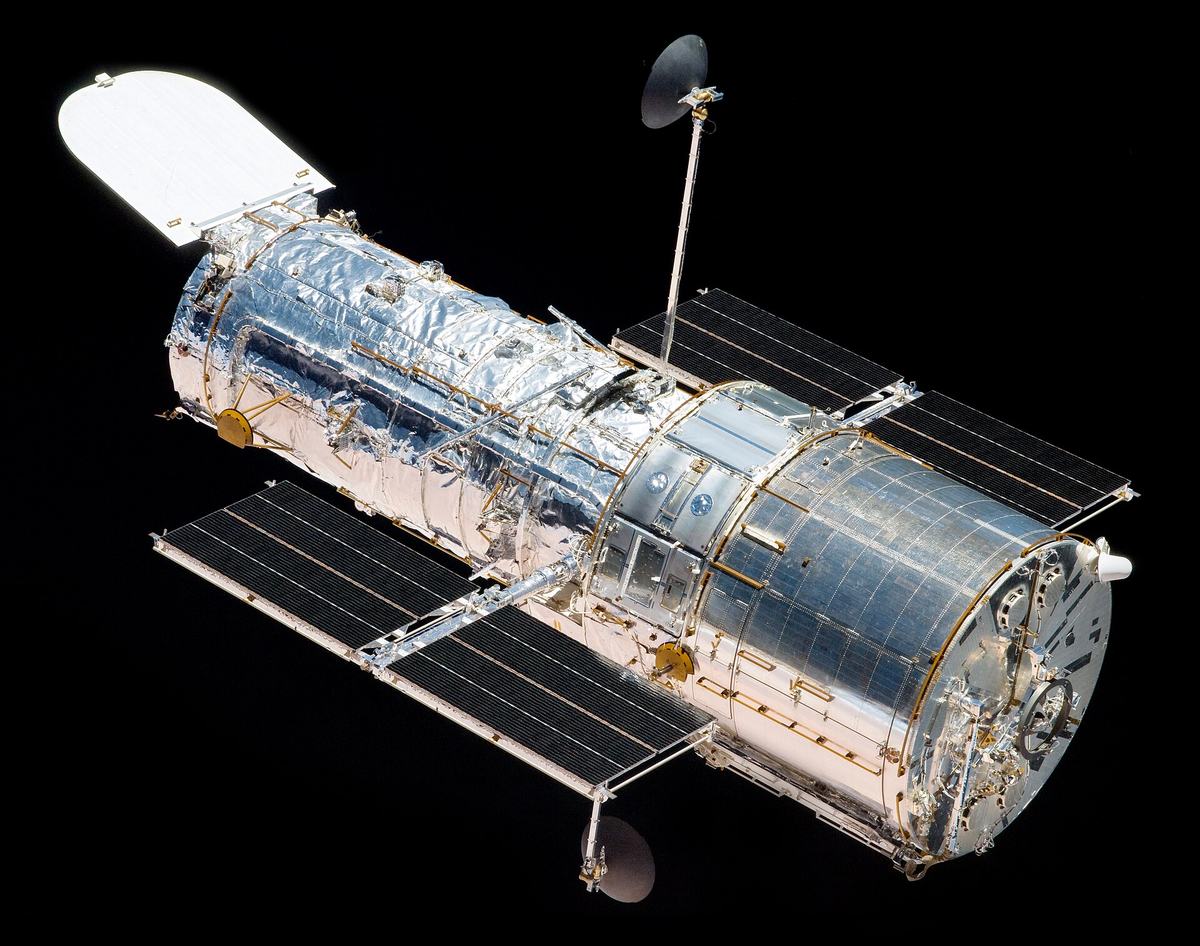
Hubble's running tab now sits at roughly $11.3 billion in 2015 dollars once every servicing trip is counted in, which makes it the priciest science mission NASA has ever flown. That price bought decades of work: the observatory passed 30 years in orbit back in April 2020, and engineers now expect it to keep functioning into the 2030s or even the 2040s.
None of that was guaranteed. Hubble left Earth with a manufacturing defect that nearly ruined it, and only survived because its design allowed astronauts to climb inside and rebuild it in orbit, more than once. What follows is the story of how a flawed mirror became one of the most productive scientific instruments ever built.
A Telescope Named After a Man Who Rewrote the Cosmos
The observatory did not always carry Edwin Hubble's name. It was only in 1983 that officials attached it, honoring the astronomer who had shown that the universe itself is stretching outward, building on groundwork laid by Georges Lemaitre. Naming a telescope after the person who proved the cosmos keeps expanding turned out to be fitting, since the instrument would go on to refine that very measurement for another four decades.
Getting the hardware into space took longer than planned. Space Shuttle Discovery finally carried it up on April 24, 1990, flying as mission STS-31, after years of delays following the grounding of the shuttle fleet. Once it reached orbit, the mission still needed to prove the machine actually worked as designed.
A Manufacturing Flaw Nobody Caught in Time
That proof did not arrive right away. Engineers had ground Hubble's primary mirror to a smoothness of roughly 10 nanometers, an almost unbelievable level of precision, yet they had missed something bigger: the edge of that same mirror was too flat by about 2200 nanometers. A defect measured in fractions of a human hair was enough to blur every image the telescope sent home.
Fixing a mirror already orbiting the planet was never part of the original plan, but the spacecraft had been built from the start with future repair crews in mind. That single design choice is what turned an embarrassing flaw into a fixable one.
Astronauts Rebuild an Observatory in Orbit
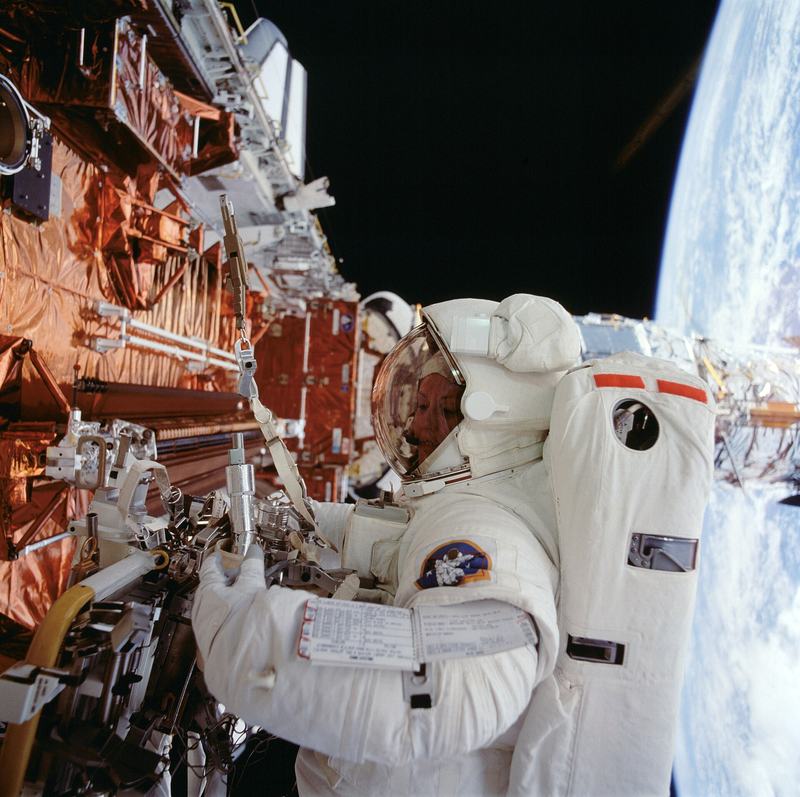

Between December 1993 and May 2009, NASA sent five separate crews to work on Hubble, each riding up on a Space Shuttle. The first of those visits swapped out the High Speed Photometer for a corrective package called COSTAR, and replaced the original camera with an upgraded Wide Field and Planetary Camera 2 that compensated for the bent mirror internally. Suddenly the telescope could see what it was always supposed to see.
The final servicing call, flown by Atlantis in 2009, turned out to be a milestone in its own right: it was the shuttle's 30th flight overall, and remarkably its first trip in over 14 years that did not head to a space station instead. It was also the only time Atlantis ever visited Hubble — Discovery had already handled two servicing runs, while Columbia and Endeavour had each taken one.
A Postage-Stamp Patch of Sky, Packed With Galaxies
In late 1995, over ten consecutive nights between December 18 and 28, Hubble stared at one tiny, apparently empty patch of sky and combined 342 separate exposures into a single picture. The target region spanned only about 2.6 arcminutes across, an angle so small it is comparable to holding a tennis ball 100 metres away and trying to judge its width.
Almost nothing in that patch turned out to be blank. The resulting image, known as the Hubble Deep Field, showed that even the emptiest-looking corners of the sky are crowded with distant galaxies once you stare long enough and gather enough light.
Deeper and Deeper Into the Past
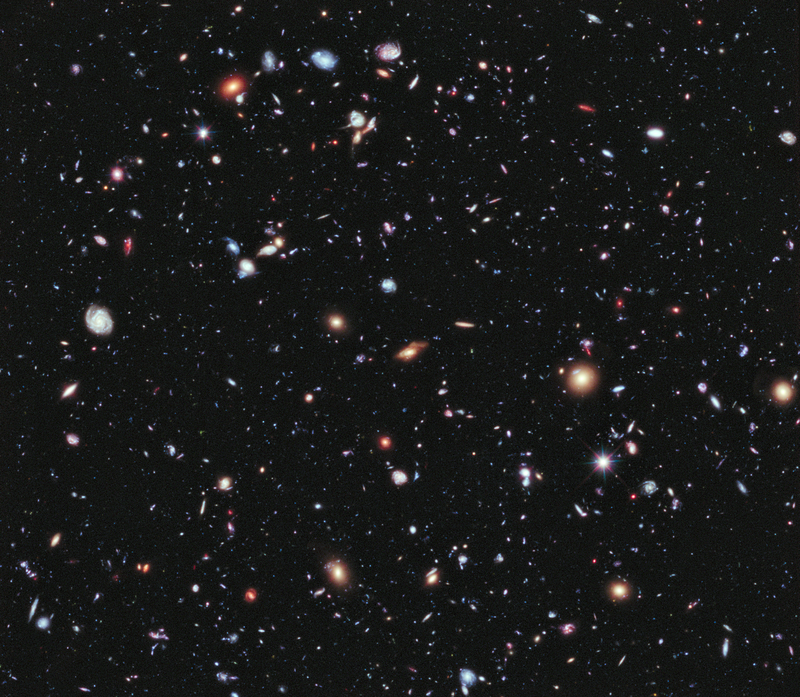

The Deep Field was just a first attempt. A later, longer exposure called the Hubble Ultra-Deep Field held the title of the most sensitive visible-light astronomical image ever produced, a record it kept until the Hubble eXtreme Deep Field took over in 2012. Each successive image pushed the telescope's reach further back in cosmic time by squeezing more collected light out of the same patch of darkness.
The Ultra-Deep Field itself targeted a small slice of the southern constellation Fornax, and researchers count roughly 10,000 galaxies packed into that single frame. The Extreme Deep Field went further still, catching galaxies as they looked 13.2 billion years ago — one of them, researchers believe, had already taken shape a mere 450 million years past the Big Bang.
The Astronomer the Telescope Is Named For
Edwin Hubble was born on November 20, 1889, and died on September 28, 1953, decades before any spacecraft carried his name into orbit. His most consequential finding came in 1929, when he confirmed that galaxies farther from Earth are receding faster than nearby ones — a pattern the field now calls Hubble's law, even though Lemaitre had put forward the same idea two years before him.
Crediting one scientist with a law that another had proposed earlier is an old habit in astronomy, and it says something about how collaborative — and occasionally messy — the history behind a "named" discovery can be.
An Archive That Keeps Growing
Hubble's own instrument bay has cycled through hardware over the decades, but its output keeps piling up: the archive now holds well over 3 million exposures, gathered across 10 different scientific instruments that have flown on the spacecraft at various points. Despite newer observatories launching since, it remains the leading telescope working in ultraviolet and visible light from orbit.
That combination of longevity and volume is why Hubble still generates fresh discoveries three decades on. Every additional year of operation adds to a dataset few other instruments can match, turning routine observing time into a growing scientific resource.