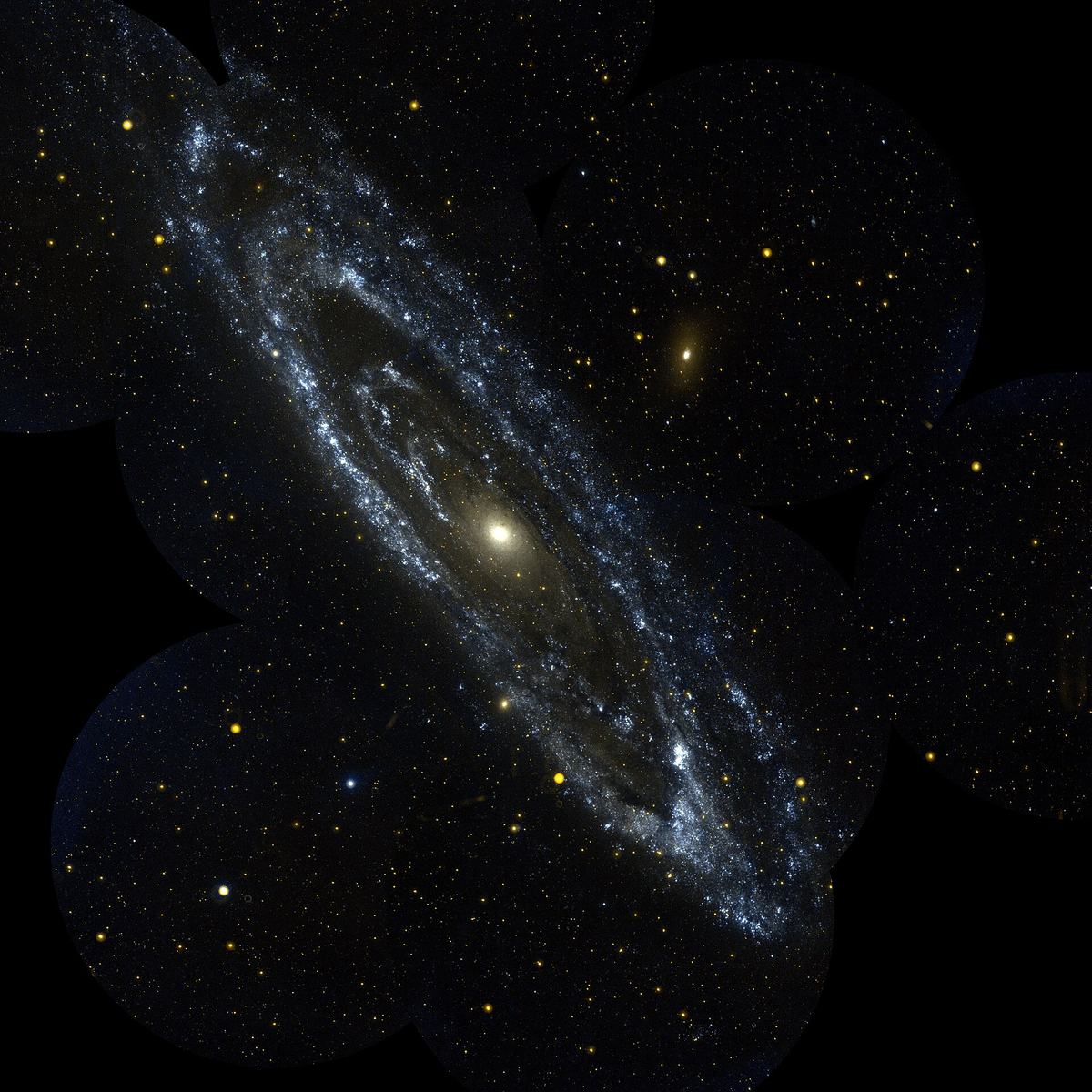
Andromeda has a D25 isophotal diameter of about 46.56 kiloparsecs (152,000 light-years) and sits approximately 765 kpc (2.5 million light-years) from Earth. That is close enough, in cosmic terms, that a Persian astronomer recorded it with the naked eye centuries before telescopes existed — and far enough that pinning down the exact distance took a century of astronomy's best instruments.
Andromeda is the nearest major galaxy to the Milky Way, and it is not standing still. It is closing the gap between us, and long after everyone reading this is gone, the two galaxies are set to merge into one.
A Cloud Recorded a Thousand Years Ago
Around the year 964 CE, the Persian astronomer Abd al-Rahman al-Sufi described the Andromeda Galaxy in his Book of Fixed Stars as a "nebulous smear" or "small cloud." It was the first historical reference to the Andromeda Galaxy and the earliest known reference to a galaxy other than the Milky Way — recorded by someone who had no way of knowing it was a galaxy at all, let alone one over two million light-years away.
For nearly a thousand years after al-Sufi, nobody could say what that smear actually was. Was it a nearby cloud of gas inside the Milky Way, or something else entirely, sitting impossibly far beyond it? Answering that question turned into one of the defining arguments of 20th-century astronomy.
A Debate That Split American Astronomy
The idea that galaxies existed beyond the Milky Way was so controversial in the early 20th century that it led to the "Shapley-Curtis Great Debate," in which astronomers Harlow Shapley and Heber Doust Curtis debated the nature of "nebulae" and the size of the Milky Way at the National Academy of Sciences on April 26, 1920. Shapley thought the Milky Way was the whole universe; Curtis argued that fuzzy patches like Andromeda were separate "island universes" entirely outside it.
Curtis had evidence, if imperfect evidence. In 1917, he observed a nova within Andromeda. After searching the photographic record, 11 more novae were discovered, and Curtis noticed that these novae were, on average, 10 magnitudes fainter than those that occurred elsewhere in the sky. As a result, he was able to come up with a distance estimate of 500,000 ly (32 billion AU) — a huge distance for its time, though it would turn out to be less than a quarter of the real figure.
The Telescope That Settled It
The Shapley-Curtis debate needed a bigger telescope to resolve, and it got one. Edwin Hubble's observations, made in 1924 with the recently completed 100-inch Hooker Telescope, proved conclusively that these nebulae were much too distant to be part of the Milky Way and were, in fact, entire galaxies outside the Milky Way galaxy. Curtis had been right about the "island universes"; he had simply lacked the instrument to prove it definitively.


Hubble's method relied on Cepheid variable stars, whose brightness pulses in a rhythm tied directly to their true luminosity, letting astronomers calculate how far away they must be to look as dim as they do. It was a breakthrough — but not the last word on Andromeda's distance, because the method itself still had a hidden flaw.
Why the Distance Kept Doubling
The estimated distance of the Andromeda Galaxy from our own was doubled in 1953 when it was discovered that there is a second, dimmer type of Cepheid variable star. Astronomers had been mixing up two different kinds of Cepheids with different brightness rules, which meant every distance calculated from them, including Hubble's, had been too small by about a factor of two. Andromeda didn't move — the ruler used to measure it got recalibrated.
Later techniques converged on the modern figure from different directions entirely. A 2004 Cepheid variable method estimated the distance to be 2.51 ± 0.13 million light-years (770 ± 40 kpc). Then, in 2005, an eclipsing binary star was discovered in the Andromeda Galaxy. The stars lie at a distance of 2.52 ± 0.14 million ly (159.4 ± 8.9 billion AU) and the whole Andromeda Galaxy at about 2.5 million ly (160 billion AU). Two independent methods, pulsing stars and eclipsing binaries, landed on nearly the same figure — a tight agreement across a gap of 2.5 million light-years.
A Bar Hiding in Plain Sight
For decades, astronomers described Andromeda as a simple spiral, much like textbook illustrations of the Milky Way. Infrared data from the 2MASS survey and the Spitzer Space Telescope showed that Andromeda is actually a barred spiral galaxy, like the Milky Way, with Andromeda's bar major axis oriented 55 degrees anti-clockwise from the disc major axis. Visible light had been hiding the bar behind dust and the glare of the disk; only infrared instruments, which see through that obscuring dust, revealed the structure underneath.
A Split Nucleus With a Black Hole Inside
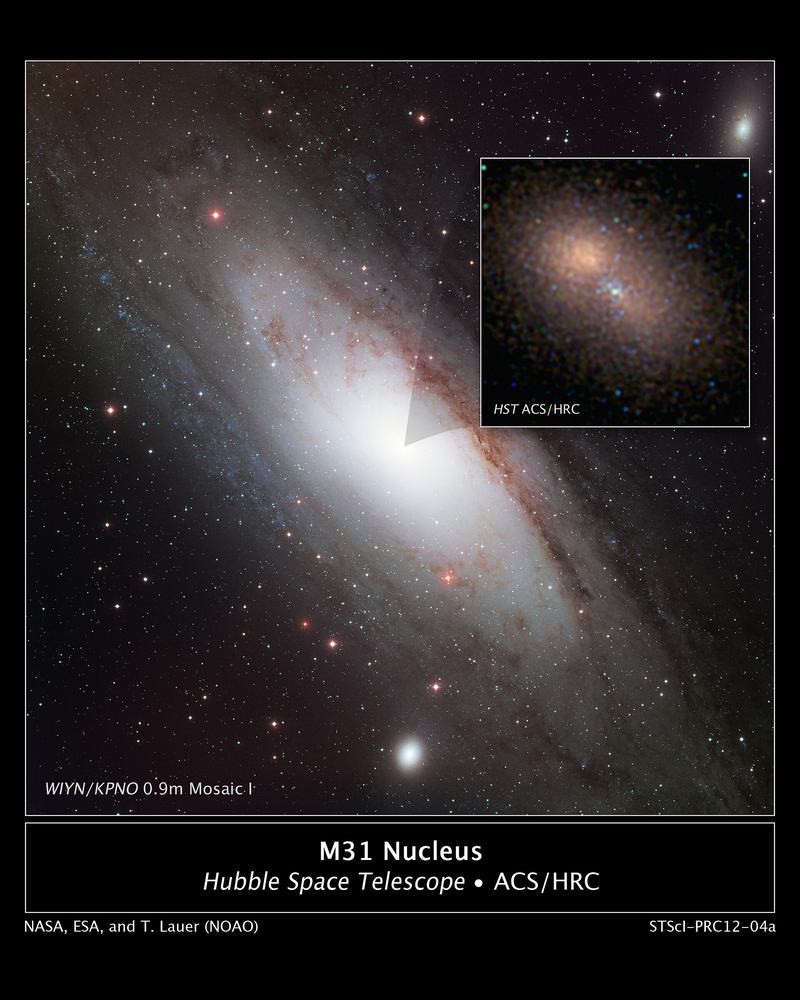
Zoom into Andromeda's center and the structure gets stranger still. The nucleus consists of two concentrations separated by 1.5 pc (4.9 ly). The dimmer concentration, P2, falls at the true center of the galaxy and contains an embedded star cluster, called P3, containing many UV-bright A-stars and the supermassive black hole, called M31*. Rather than one bright core, Andromeda's center looks like two, and the fainter of the pair is the one that actually marks the galaxy's gravitational middle and hosts its central black hole.
.jpg)
Millions of Stars, Packed Into One Cluster
Andromeda's outskirts hold their own superlatives. There are approximately 460 globular clusters associated with the Andromeda Galaxy. The most massive of these clusters, identified as Mayall II, nicknamed Globular One, has a greater luminosity than any other known globular cluster in the Local Group of galaxies. It contains several million stars and is about twice as luminous as Omega Centauri, the brightest known globular cluster in the Milky Way. A cluster more luminous than anything the Milky Way itself can offer, sitting quietly in Andromeda's halo, is easy to miss next to the galaxy's more famous features.
Small Companions With Very Different Fates
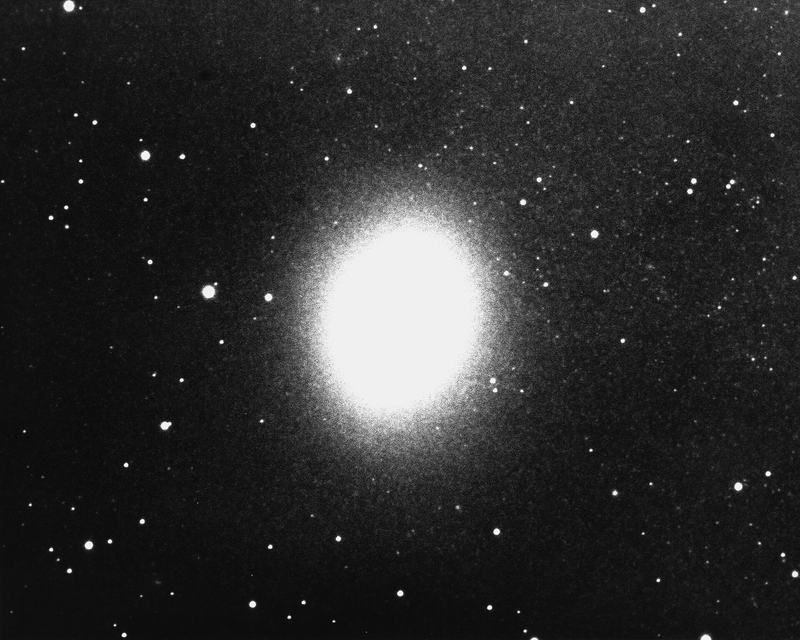
Like the Milky Way, the Andromeda Galaxy has smaller satellite galaxies, consisting of over 20 known dwarf galaxies. The best-known and most readily observed satellite galaxies are M32 and M110. Both are visible in binoculars alongside Andromeda itself, but they tell very different stories about what happens to a small galaxy that strays too close to a big one.
M32 may once have been a larger galaxy that had its stellar disk removed by M31 and underwent a sharp increase of star formation in the core region, which lasted until the relatively recent past. Its neighbor fared differently: unlike M32, Messier 110 lacks evidence for a supermassive black hole at its center. One satellite was stripped down to a compact, star-formation-scarred remnant; the other shows no sign of the kind of central black hole that both Andromeda and M32 possess.
.jpg)
The Group That Hubble Named
Andromeda and the Milky Way are not isolated from each other, or from a wider neighborhood. The term "The Local Group" was introduced by Edwin Hubble in Chapter VI of his 1936 book The Realm of the Nebulae. There, he described it as "a typical small group of nebulae which is isolated in the general field" and listed its members, by decreasing luminosity, as M31, Milky Way, M33, Large Magellanic Cloud, Small Magellanic Cloud, M32, NGC 205, NGC 6822, NGC 185, IC 1613 and NGC 147. The same astronomer who proved Andromeda was a separate galaxy also gave a name to the small cluster of galaxies it belongs to, with Andromeda itself topping his own luminosity ranking.
On a Collision Course
Being neighbors in the same small group has a consequence: gravity is pulling Andromeda and the Milky Way together. The Andromeda–Milky Way collision is a galactic collision that may occur in about 4.5 billion years between the two largest galaxies in the Local Group. The Andromeda Galaxy is approaching the Milky Way at about 110 kilometres per second (68.4 mi/s) as indicated by blueshift — a rare thing among distant galaxies, most of which are redshifted as the universe expands away from us.
That approach sounds alarming, but the collision will not look like a car crash. While the Andromeda Galaxy contains about 1 trillion (10^12) stars and the Milky Way about 300 billion (3×10^11), the chance of even two stars colliding is negligible because of the huge distances between the stars. Trillions of stars will pass through each other's territory with almost nothing actually touching, because even a crowded galaxy is, star for star, mostly empty space.
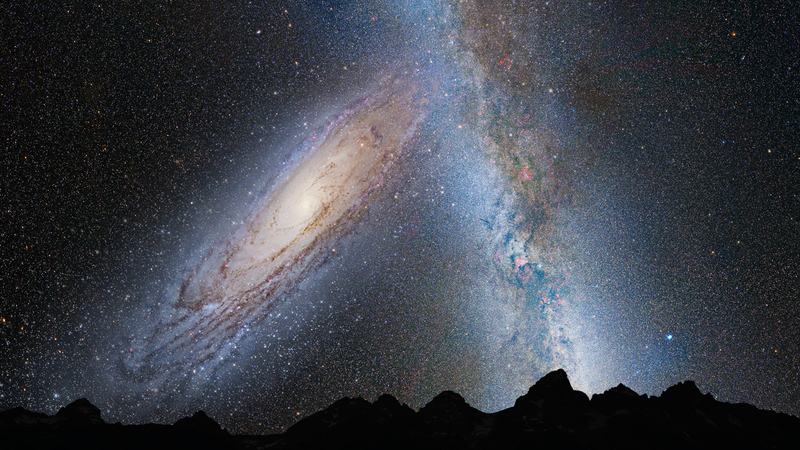

The one dramatic exception involves the black holes at each galaxy's core, including Andromeda's own M31*. Gas taken up by the combined black hole could create a luminous quasar or an active galactic nucleus, releasing as much energy as 100 million supernova explosions. Everything else about the merger will be a quiet, million-year drift of stars sliding past each other; the black holes are where the real fireworks happen.