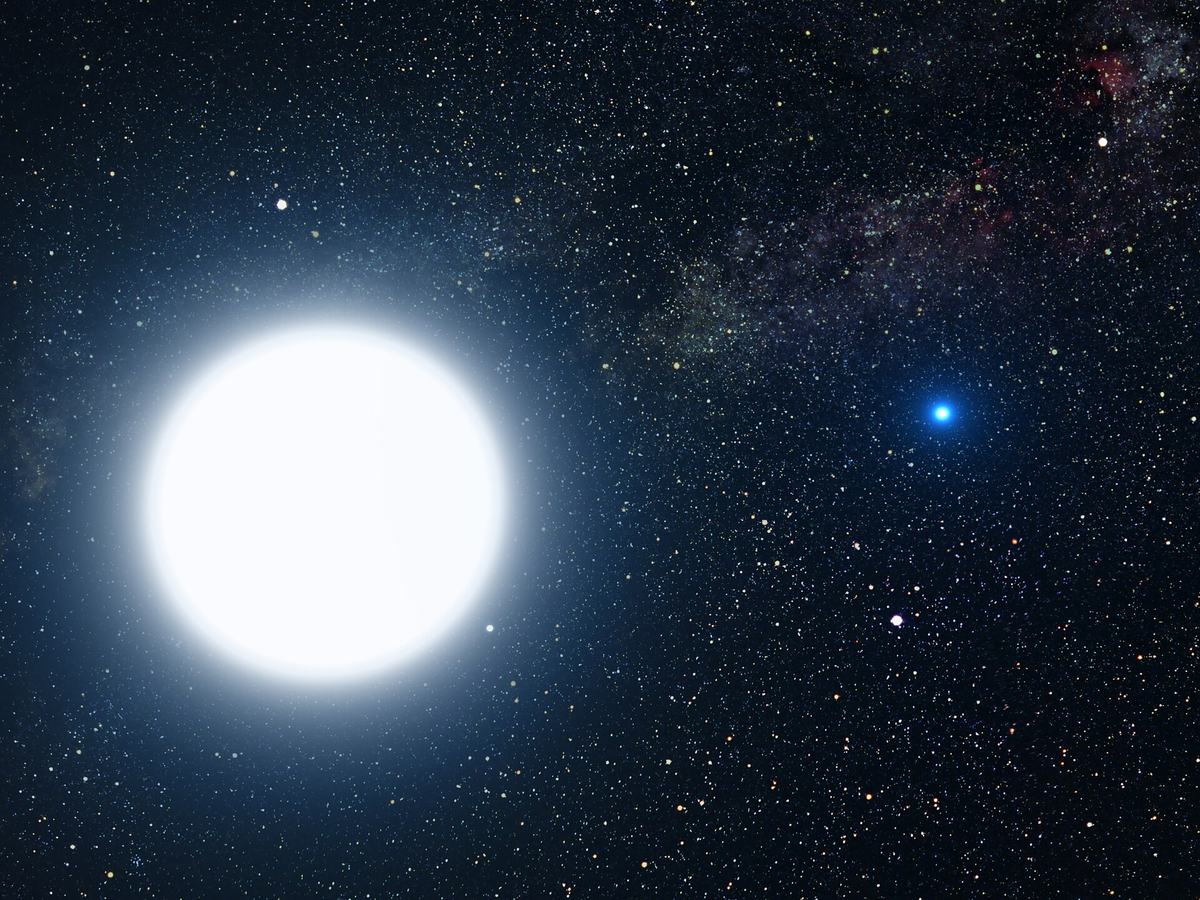
No star in Earth's sky burns brighter than Sirius. Point a telescope, or just your eyes, at the winter sky and it is impossible to miss: a steady, almost blue-white beacon well ahead of anything around it. That brilliance is not a coincidence of size or heat alone. It comes from a combination of genuine luminosity and sheer proximity, and it is only half the story.
The other half is invisible to the naked eye. Sirius has a companion, a collapsed stellar corpse packed into a ball the size of a planet, and for decades astronomers knew it existed only because Sirius itself seemed to wobble as it moved. Working out what that companion actually was took over a century of careful measurement, spanning a handwritten 1844 letter, a chance discovery through a new telescope, and, eventually, orbiting observatories capable of weighing a star from a distance of 8.6 light-years. What follows is how that brightness was measured, how the wobble gave away a hidden star, and how a record-setting aircraft ended up borrowing the name.
The Brightest Point of Light You Will Ever See
Sirius has a visual magnitude of -1.46, which makes it almost twice as bright as Canopus, the runner-up in Earth's night sky. Brightness scales work backwards, with lower and negative numbers meaning more light, so that gap is a real and substantial one, not a marginal difference between similar stars. Nothing else in the night sky comes close to matching it, which is exactly why it has anchored navigation, calendars, and mythology across so many unrelated cultures for thousands of years.
Part of the reason is distance. At 2.64 parsecs, or 8.6 light-years, the Sirius system is one of the nearest star systems to Earth, close enough that its light has barely had time to spread out and fade. That will not last forever: Sirius is slowly closing the distance further, and its brightness is expected to keep climbing for tens of thousands of years before it starts to fade again. Even so, it is set to hold its title for a long time. Sirius should remain the brightest star in Earth's sky for roughly the next 210,000 years, after which the intrinsically more luminous star Vega will take over the top spot. Vega only wins that contest because it puts out more light to begin with; today it simply sits too far away for that extra output to outshine Sirius's advantage of proximity.
The Wobble That Gave Away an Invisible Companion
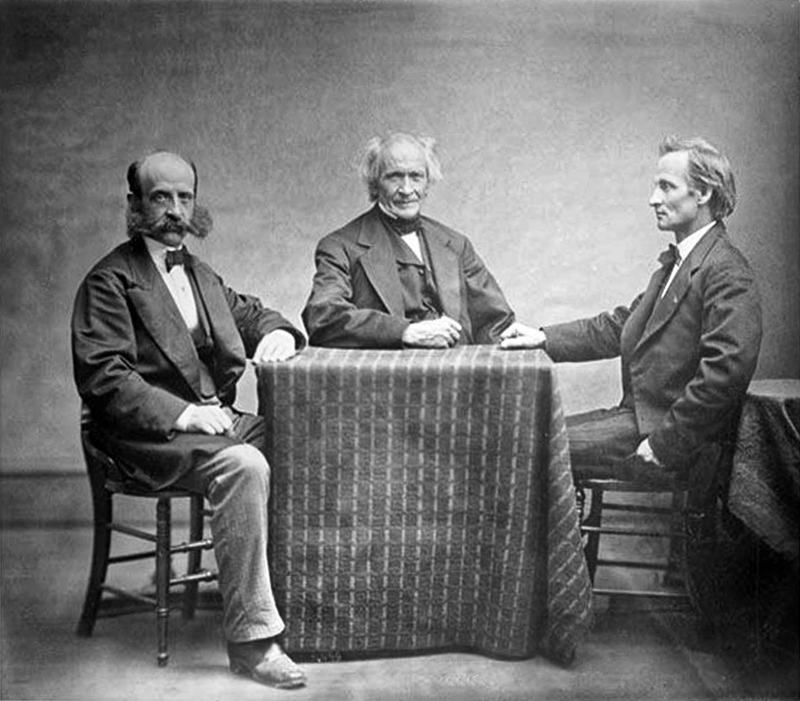

Sirius looks like a single point of light, but it has not traveled alone for a very long time. In a letter dated 10 August 1844, German astronomer Friedrich Wilhelm Bessel worked out that something was tugging at Sirius, having noticed that its proper motion through space kept drifting slightly off course. No telescope of the era could see a second star there, so Bessel deduced the presence of an unseen companion purely from that irregular path, years before anyone actually saw it. It is one of the earliest examples of astronomers finding an object by its gravity alone, long before they could point an instrument straight at it.
The confirmation came almost two decades later. On 31 January 1862, American instrument builder Alvan Graham Clark spotted a faint pinprick of light next to Sirius while testing new equipment, the first glimpse of what became known as Sirius B. Bessel had been right: the wobble was real, caused by a second star so faint it had been hiding in plain sight, washed out by the glare of its far brighter neighbor. The eighteen-year gap between prediction and confirmation says as much about the technology of the era as it does about how faint Sirius B truly is next to its dazzling companion.
An Earth-Sized Ember


What Clark eventually found was strange even by the standards of stars. Hubble Space Telescope measurements published in 2005 pinned Sirius B at roughly 12,000 kilometres across, close to Earth's own width, yet packing in a mass equal to 102% of the Sun's. Squeezing that much mass into that little space produces matter unlike anything found on a planet: white dwarf material is so dense that a teaspoon of it could weigh 5.5 tonnes.
That crushed state is not a phase Sirius B is passing through; it is closer to a preserved corpse. A white dwarf no longer generates energy through fusion, so it simply radiates away the heat it already has, slowly, for an extraordinarily long time. Which raises an obvious question: if it is not making new heat, how old is the leftover ember actually cooling in front of us?
Timing the Death of a Star
Modelling the evolution of the Sirius A/B system gives it a combined age of 225 to 250 million years, calculated from the well-measured size and brightness of Sirius A. Separately, the cooling of Sirius B itself points to a white dwarf age of 124 million years, give or take about 10 million, meaning the collapse into its current form happened well after the system first formed.
The gap between those two figures is itself a measurement. Subtracting the shorter cooling age from the longer system age tells astronomers how long the star that became Sirius B spent burning fuel as a normal star before collapsing, and from that lifetime they can work back to its original bulk: about 5.056 solar masses. In other words, the unremarkable white dwarf sitting next to Sirius today started out as a star roughly five times heavier than our own Sun.
The Airplane That Borrowed a Star's Name
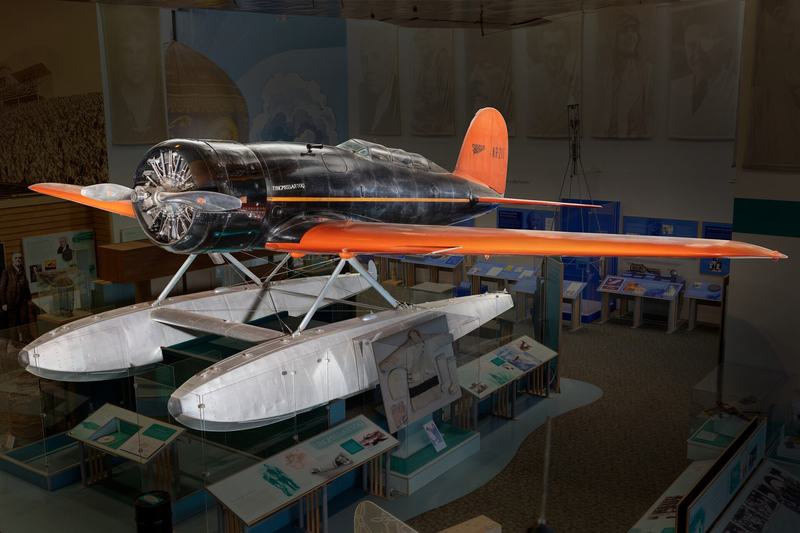

Long before any of that cooling math existed, the name Sirius had already been attached to something built by humans: a Lockheed Sirius aircraft. Engineers John K. Northrop and Gerard Vultee drew up the design back in 1929, and this particular airframe later had floats bolted on for landing on water. Charles and Anne Morrow Lindbergh flew it, and used it to set a coast-to-coast speed record on April 20, 1930, well before its more ambitious journeys began.
The aircraft earned its lasting nickname on a later trip. Flying survey routes in 1933, the Lindberghs stopped in Greenland, where a local boy dubbed the plane "Tingmissartoq," meaning "one who flies like a big bird." Under that name it went on to complete a punishing survey flight covering 30,000 miles across four continents and twenty-one countries, gathering data that would help chart future transatlantic air routes. On one leg of that trip, Charles worked as a technical advisor for Pan Am, and the pair departed New York on July 9, once again piloting the refitted Sirius with his wife serving as copilot and radio operator. It is a strange kind of tribute: a star known for its steady, singular blaze in the sky lending its name to a machine that spent its working life restlessly on the move.