Point a camera at almost any bright star today and you get a picture in seconds. In 1850, doing that for the very first time took a daguerreotype plate, a long exposure, and a target bright enough to leave a mark. Astronomers at the Harvard College Observatory chose Vega, and the resulting image became the earliest photograph ever taken of a star other than the Sun.
That single exposure kicked off a pattern. Vega, the brilliant blue-white star anchoring the constellation Lyra, keeps turning up at the front of astronomy's timeline: the first star spectrum ever captured on film, the first star found to be wrapped in a disk of dust, and, weirdly, a star whose own magnetic field wasn't confirmed until the twenty-first century. It is close enough, bright enough, and studied intensely enough that new instruments tend to get pointed at it first.
The sections below walk through why Vega became that default target, what its unusually fast spin does to its shape and surface, and how it fits into its own crowded corner of the night sky.
A Star of Firsts

Harvard's 1850 daguerreotype was only the opening act. Two decades later, in August 1872, astronomer Henry Draper aimed his equipment at Vega again and captured its spectrum on a photographic plate, catching the dark absorption lines in starlight for the first time anywhere. That single image gave astronomers a repeatable way to record what a star's light was made of, rather than relying on sketches made through an eyepiece.
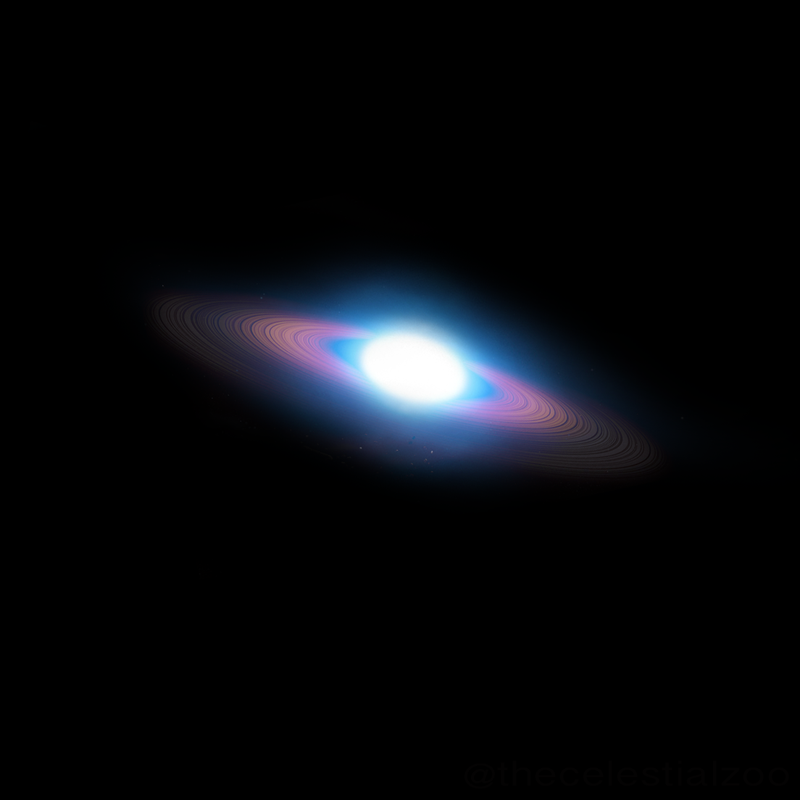
The pattern held into the space age. In 1983, data from an orbiting infrared satellite revealed a glow of heat coming from around Vega that didn't match a normal stellar surface, making it the first star discovered to be surrounded by a disk of dust. It took another three decades of astronomy naming conventions to catch up: despite being a fixture of star charts for millennia, "Vega" only became the star's internationally sanctioned name in 2016, when the International Astronomical Union's newly formed naming body issued its first approved list.
A Sun Running on Fast-Forward
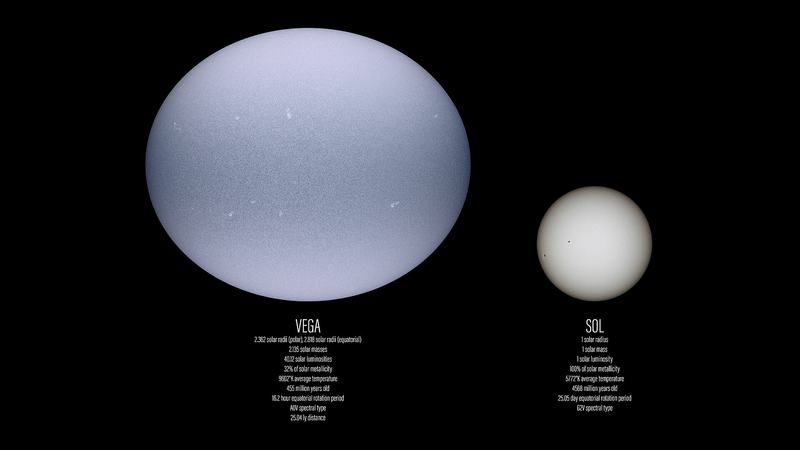

Vega packs roughly twice the Sun's mass into a star that has lived only about one tenth as long. Everything about it runs hotter and faster as a result: a full rotation takes Vega less than a day, compared with the Sun's leisurely 27-day spin.
That speed reshapes the star itself. Centrifugal force flattens Vega's poles and drags material away from its equator, creating a temperature gap of more than 1,000 degrees Celsius between the warmer poles and the cooler equatorial band. A single star, in other words, wearing two different temperatures depending on where you look.
A Magnetic Surprise
Given how thoroughly astronomers have measured Vega, one might expect its magnetic field to be old news. It wasn't. Astronomers only confirmed that Vega even has a magnetic field in 2009.
The field itself turned out to be unremarkable in strength: about 50 micro-tesla at the surface, close to the average field strength measured on Earth and on the Sun. The real news was that it existed at all and could finally be measured, opening a path to studying how magnetism behaves inside stars built so differently from the Sun.
The Pole Star That Time Forgot

Everyone learns that Polaris marks north. Fewer people learn that the title rotates. Vega held that job around 12,000 BCE, sitting less than six degrees from the pole, and Earth's slow wobble will hand the role back to it around the year 13,724.
Vega has an even bigger promotion coming. Because stars drift and brighten on timescales longer than civilizations, current projections put Vega as the brightest star in the entire night sky in about 210,000 years, peaking in brightness in about 290,000 years at an apparent magnitude of -0.81.
Getting Vega's Distance Right
Pinning down exactly how far away Vega sits took over a century of argument. An early parallax estimate for the star turned out to be remarkably close to the figure now accepted, 0.129 arcsecond, a value later confirmed by the European Space Agency's Hipparcos astrometry satellite.
Hipparcos didn't stop refining that number after its original release. A later reanalysis of the mission's raw astrometric data improved the total weight of its measurements by a factor of 2.2 compared with the catalogue published in 1997, sharpening distance estimates for Vega and thousands of stars like it used in studies of stellar brightness and galactic motion.
Neighbors Worth a Second Look
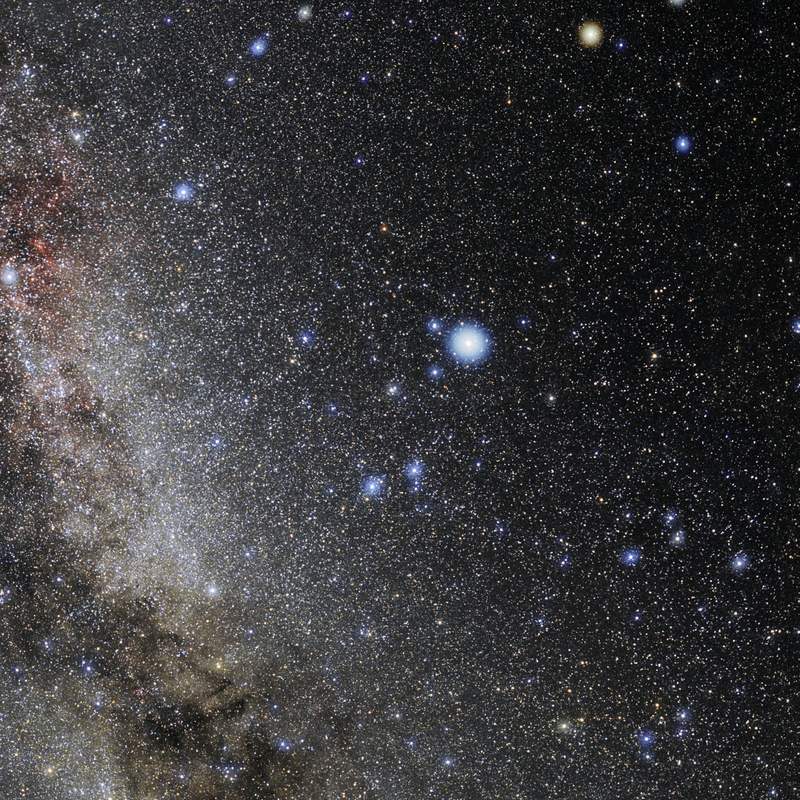
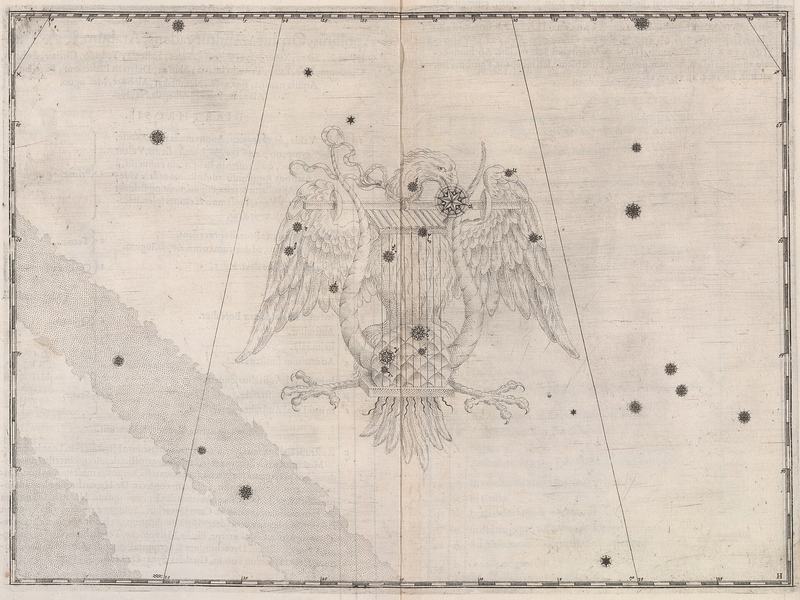
Vega doesn't have to share the spotlight in Lyra, but its neighborhood rewards a longer look. Sitting only 25 light years away, Vega ranks fifth among all the stars in Earth's sky for sheer brightness, close enough that the rest of the constellation is worth exploring with the same telescope.
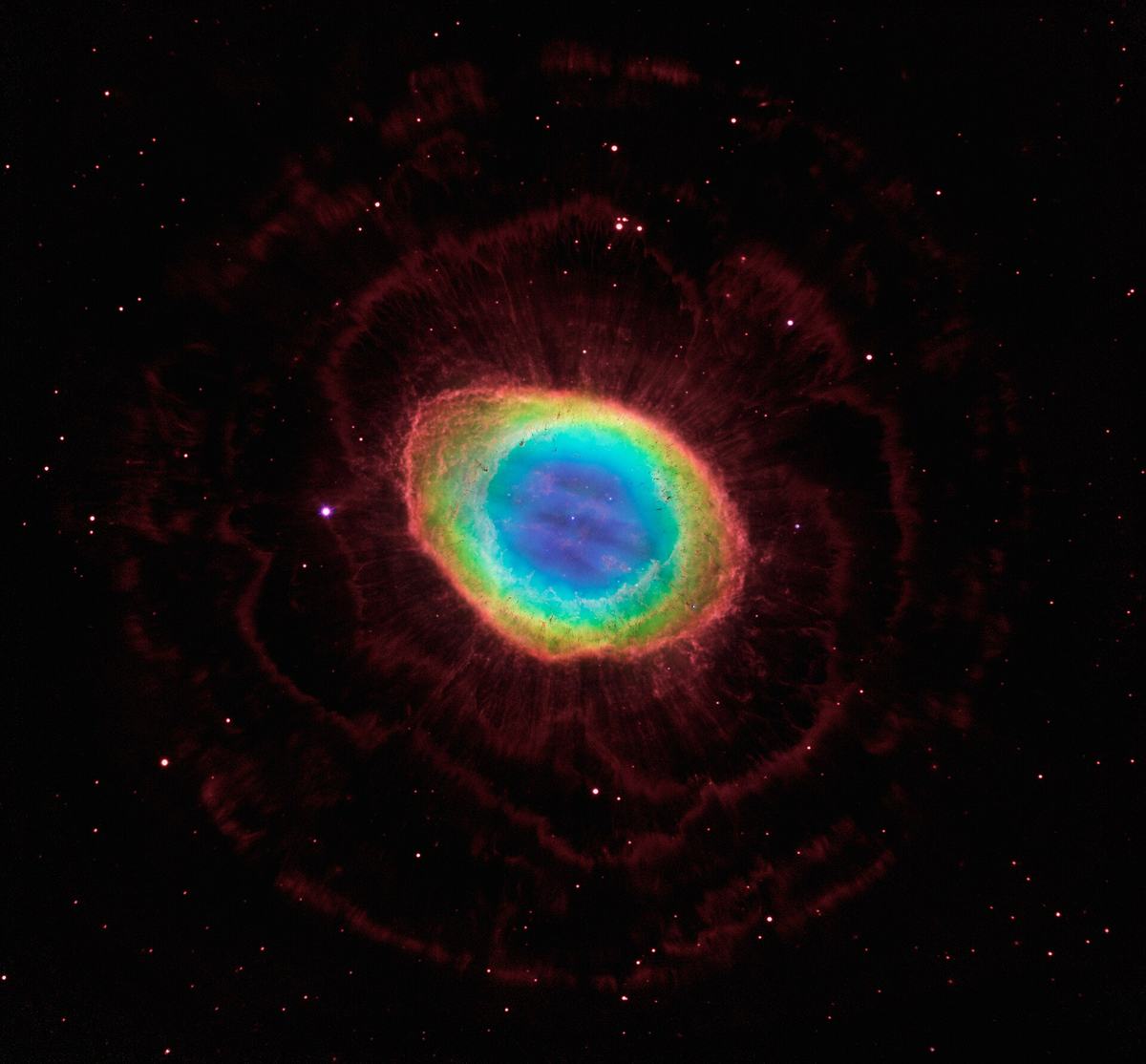
Lyra's other headline object is the Ring Nebula, a shell of gas shed by a dying sun-like star; astronomers count it as only the second planetary nebula ever found, and it remains the most famous specimen of the type. Closer to Vega sits Epsilon Lyrae, a system built from no fewer than five stars packed into roughly 160 light years of distance from us. Its two brightest components sit 208 arcseconds apart, easily split with ordinary binoculars, while each of those in turn hides a second, tighter pair only about 2.35 arcseconds apart — a gap so narrow that splitting it has become a standard test of a telescope's resolving power. The wide pair is separated by roughly one hundred times the distance of the close pairs nested inside it, giving stargazers a rare double act at two very different scales in the same patch of sky.