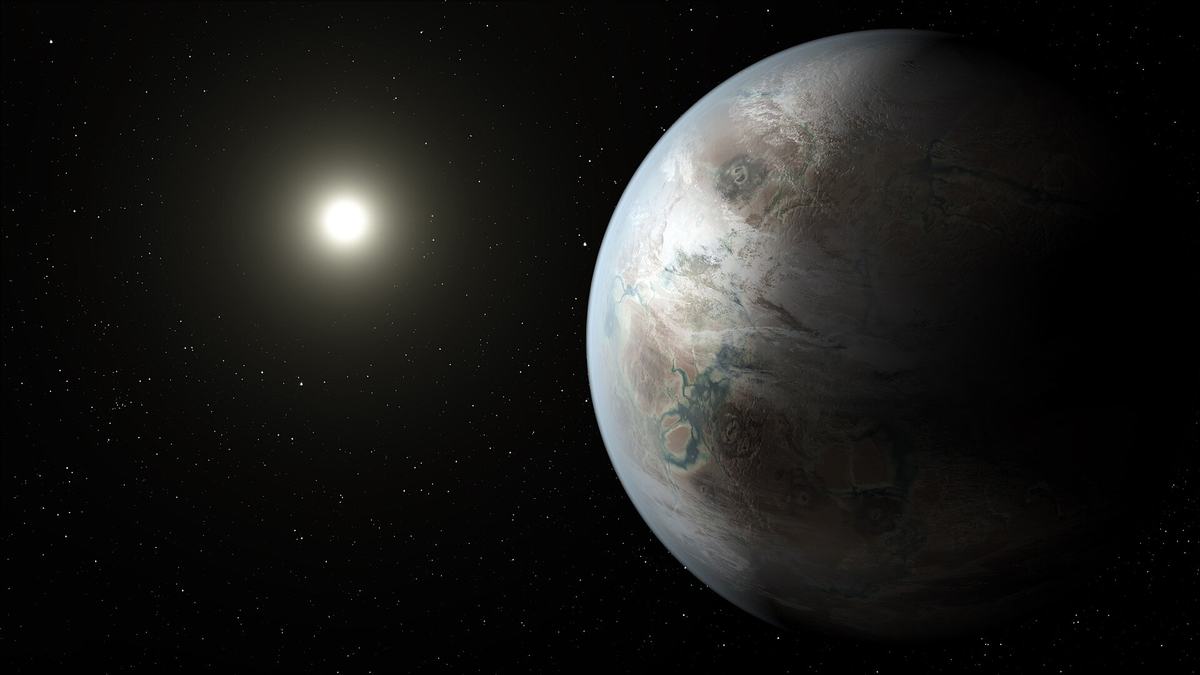
Kepler space telescope data, announced on November 4, 2013, pointed to roughly 40 billion Earth-sized worlds that might circle inside the zones where liquid water could survive around Sun-like stars and red dwarfs scattered through the Milky Way. That single number reframed how astronomers talk about our galaxy — not as a scattering of stars, but as a field thick with places where liquid water could plausibly pool on a rocky surface.
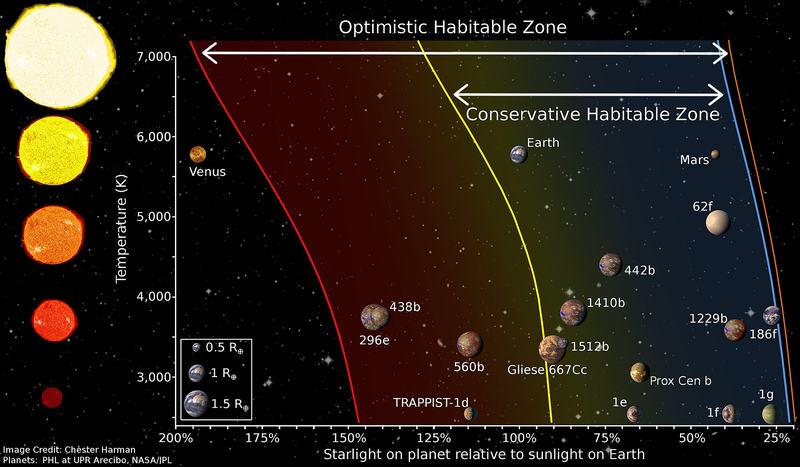
The habitable zone itself is a deceptively simple idea: the range of distances from a star where a planet could be warm enough to hold liquid water but not so hot that it boils away. It sounds like basic geometry, but the real science is messier — a planet's atmosphere, its orbit, and its star's own temperament all push the boundaries around. This guide walks through where the idea came from, what it actually predicts, and where it breaks down.

An Idea Older Than Exoplanets Themselves
The term habitable zone possibly first appeared in 1913, in astronomer Edward Maunder's book Are The Planets Inhabited? — decades before anyone had confirmed a single planet beyond our own solar system. Maunder was reasoning from first principles: a planet's temperature depends on its distance from its star, so there should be a band where that temperature allows for liquid water.
The modern version of the concept, the one astronomers actually use today, was proposed in 1959 by astrophysicist Su-Shu Huang, who built it around the climate constraints a host star imposes on any planet orbiting it. Huang's framework is why the phrase "habitable zone" now shows up in nearly every exoplanet discovery announcement — it gives reporters and researchers alike a quick shorthand for "this planet is at roughly the right distance."
Real Planets Found in the Zone
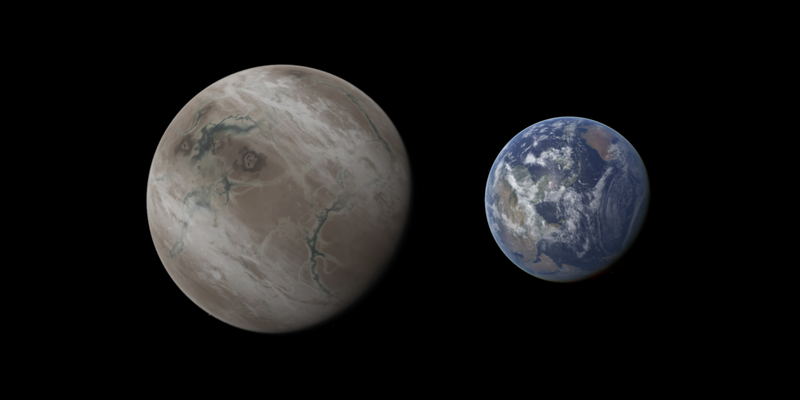
Kepler-452b is one of the clearest examples of the idea in action. It orbits its star at 1.04 AU (156 million km) — almost exactly Earth's distance from the Sun — completing an orbit every 385 days, with a radius about 1.63 times Earth's and a mass at least three times Earth's. What makes it more remarkable is time: Kepler-452b has spent most of its existence inside its star's habitable zone, just over six billion years and counting, longer than Earth has existed at all.

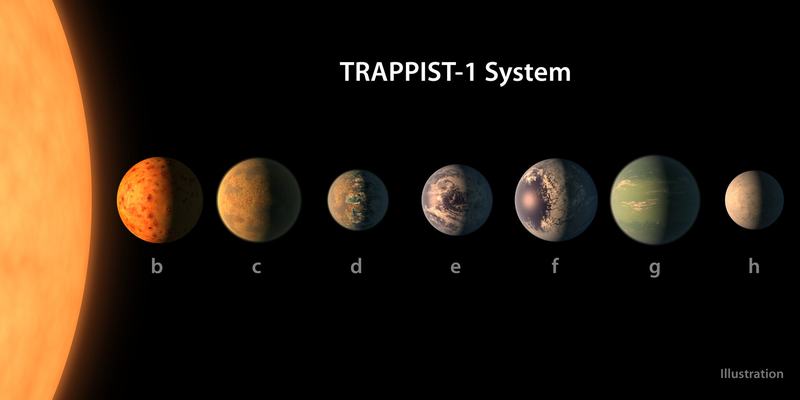
Not every habitable-zone planet orbits a star like the Sun. TRAPPIST-1's effective temperature is only 2,566 K (2,293°C); that makes it, as of 2022, the coldest star known to host planets — a reminder that the zone shifts inward, not outward, around dim, cool stars. And the search isn't limited to small, quiet systems: 55 Cancri f was found orbiting inside the habitable zone of its star, 55 Cancri A, part of a system that became the only one besides our own known to host five planets after astronomers confirmed the fifth. The 55 Cancri system sits 41 light-years away and echoes our own solar system's shape — four planets tucked in close and one giant world farther out — yet has no counterpart to Earth or Mars. That fifth planet, 55 Cancri f, is roughly half of Saturn's size, at least 45 times Earth's mass, and completes an orbit at 0.785 AU every 260.8 days — a gas giant sitting where a rocky world might have been expected.
Size Alone Doesn't Tell You Much
Being in the habitable zone says nothing about what a planet is actually made of, and that's where density data becomes essential. Across the known exoplanet population, density peaks at 7.6 grams per cubic centimeter for planets around 1.4 Earth radii — denser, at that size, than almost anything else in the census. Beyond about 1.5 Earth radii, though, planet density drops off quickly, a sign that these worlds carry a thick layer of volatiles over a rocky core rather than being rock all the way through. A habitable-zone planet that looks Earth-sized on paper could, in practice, be a small gas world with no solid surface at all.
How Many Are Actually Out There
Estimating how common these planets are has been a moving target. A 2013 study by Dressing and Charbonneau used Kepler data to calculate that cool stars carry about 0.15 Earth-size habitable-zone planets per star. A later reanalysis raised that estimate to 0.48 to 0.53 habitable-zone planets per red-dwarf star, depending on how conservatively the zone's edges are drawn — more than triple the original figure, just from adjusting the assumptions about where the zone begins and ends. That swing is a useful lesson: the habitable zone isn't a fixed, universally agreed line, it's a working estimate that shifts as the models improve.
A Star's Mood Matters as Much as Its Distance
Even a planet sitting in the geometric middle of its star's habitable zone depends on that star behaving predictably. The Sun itself stays remarkably steady, with total brightness shifting by only 0.1% across its roughly 11-year cycle of solar activity — a much gentler wobble than seen in stars that pulse and flare far more violently, and a big part of why Earth's climate has stayed survivable across geological time. Steadiness isn't guaranteed, though, and its absence leaves a mark: a 70-year lull in sunspots called the Maunder Minimum, spanning the late 17th and early 18th centuries, has been linked to the coldest stretch of the Little Ice Age, when Europe and North America endured brutally cold winters. A star's tiny wobbles in output can nudge an entire planet's climate for generations.
Orbits Are Rarely as Tidy as Earth's
The habitable zone is usually drawn as a clean ring, but few planets actually travel it on a circular path. Measured orbital eccentricities of exoplanets have surprised researchers: 90% are more eccentric than anything in the Solar System, and the average eccentricity is 0.25. A planet on a stretched, elliptical orbit can swing from the outer edge of the habitable zone to the inner edge and back over the course of a single year, turning a stable-looking "zone" into a much harsher, more variable ride.
Sources
- ScienceDaily: Astronomers Discover Record Fifth Planet Around Nearby Star 55 Cancri
- arXiv: The Mass-Radius Relation for 65 Exoplanets Smaller than 4 Earth Radii
- arXiv: A revised estimate of the occurrence rate of terrestrial planets in the habitable zones around Kepler M-dwarfs
- NASA Science: Solar Variability and Terrestrial Climate
- Wikipedia: Habitable zone
- Wikipedia: Kepler-452b
- Wikipedia: TRAPPIST-1
- Wikipedia: Planetary habitability