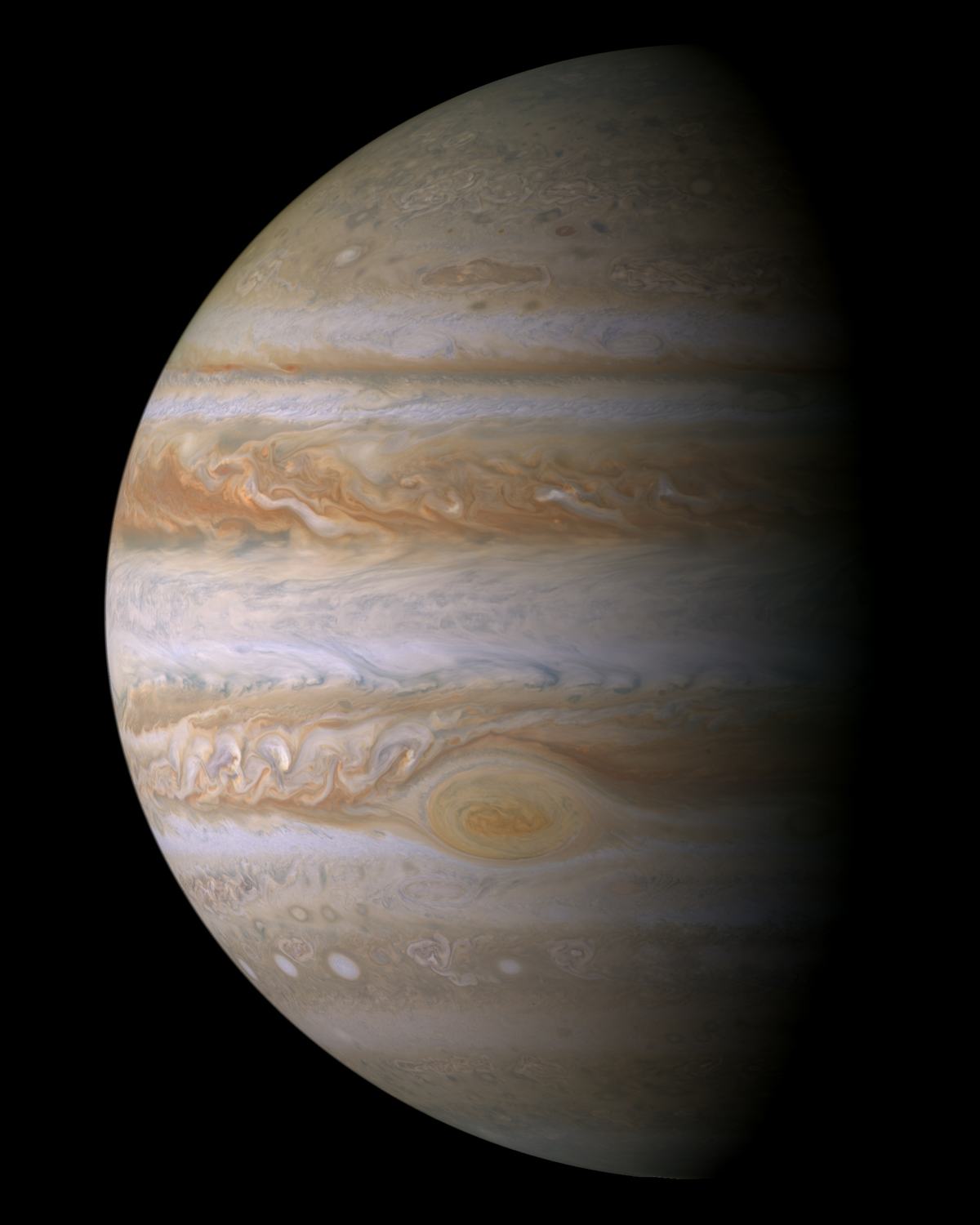
Every planet in the Solar System technically orbits a point it shares with the Sun, not the Sun's exact center. For every planet except one, that point still falls inside the Sun. Jupiter is the exception: it is the only planet whose barycentre with the Sun lies outside the Sun's volume, by about 7% of the Sun's radius. The Sun is dragged into a small orbit of its own.
That single fact says a lot about what Jupiter is: a gas giant with nearly 2.5 times the mass of every other planet in the Solar System combined, and still just under a thousandth the mass of the Sun it orbits. It has been shaping the rest of the Solar System since before most of the other planets existed, and five centuries after Galileo first turned a telescope on it, spacecraft are still finding things it hadn't shown anyone yet.
The Oldest Planet in the Neighborhood
Jupiter is believed to be the oldest planet in the Solar System, having formed just one million years after the Sun itself and roughly 50 million years before Earth. It got a head start on gathering material, and that early advantage compounded: by the time the rocky inner planets were still assembling, Jupiter already had the gravitational muscle to influence how they came together.
Being an early, massive arrival mattered — Jupiter's gravity helped determine which building blocks stayed to form the other planets and which got flung away, making it one of the most influential shapers of the Solar System's final architecture.
A Ten-Hour Day on the Biggest Planet
Despite its size, Jupiter spins faster than any other planet in the Solar System, completing a full rotation on its axis in slightly less than ten hours — NASA pins it at about 9.9 hours, the shortest day of any planet. A world 11 times wider than Earth turning that quickly has consequences: the spin flattens it slightly, so Jupiter's equatorial radius is 7% longer than its polar radius, a bulge visible even through an amateur telescope.
That same rapid rotation, combined with the planet's internal heat, is part of what drives the ferocious weather in Jupiter's atmosphere — including its most famous feature.
The Storm That Might Be Older Than the Telescope
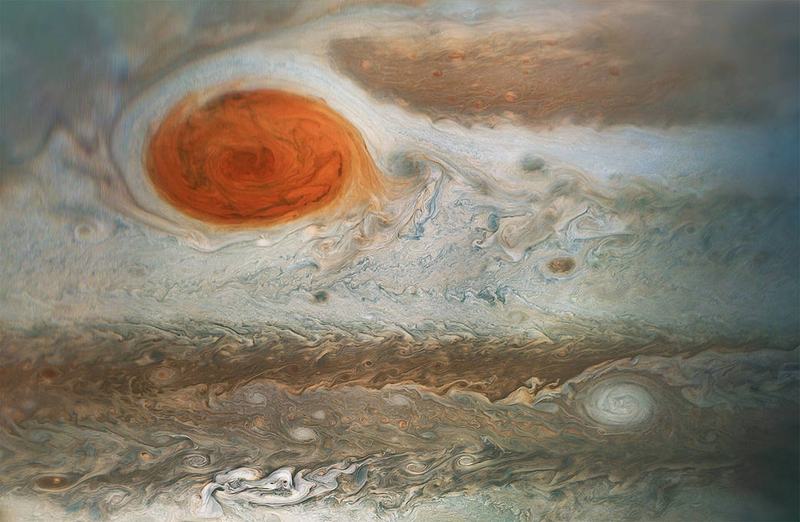
The Great Red Spot is a persistent, high-pressure region in Jupiter's atmosphere that produces the largest anticyclonic storm in the Solar System. Sitting 22 degrees south of the planet's equator, it drives wind speeds up to 496 km/h (308 mph) — comparable to the strongest tornadoes ever recorded on Earth, except this storm doesn't dissipate in minutes.
Nobody can say for certain how old it is. The Great Red Spot may have existed before 1664, but it's also possible the storm seen back then faded, and the spot we see today was first noticed only in 1830 and wasn't studied seriously until a prominent appearance in 1879. Either way, humanity has now been watching it for well over a century.
We got our first close look in 1979, when the Voyager 1 spacecraft, still 9,200,000 km (5,700,000 mi) from Jupiter, transmitted the first detailed image of the storm. Since then, the Great Red Spot has visibly changed size. Initial observations in the late 1800s put it at roughly 41,000 km (25,500 mi) across; by 3 April 2017 it measured 16,350 km (10,160 mi) wide — still 1.3 times the diameter of Earth, but noticeably shrunk, and the 21st century has continued to show its major diameter contracting.

A Magnetic Field That Dwarfs Earth's
Jupiter's magnetic field is the strongest of any planet in the Solar System, with a dipole moment of 4.170 gauss (0.4170 mT), tilted 10.31° from the planet's rotation axis. That field carves out a magnetosphere large enough to shield the planet's biggest moons from the solar wind, and it's powerful enough that its radio bursts were detected from Earth as early as 1955, when Bernard Burke and Kenneth Franklin picked them up at a frequency of 22.2 MHz.
More Moons Than Anyone Has Finished Counting
Jupiter has 115 known natural satellites, and that number keeps climbing as telescopes improve — of those, only 16 are larger than 10 km across. Most of the rest are tiny captured objects, a reminder of just how much debris a planet this massive can hold onto gravitationally.
Four of those moons have been famous for over four centuries. In 1610, Italian polymath Galileo Galilei discovered the four largest moons of Jupiter — now called the Galilean moons — using a telescope, in what is thought to be the first telescopic observation of moons other than Earth's own.
Three Worlds, Three Different Kinds of Extreme
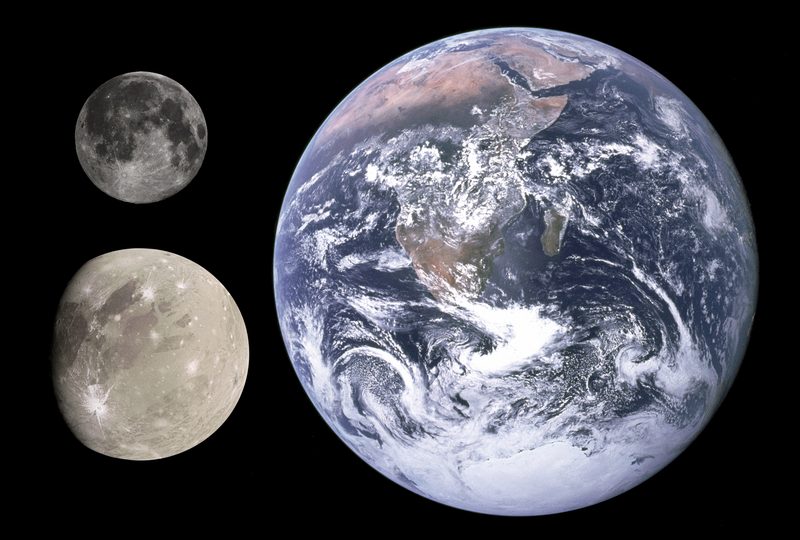
The four Galilean moons turned out to be individually remarkable. Ganymede is the largest and most massive moon in the Solar System — larger even than the planet Mercury, which has a diameter of 4,880 km (3,030 mi), though Ganymede is only 45 percent of Mercury's mass, since so much of it is ice rather than rock.

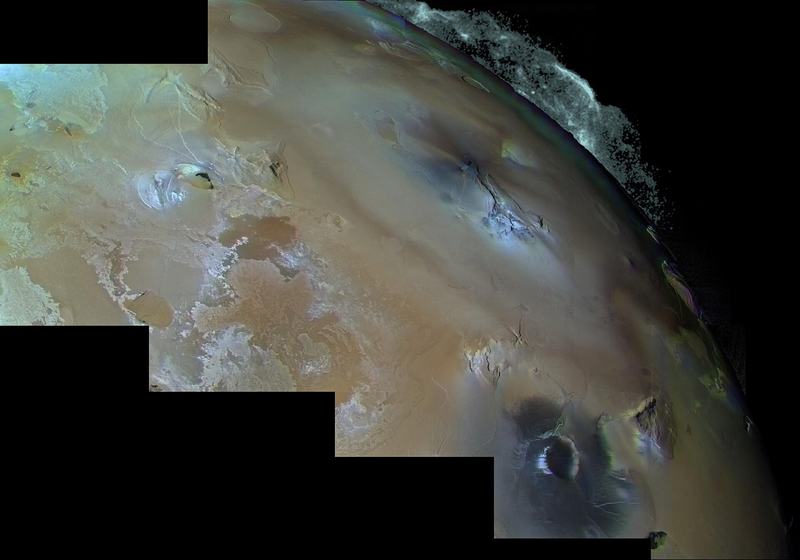
Io, the innermost of the four, is the opposite kind of extreme: with over 400 active volcanoes, it is the most geologically active object in the Solar System, constantly resurfaced by the tidal forces Jupiter and its neighboring moons exert on it.

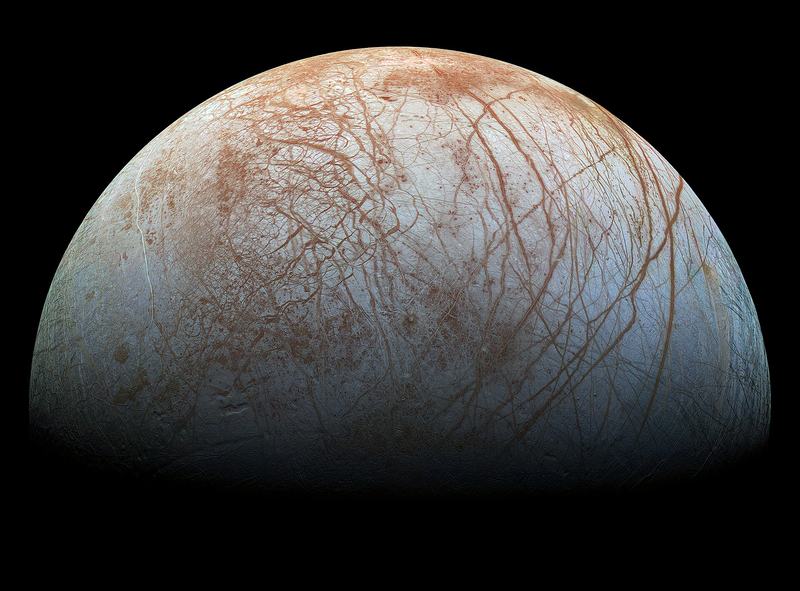
Europa, the smallest and least massive of the four, is quieter on the surface but arguably more intriguing underneath. It's estimated to have an outer layer of water around 100 km (62 mi) thick — part frozen into an icy crust, part a liquid ocean beneath it, sealed off from the vacuum of space.

Visitors From Earth
Jupiter's scale has made it a magnet for both deliberate and accidental visitors. In July 1994, the comet Shoemaker-Levy 9 collided with the planet, giving astronomers a rare, direct look at what happens when a comet meets a gas giant.
Spacecraft have made the trip on purpose too. The Galileo probe was delivered into Earth orbit on October 18, 1989, by Space Shuttle Atlantis during mission STS-34, then reached Jupiter on December 7, 1995, after gravitational assist flybys of Venus and Earth. Its arrival made it the first spacecraft ever to orbit an outer planet — a title that, decades later, still belongs to it and the missions that followed in its path.