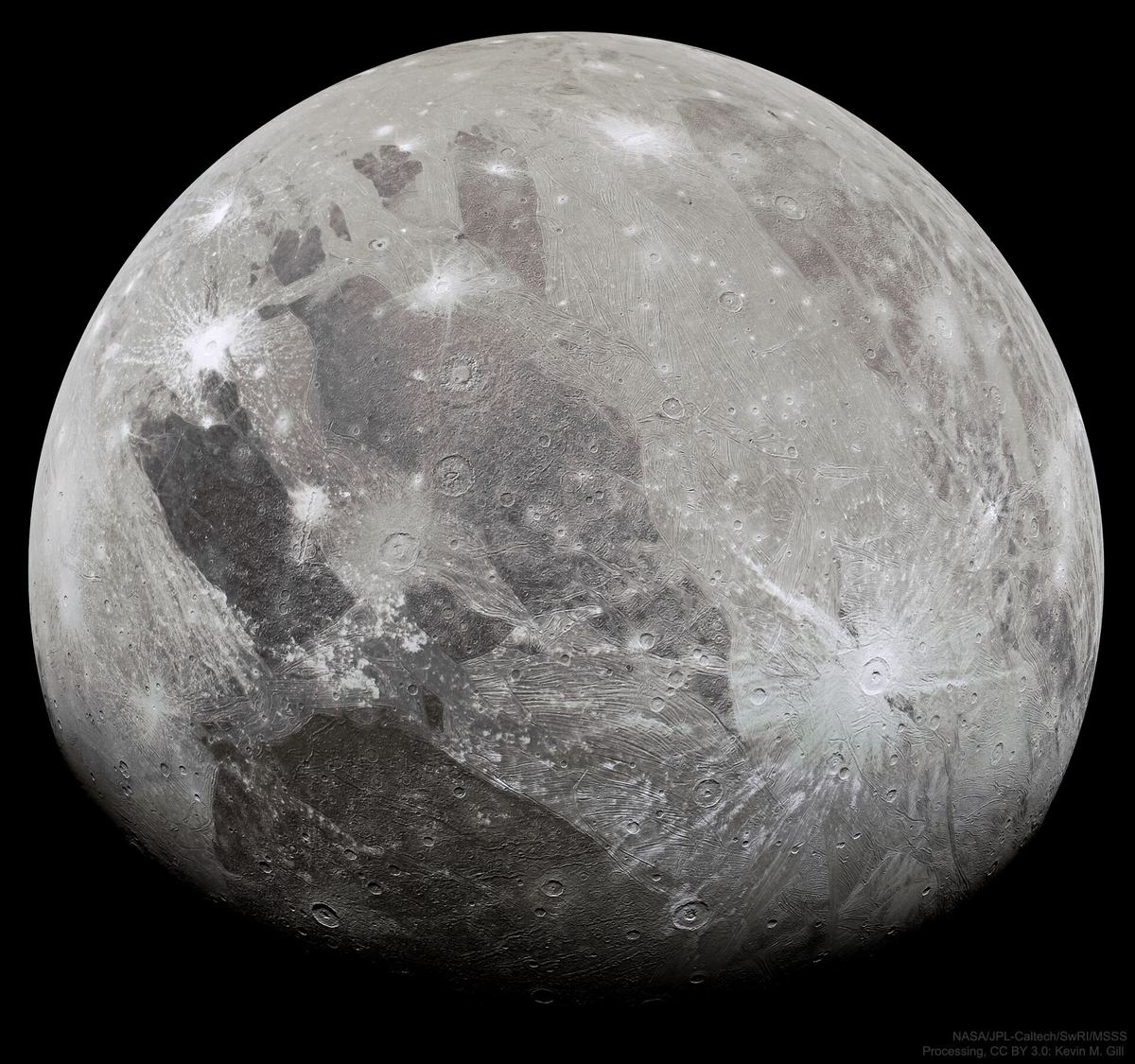
Ganymede is a natural satellite of Jupiter and is the largest and most massive moon in the Solar System. Like Saturn's largest moon Titan, it is larger than the planet Mercury itself, though it has somewhat less surface gravity than Mercury, Io, or Earth's Moon because it is made of lighter, less dense material. It is a moon that keeps breaking the mental category of "moon" the closer you look at it.
The most striking break from category is invisible from the outside: Ganymede is the only natural satellite in the Solar System known to possess an internally generated magnetic field. Planets have magnetic fields. Moons, as a rule, do not. Ganymede does anyway, and it has been reshaping what scientists expect from large icy worlds ever since the Galileo spacecraft confirmed it starting in 1995.
Add to that a hidden ocean, a chaotic impact history, and a European spacecraft now on its way to become the first ever to orbit it, and Ganymede turns out to be one of the most quietly extraordinary objects in the outer Solar System.
Bigger Than a Planet, Locked in Rhythm With Its Neighbors
With a diameter of about 5,270 km, Ganymede is slightly more massive than the second most massive moon, Saturn's Titan, and is more than twice as massive as Earth's Moon. It is larger than Mercury, which has a diameter of 4,880 km, but is only 45 percent of Mercury's mass — a reminder that Ganymede's bulk is made of far lighter material than a rocky planet's. Taken together, it ranks as the ninth-largest object in the entire Solar System, but only the tenth-most massive, because size and mass tell different stories once ice enters the equation.
That size comes with a precise orbital rhythm. Ganymede orbits Jupiter in roughly seven days and is locked in a 1:2:4 orbital resonance with the moons Europa and Io — for every one orbit Ganymede completes, Europa completes two and Io completes four, a clockwork relationship maintained by their mutual gravity. Farther out still, Callisto orbits Jupiter at about 1.88 million km, significantly farther than Ganymede's own orbital radius of 1.07 million km, placing Ganymede third among the four Galilean moons in distance from the planet.
A Structure Unlike Any Other Solid Body
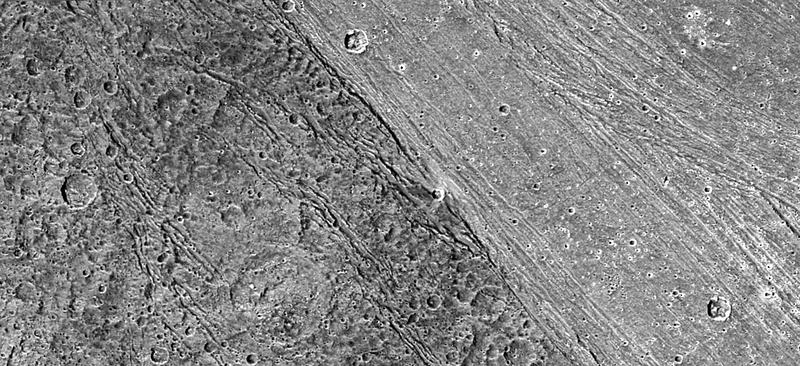

Beneath its surface, Ganymede is a fully differentiated body with an iron-rich, liquid metallic core, giving it the lowest moment of inertia factor — 0.31 — of any solid body in the Solar System. That number matters because it describes how a body's mass is distributed: a low moment of inertia factor means Ganymede's densest material has sunk deep into a compact core, exactly the kind of internal separation you'd expect from a planet, not a moon.
That layered structure is also why Ganymede generates its own magnetic field, something no other moon does. The Galileo spacecraft made six close flybys of Ganymede between 1995 and 2000 and discovered that its permanent magnetic moment is about three times larger than Mercury's. At the moon's equator, that field reaches a strength of 719 nT, roughly six times stronger than Jupiter's own magnetic field measured at Ganymede's distance, which comes in at about 120 nT there. The field is even stronger at the poles, where the intrinsic strength of 1440 nT is exactly double what it is at the equator.
An Ocean That Could Out-Volume Earth's
Ganymede's internal ocean potentially contains more water than all of Earth's oceans combined — a claim that sounds implausible until you remember that Ganymede is mostly built from water ice and rock in roughly equal measure, with a liquid layer sandwiched between layers of ice rather than spread across a surface like Earth's seas.
That ocean doesn't show through in an obvious way at the surface. Ganymede's surface has an albedo of about 43 percent, and water ice is present at a mass fraction of 50 to 90 percent on the surface, significantly more than in Ganymede as a whole — the outer shell is essentially an ice-rich skin sitting atop the rock, metal, and buried ocean below.
Living beneath that ice comes with real hazards from above. The radiation level at Ganymede's surface, 50 to 80 mSv per day, is considerably lower than on Europa, but it would still cause severe illness or death in a human exposed for two months — a reminder that "lower than the worst place nearby" still means genuinely dangerous.
A Violent, Uneven Youth
Ganymede's accretion probably took about 10,000 years, much shorter than the roughly 100,000 years estimated for the neighboring moon Callisto — a surprisingly fast assembly for a body this large, and one reason its interior ended up so thoroughly layered while Callisto's stayed comparatively mixed.
That early history wasn't peaceful. A 2020 study suggests Ganymede was hit by a massive asteroid about 4 billion years ago, an impact so violent it may have shifted the moon's axis entirely — evidence that even a body large enough to generate its own magnetic field wasn't immune to catastrophic collisions in the Solar System's early, chaotic days.
Four Centuries of Watching
Ganymede has been under observation almost as long as the telescope has existed. Galileo Galilei first observed it on January 7, 1610, though it took him until January 15 to conclude that the objects he was tracking near Jupiter were bodies orbiting the planet rather than fixed stars — the moment astronomy's most famous instrument first upended the assumption that everything in the sky circled Earth.
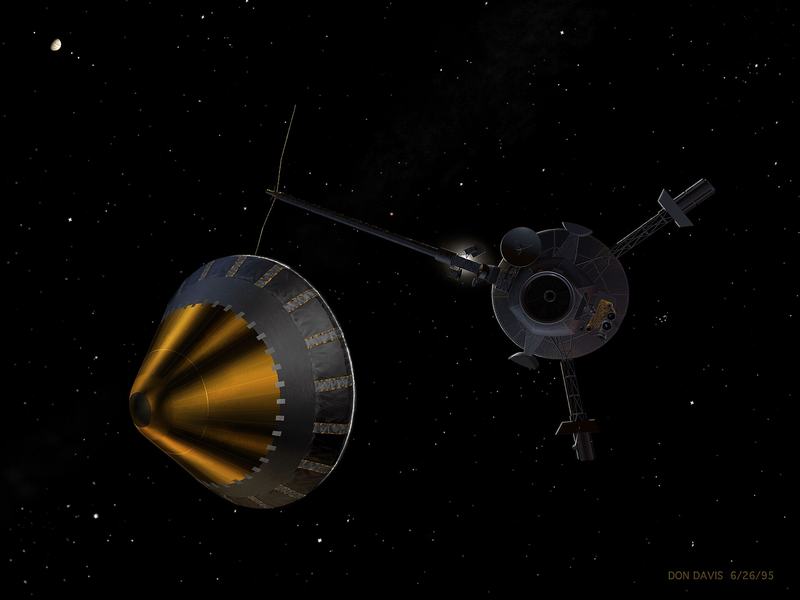

Spacecraft didn't reach Ganymede until more than three and a half centuries later. Pioneer 10's closest approach to Ganymede in 1973 was 446,250 km, about 85 times Ganymede's own diameter — a distant first look rather than a close study, but the beginning of Ganymede's transition from a telescope dot to a mapped world.
A Spacecraft Finally on Its Way to Orbit
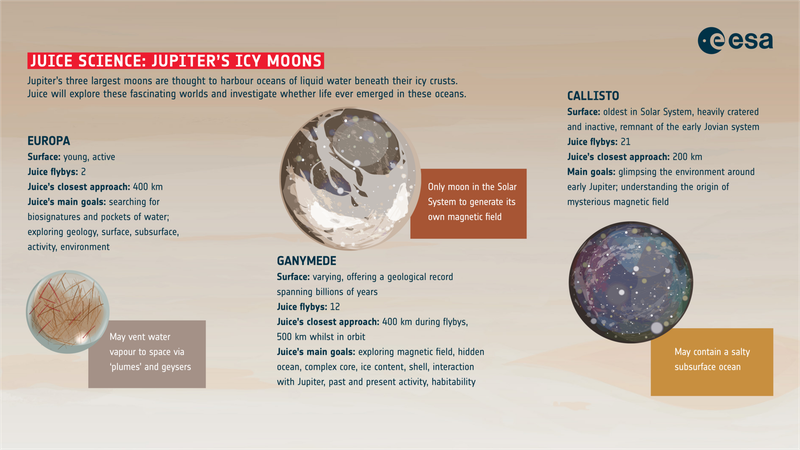

No spacecraft has ever orbited Ganymede itself, but that is about to change. ESA's JUICE spacecraft launched from the Guiana Space Centre on April 14, 2023, and is the first interplanetary spacecraft to the outer Solar System planets not launched by the United States. It is planned to enter orbit around Ganymede in December 2034 for its close-up science mission, becoming the first spacecraft ever to orbit a moon other than Earth's own — closing a loop that started with Galileo's naked-eye telescope more than four hundred years earlier.