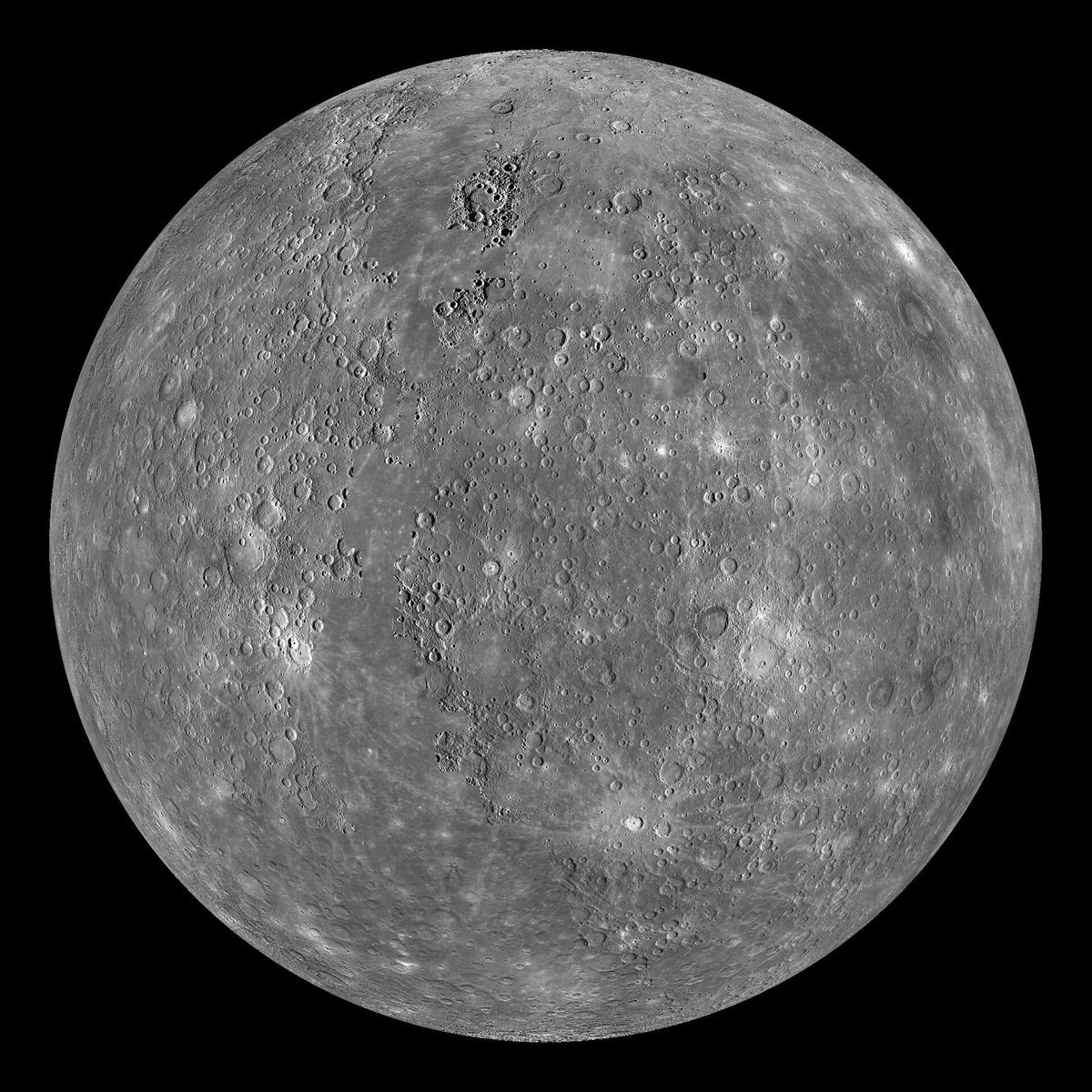
Picture living on a planet where the Sun rises, crawls at a glacial pace across the sky, and doesn't set for months on end — and then the same thing happens all over again before your calendar year is even up. That is everyday life on Mercury. One solar day, measured from sunrise to the next sunrise, lasts 176 Earth days. Its year — one full orbit around the Sun — is only 87.969 days. Mercury manages to lap itself.
It is easy to assume the planet closest to the Sun must be the simplest. It has no moons, no rings, and barely an atmosphere. But Mercury is one of the most physically surprising objects in the Solar System: a planet with a core that dominates it in a way nothing else in our neighborhood does, a magnetic field it has no business having, and an orbit that once stumped every physicist on Earth until Albert Einstein came along.
There have been just two robotic visitors in all of human history, with a third currently en route. Getting there is — by one measure — harder than reaching any other planet. What those missions found keeps rewriting the textbooks.
A Year You Could Lap Twice in One Day
Mercury's strange relationship with time comes from a 3:2 spin–orbit resonance: the planet rotates exactly 3 times on its axis for every 2 orbits around the Sun. The result is that one solar day — the time between two sunrises at the same spot — equals 176 Earth days, twice Mercury's orbital year of 87.969 days.
This also produces one of the Solar System's stranger spectacles. Because Mercury moves fastest along its elliptical orbit when it is closest to the Sun, its orbital speed briefly outpaces its rotation rate. For an observer standing on Mercury's equator at the right longitude, the Sun would appear to rise, slow down, reverse direction for a while, and then resume its westward crawl — a spectacle that happens near every perihelion passage.
Mercury's axis is tilted just 2 degrees with respect to the plane of its orbit — virtually upright. There are no seasons on Mercury, none at all, because neither pole ever tips meaningfully toward or away from the Sun.
The Iron Giant in a Tiny Suit
For the smallest planet in the Solar System — equatorial radius 2,439.7 km — Mercury carries a startlingly oversized core. That core occupies about 57% of Mercury's volume. Earth's core takes up only 17%.
The density numbers make the picture even starker. Mercury is the second densest planet in the Solar System, at 5.427 g/cm³, only slightly behind Earth's 5.515 g/cm³. But Earth is much larger, and gravity compresses its own material. Remove the compression effect from both planets and Mercury's uncompressed density of 5.3 g/cm³ actually exceeds Earth's uncompressed 4.4 g/cm³. The material Mercury is built from is intrinsically denser than what Earth is made of.
Why Mercury ended up so iron-rich is one of the planet's enduring mysteries. What is clear is that the core is at least partially molten: Earth-based radar measurements of Mercury's rotation detected a slight rocking motion that only a liquid interior can produce, and iron "snow" crystallizing at depth may be what keeps Mercury's magnetic field alive.
An Orbit That Kept Scientists Up at Night
Mercury has the most eccentric orbit of all the planets in the Solar System: eccentricity 0.21, with its distance from the Sun ranging from 46,000,000 km at closest approach to 70,000,000 km at its farthest. No other planet's path is that egg-shaped.
That eccentricity fed one of the longest unsolved problems in astronomy. Astronomers noticed that Mercury's orbit precessed — the orientation of its ellipse drifted — at a rate that Newtonian gravity could not fully explain, even accounting for every known planet's gravitational tug. The unexplained excess was tiny: just 42.980 arcseconds per century.
Einstein's general theory of relativity predicted exactly that amount of extra precession, caused by the curvature of spacetime near the Sun. The match was almost perfect, and Mercury's orbit became the first observational proof that general relativity was right. That 42.980-arcsecond drift takes Mercury just over 3 million years to accumulate into one full extra revolution of its orbit — small, but measurable, and it changed physics.
Hot Enough to Melt Lead, Cold Enough to Keep Ice
Without an atmosphere to retain heat, Mercury's surface temperature swings between extremes nothing else in the inner Solar System matches. Daytime temperatures reach 430°C (800°F). At night, the same surface drops to −180°C (−290°F). The planet has no way to hold warmth once the Sun goes down.
Here is the counterintuitive part: Mercury is not the hottest planet. Despite being the closest planet to the Sun, that distinction belongs to Venus. Venus's thick carbon dioxide atmosphere acts as a planetary pressure cooker, trapping heat so effectively that its surface stays scorching around the clock. Mercury gets hotter at its subsolar point at perihelion, but cannot hold that heat.
Mercury's 2-degree axial tilt means the poles never receive direct sunlight. Temperatures there never rise above 180 K (−93 °C). Some craters near the poles sit in permanent shadow, shielded by their own rims from any direct solar exposure. Mercury may have water ice inside those craters — cold enough, and dark enough, to have kept it for billions of years.
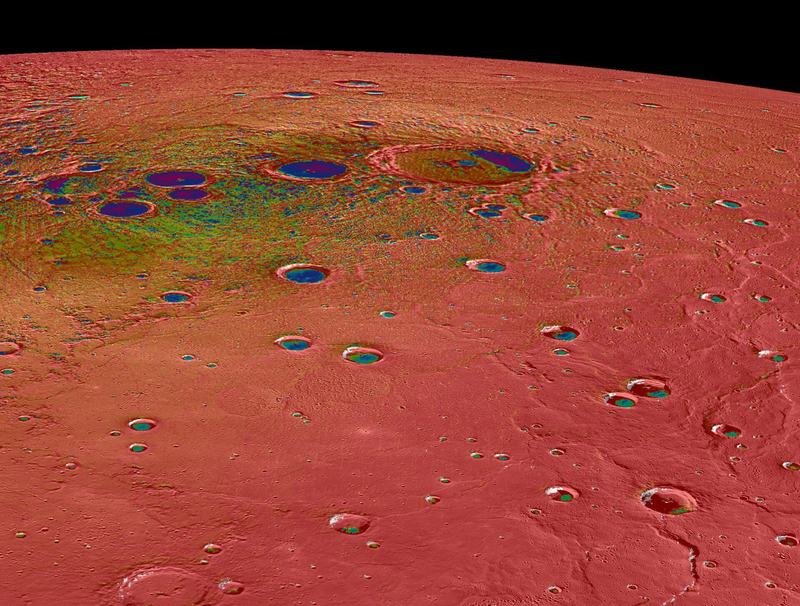

A Magnetic Field That Shouldn't Exist
When the first spacecraft flew past Mercury in 1974, scientists did not expect to find a magnetic field. Mercury rotates once every 59 Earth days — far too slowly, conventional wisdom said, to sustain a planetary dynamo. They were wrong.
Mercury has a significant, apparently global magnetic field measuring about 1.1% the strength of Earth's. The field is a magnetic dipole, oriented nearly along Mercury's spin axis — similar in structure to Earth's field, just much weaker. It is strong enough to create a true magnetosphere, though a compact one: Mercury's magnetospheric cavity is about 20 times smaller than Earth's.
The weakness of that field has an unexpected consequence. Mercury's magnetosphere is extremely "leaky." During MESSENGER's second flyby of Mercury in October 2008, the probe detected intense magnetic tornadoes — tubes of magnetic flux twisted by the solar wind — that funnel fast, hot solar wind plasma directly down to the planet's surface. On Earth, the magnetic field is strong enough to deflect that plasma toward the poles. On Mercury, it punches through.
The Scar That Shook the Whole Planet
An object estimated to be at least 100 km across once struck Mercury with enough force to leave behind the Caloris Basin, a circular scar 1,550 km in diameter — about one-third the diameter of the planet itself. It is one of the largest impact basins in the Solar System.
The name is deliberate: "calor" is Latin for heat. Because Mercury's spin and orbit are locked in that 3:2 resonance, the Sun hangs almost directly overhead above the Caloris Basin every second time Mercury passes perihelion. The basin sits at one of the two hottest points on the planet's surface.
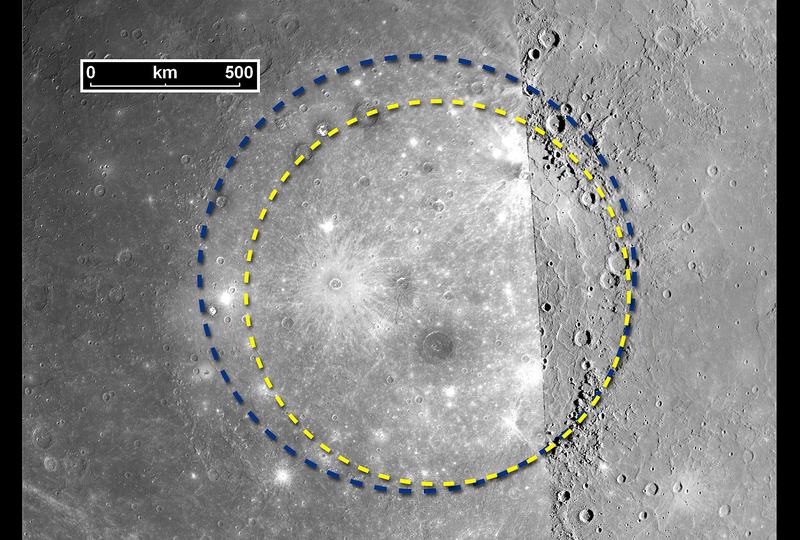

The impact did something strange to the opposite side of the planet. Shock waves from the Caloris collision traveled around and through Mercury, converging at the antipodal point — the spot exactly 180° away. The concentrated energy deformed the terrain there into a chaotic jumble of disrupted hills and plains. Two dramatic landforms, on opposite sides of a small world, created by a single event billions of years ago.
The Hardest Planet to Reach
Mercury is relatively close to Earth, and yet it is — by one rigorous measure — the hardest planet in the Solar System to reach. Mercury has the highest delta-v required for travel from Earth, more than any other planet, including the much more distant outer planets. The reason is geometry: a spacecraft must shed enormous speed to fall inward toward the Sun, and then shed even more to avoid sailing straight past Mercury.
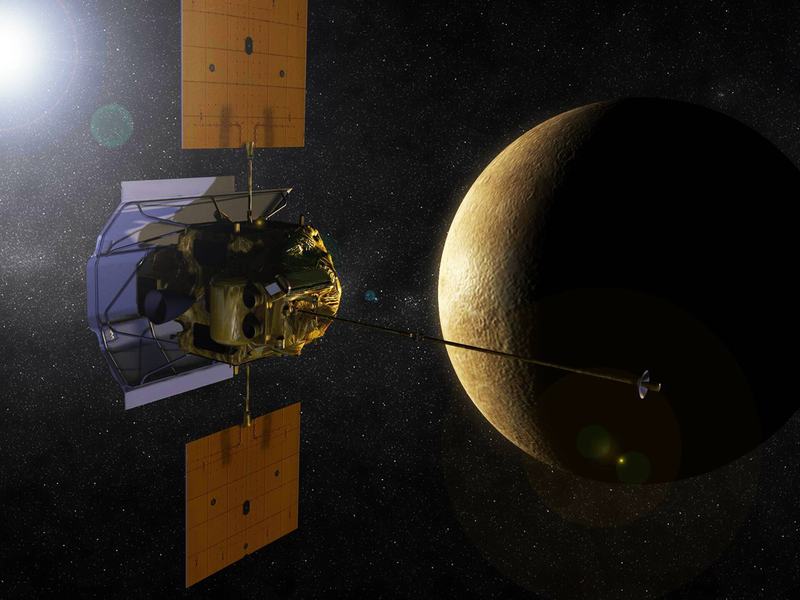

Mariner 10 solved part of the problem in 1974 by using Venus's gravity to slow down — the first spacecraft ever to use the gravity-assist technique. That maneuver is now a standard tool of interplanetary navigation, used by dozens of missions since. MESSENGER (2011–2015) refined the approach further, flying past Earth once and Venus twice before making three Mercury flybys, each one bleeding off more velocity. Once in orbit, it collected close to 100,000 images and achieved 100% mapping of Mercury's surface by March 6, 2013.
The next mission is already en route. BepiColombo, a joint project of the European Space Agency and the Japan Aerospace Exploration Agency, launched in October 2018. To reach Mercury orbit it needs nine gravity assists, slowing the spacecraft down with each pass. After a thruster issue delayed its arrival, BepiColombo is now expected to enter Mercury orbit in November 2026. When it does, two orbiters will study the planet together, mapping its magnetic field and interior with instruments no earlier probe could carry.