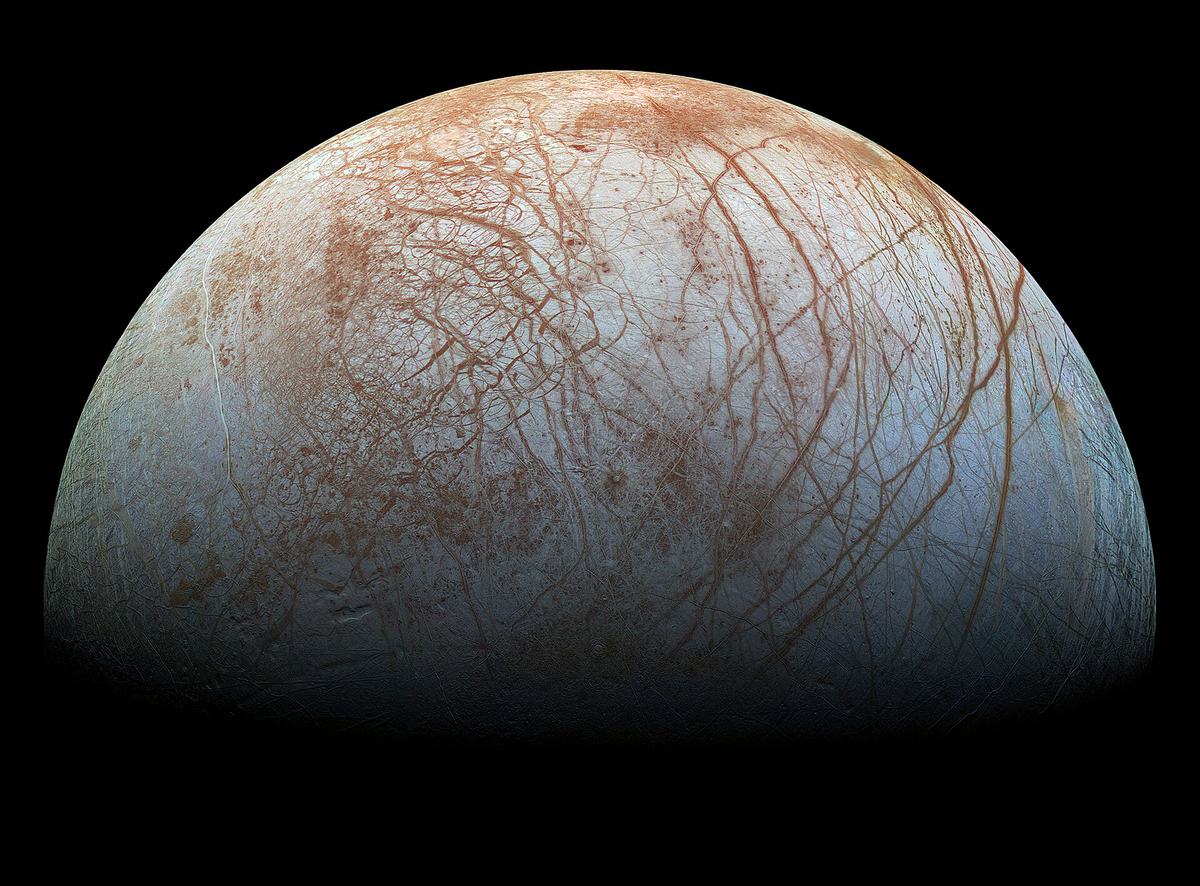
Europa is the smallest and least massive of Jupiter's four Galilean moons, and it is slightly smaller and less massive than Earth's own Moon. On the outside, that makes it sound unremarkable. On the inside, it is anything but: beneath its icy shell sits an ocean with an estimated volume of 3x10^18 cubic metres — between two and three times the volume of every ocean on Earth combined, hidden under a world barely bigger than our own satellite.
That hidden ocean is why Europa keeps showing up on shortlists for where life might exist beyond Earth. Nothing about its surface looks alive — it is bright, cold, and cracked — but what lies underneath has scientists building spacecraft specifically to go check.
Europa was discovered by Galileo Galilei on January 8, 1610, alongside Jupiter's three other large moons, Io, Ganymede, and Callisto, and possibly independently by the astronomer Simon Marius. More than four centuries later, it's still one of the most closely watched targets in the Solar System.
A Small Moon With a Fast, Tight Orbit
Europa orbits Jupiter in roughly 3.55 days, at an orbital radius of about 670,900 km — a tight, fast loop compared to how Earth relates to the Sun. At just over 3,100 km in diameter, it's the sixth-largest moon and fifteenth-largest object in the entire Solar System, respectable size but nowhere near the biggest of Jupiter's four Galilean satellites.
That fast, close orbit matters more than it might seem. It's the source of the tidal flexing that keeps Europa's interior warm enough to sustain liquid water in the first place — squeezed and stretched by Jupiter's gravity on every trip around the planet.
An Ocean Bigger Than All of Earth's Combined
Europa has an outer layer of water around 100 km thick, split between a frozen crust on top and a liquid ocean underneath the ice. It's that liquid layer that adds up to two to three times the volume of Earth's oceans — an amount of water that dwarfs our own planet's, wrapped inside a moon smaller than the Moon.
Keeping that ocean liquid at Europa's distance from the Sun takes real heat, and Europa's surface makes clear how little of it reaches the outside: surface temperatures average about 110 K (-160°C) at the equator and drop to just 50 K (-220°C) at the poles, cold enough to keep the icy crust as hard as granite. Whatever warmth sustains the ocean below comes from tidal flexing deep within the moon, not from the Sun.
The Smoothest Surface in the Solar System
Europa's icy crust has an albedo of 0.64, one of the highest reflectivity ratings of any moon, and based on the frequency of cometary bombardment it endures, the surface is estimated to be only 20 to 180 million years old — young by planetary standards. That surface also lacks large-scale features such as mountains or craters, making Europa the smoothest known solid object in the entire Solar System.
Both facts point to the same underlying cause: an active surface that keeps resurfacing itself, most likely because the ice shell isn't rigidly fixed to whatever lies beneath it. A full revolution of Europa's outer icy shell relative to its interior takes at least 12,000 years — direct evidence that the shell effectively floats independently on the ocean below, rather than being locked to Europa's rocky core.
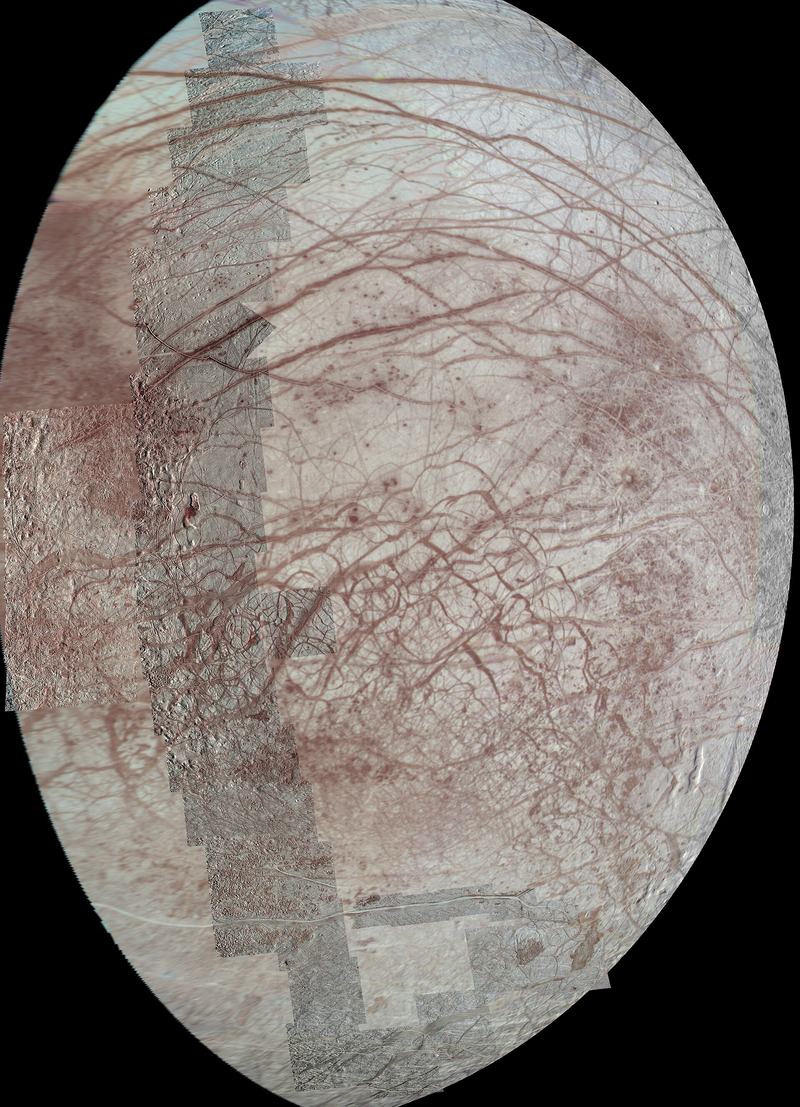

The dark streaks that do mark Europa's surface, called lineae, tell a related story. The largest of these bands are more than 20 km across, often with dark, diffuse outer edges, regular striations, and a central band of lighter material — patterns consistent with a crust that repeatedly splits open and refreezes as it drifts.
A Hostile Neighborhood, But a Genuine Atmosphere
Sitting this close to Jupiter comes at a cost. The ionizing radiation level at Europa's surface is equivalent to a daily dose of about 5.4 sieverts, an amount that would cause severe illness or death in a human being exposed for a single 24-hour day. Any future lander will need serious shielding just to survive long enough to collect data.
Despite that hostile environment, Europa still holds onto a genuine, if extremely thin, atmosphere: a layer of oxygen that extends to a height of about 190 km above the surface. It also generates its own small magnetosphere, at approximately 25% the strength of neighboring Ganymede's — modest, but enough to shape how charged particles interact with the moon.
Signs of Water Breaking Through
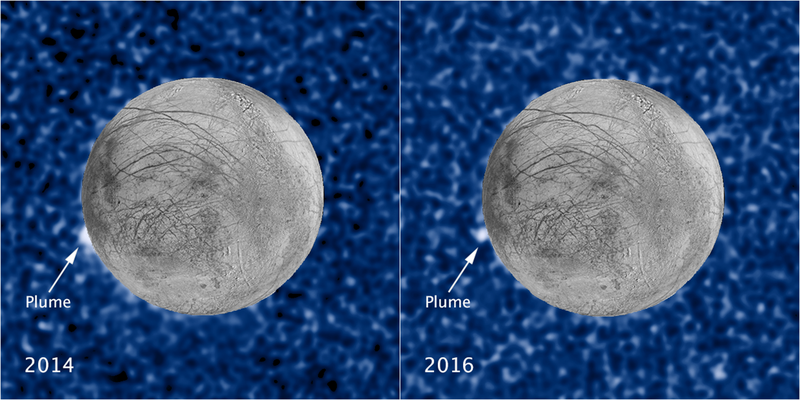

The most tantalizing evidence for Europa's ocean comes not from what's beneath the ice, but from what may occasionally escape it. In 2012, the Hubble Space Telescope captured an image interpreted as a plume of water vapor erupting near Europa's south pole, estimated to reach as high as 200 km above the surface. In May 2018, astronomers added further support for that plume activity, based on an updated analysis of data from the Galileo space probe, which had orbited Jupiter from 1995 to 2003 — evidence hiding in a decades-old dataset that took new analysis techniques to uncover.
Galileo itself has a notable history: the spacecraft was delivered into Earth orbit on October 18, 1989 by Space Shuttle Atlantis, and arrived at Jupiter on December 7, 1995, becoming the first spacecraft ever to orbit an outer planet. Its data on Europa is still being mined for discoveries more than two decades after the mission ended.
Galileo wasn't the first to see Europa up close, either. Exploration of the moon began with the Jupiter flybys of Pioneer 10 and 11 in 1973 and 1974, and the two Voyager probes followed in 1979, providing far more detailed images of Europa's icy surface than anything before them.
The Next Mission Is Already on Its Way
.jpg)
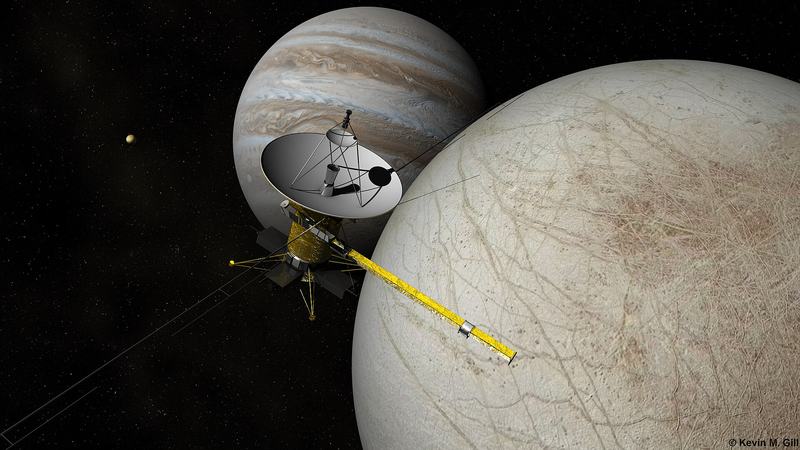
Europa Clipper launched on October 14, 2024, and is the largest interplanetary spacecraft ever built by NASA — a scale that reflects just how seriously the agency is taking this particular moon. It is planned to enter Jupiter orbit in April 2030 and begin a series of close flybys of Europa starting in March 2031, specifically to investigate the ice shell and the ocean underneath it.
For a moon with roughly 13% of Earth's surface gravity, Europa punches well above its weight scientifically. It is smaller than our own Moon, drenched in lethal radiation, and locked in permanent deep-freeze at the surface — and it may still be hiding the best chance in the Solar System, besides Earth, for liquid water to support something alive.