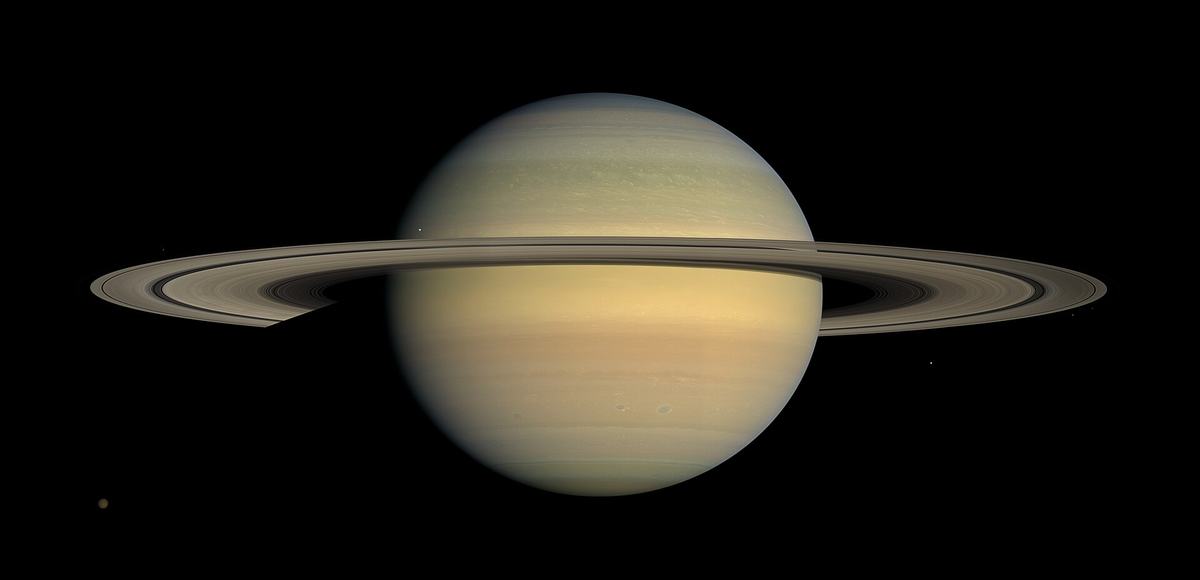
Saturn is the only planet in the Solar System that is less dense than water — about 30% less. Drop it into an ocean large enough to hold it, and it would bob on the surface. That single, almost absurd fact captures what makes Saturn different from every other planet: it's a world built almost entirely of gas, barely holding itself together against its own bulk.
It's a gas giant with an average radius about 9 times that of Earth, yet it has only an eighth of Earth's average density — yielding a planet over 95 times more massive than Earth despite being mostly empty puff. Even though Saturn is almost as big as Jupiter, it has less than a third of Jupiter's mass. Between its low density, its famous rings, its enormous moon Titan, and a hexagon-shaped storm that shouldn't really exist, Saturn is a planet that keeps surprising the people who study it closely.
A Giant Built From Almost Nothing
Saturn's low density isn't the only thing distorted by its gas-giant nature. Its equatorial radius is more than 10% longer than its polar radius — 60,268 km (37,449 mi) versus 54,364 km (33,780 mi) — a bulge caused by how fast the planet spins on a body held together mostly by gravity rather than solid structure. Saturn has the second-shortest day in the Solar System: one day takes only 10.7 hours, even though a full trip around the Sun takes about 29.4 Earth years (10,756 Earth days).
That spin also drives Saturn's weather. Winds in the upper atmosphere reach 1,600 feet per second (500 meters per second) in the equatorial region — compare that to the strongest hurricane-force winds on Earth, which top out at about 360 feet per second (110 meters per second). Saturn's "calm" bands are still faster than anything a hurricane can produce here.
Rings Thinner Than They Look
Saturn's rings extend from 6,630 to 120,700 kilometres (4,120 to 75,000 mi) outward from the planet's equator — and yet average only about 20 metres (66 ft) in thickness. Scaled down, a system that wide and that thin is proportionally flatter than a sheet of paper laid across a football field.
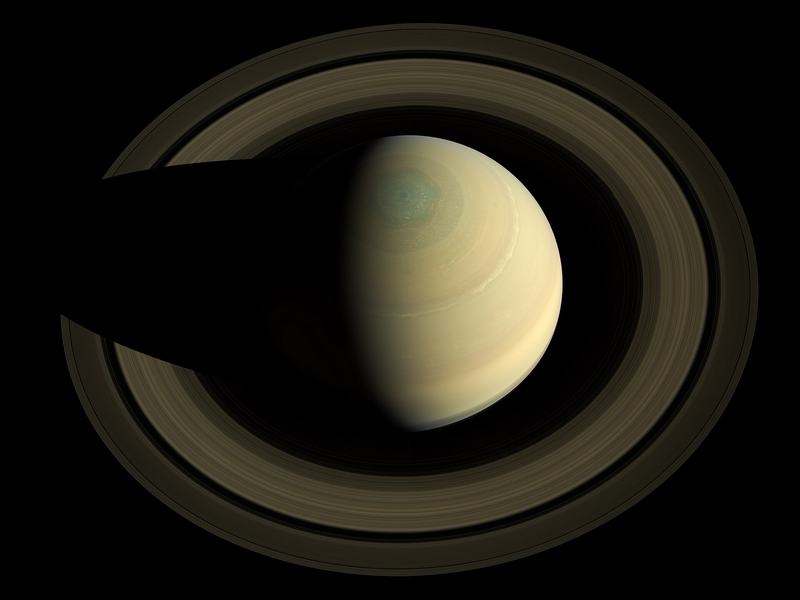

Humans have been looking at the rings for over four centuries without immediately understanding what they were looking at. In 1610, the year after his first observations with a telescope, Galileo Galilei became the first person to observe Saturn's rings, though he could not see them well enough to discern their true nature. It took until 1655 for Christiaan Huygens to be the first to describe them as a disk surrounding the planet — and that same year, on March 25, 1655, Huygens also discovered Titan, Saturn's largest moon, in the same burst of observation. Two decades later, in 1675, Cassini discovered the gap in the rings now known as the Cassini Division.
Stranger still, the rings might be a relatively recent addition to the Saturn system. Data from the Cassini spacecraft suggest they are much younger than the planet itself, having most likely formed within the last 100 million years and possibly as recently as 10 million years ago — meaning dinosaurs may have looked up at a ringless Saturn. Based on current depletion rates, the rings may disappear again in about 300 million years, making this whole spectacle a temporary phase in Saturn's multi-billion-year life.
A Family of 293 Moons, Dominated by One
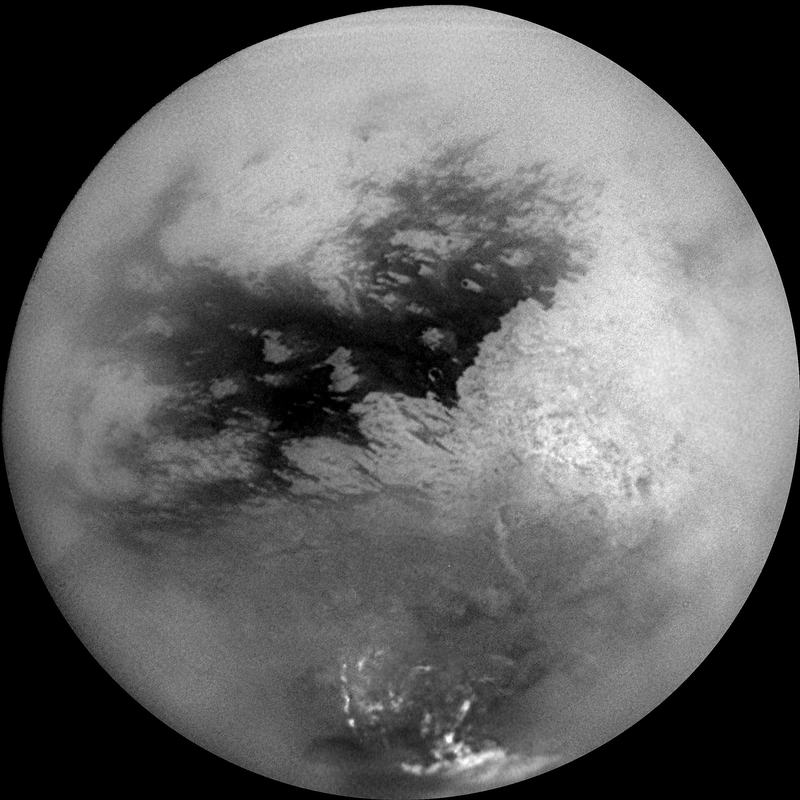
Saturn has 293 known moons, 63 of which have formal names — and the list keeps growing as fainter, smaller satellites are confirmed. But one moon dwarfs the rest: Titan, the largest, comprises more than 90% of the mass in orbit around Saturn, including the rings themselves.
Titan is the largest moon of Saturn and the second largest in the Solar System. It is the only moon known to have a dense atmosphere — denser than Earth's — and is the only known object in the Solar System besides Earth with clear evidence of stable bodies of surface liquid. For decades that liquid was suspected but unconfirmed; the existence of liquid hydrocarbons on Titan was finally confirmed in situ by the Cassini orbiter, with the Cassini mission team announcing "definitive evidence of the presence of lakes filled with liquid methane on Saturn's moon Titan" in January 2007.

A Small, Icy Moon With Its Own Ocean
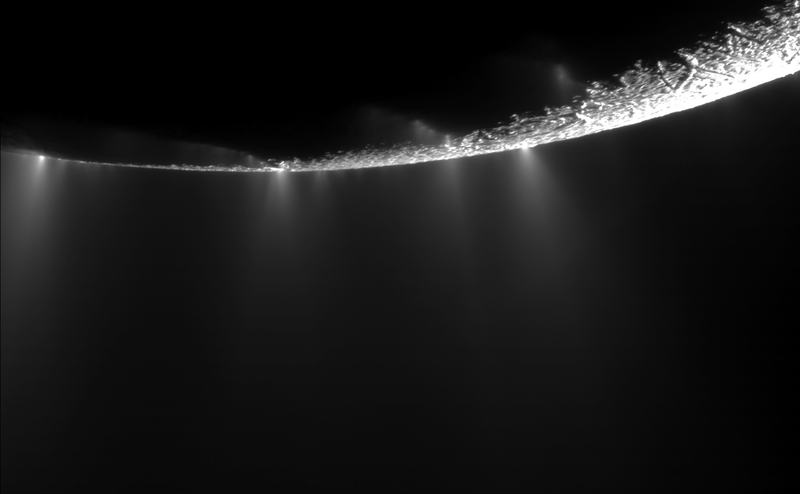
Enceladus, much smaller than Titan, tells a different story about water in the outer Solar System. It is covered by clean, freshly deposited snow hundreds of meters thick, making it one of the most reflective bodies in the Solar System — a moon so white it looks almost artificial against the black of space.
That reflective shell turned out to be hiding something. Evidence of liquid water on Enceladus began to accumulate in 2005, when scientists observed plumes containing water vapour spewing from its south polar surface, with jets moving 250 kg of water vapour every second at up to 2,189 km/h (1,360 mph) into space — a small moon actively venting an ocean into the void.

The Storm Shaped Like a Hexagon
Saturn's north pole hosts one of the strangest features in the Solar System: a persistent, approximately hexagonal cloud pattern located at about 78°N. The sides of the hexagon are about 14,500 km (9,000 mi) long — about 2,000 km (1,200 mi) longer than the diameter of Earth — meaning a single side of this storm could swallow our entire planet with room to spare.
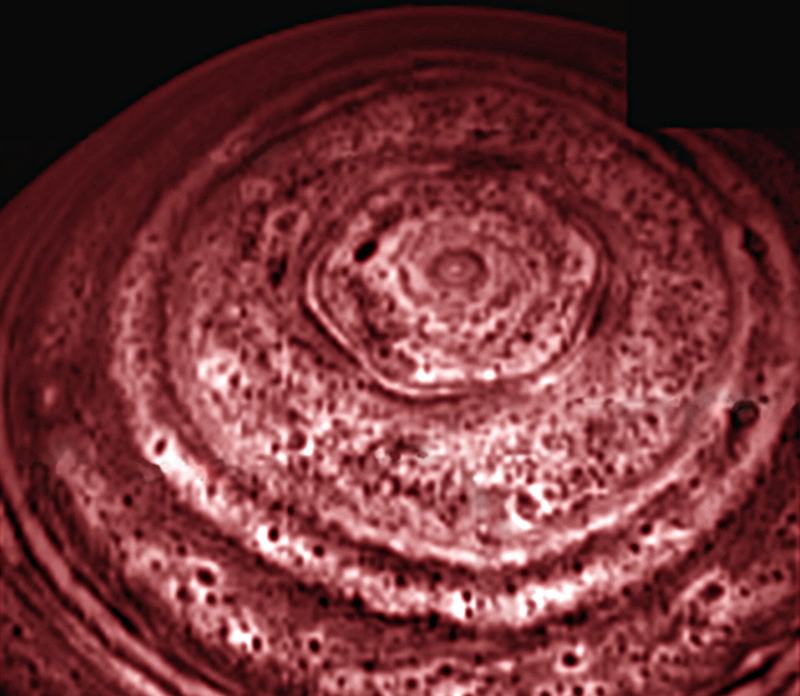

It wasn't discovered on purpose. Saturn's polar hexagon was found by David Godfrey in 1987, pieced together from fly-by images taken by the 1981 Voyager mission, and was revisited in close detail in 2006 by the Cassini mission, decades after anyone first noticed the shape hiding in old data.
The Mission That Watched It All
Much of what's known about modern Saturn — its rings' age, Titan's lakes, Enceladus's plumes, the hexagon's persistence — traces back to one spacecraft. Cassini was the fourth space probe to visit Saturn and the first to enter its orbit, where it stayed from 2004 to 2017. It was launched on October 15, 1997, and remained active in space for nearly 20 years, spending almost 7 years in transit and 13 years orbiting Saturn before its mission ended.