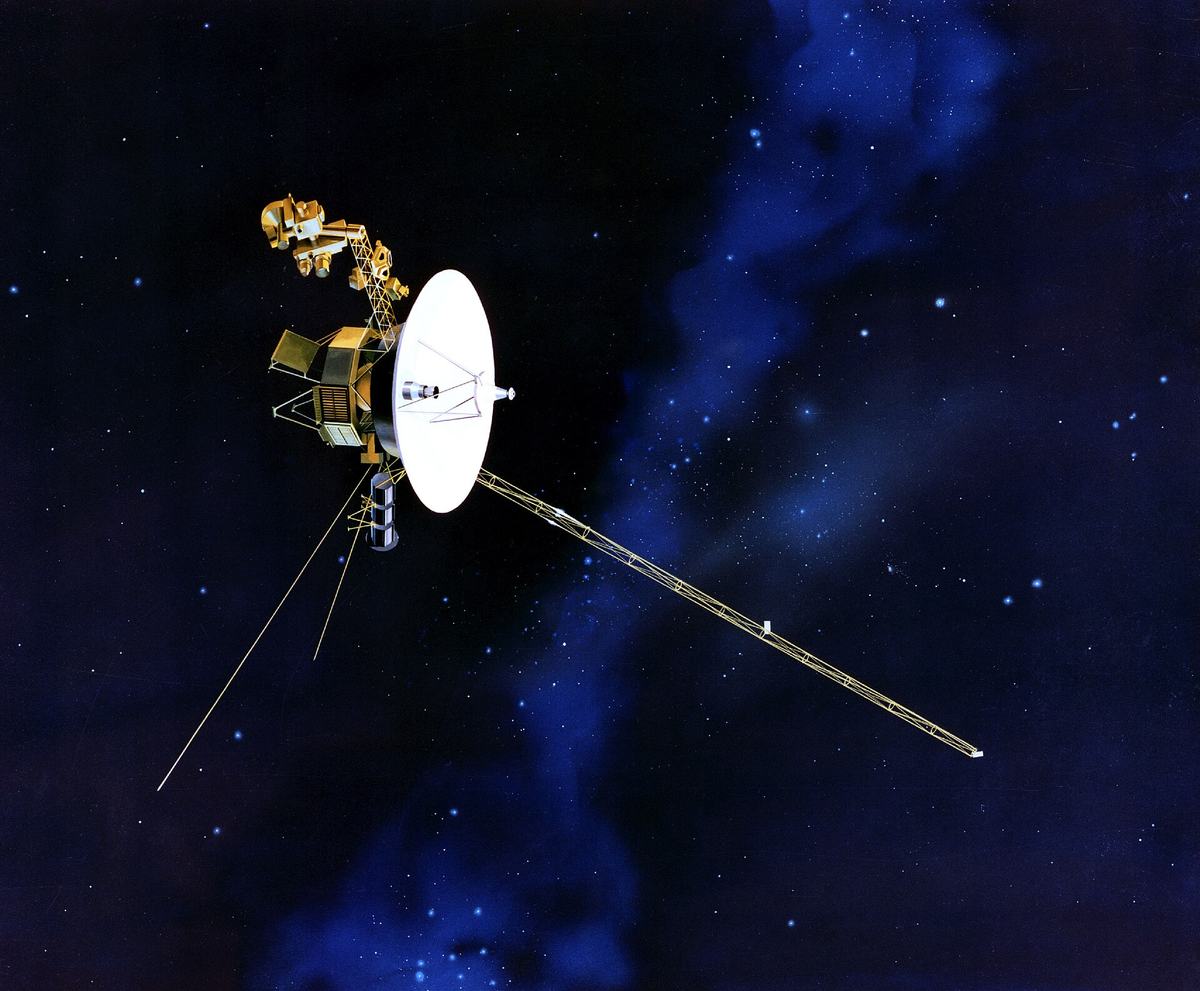
As of March 2026, Voyager 1 has put 172.59 AU — about 25.8 billion kilometers (16.0 billion miles) — between itself and Earth, more distance than any other object humans have built has ever covered. It left Cape Canaveral on September 5, 1977, aimed at the outer Solar System, finished its planetary work within a few years, and then just kept going.
Nearly five decades later, the spacecraft is still transmitting, still carrying a gold-plated record of Earth sounds, and still turning up firsts nobody expected from a probe designed for a much shorter mission. The facts below trace that arc: the planetary flybys that rewrote a moon's reputation, the single photograph that became a cultural touchstone, and the slow, strange business of listening to a machine phone home from beyond the Sun's influence.
A Grand Tour That Redrew Two Giant Planets
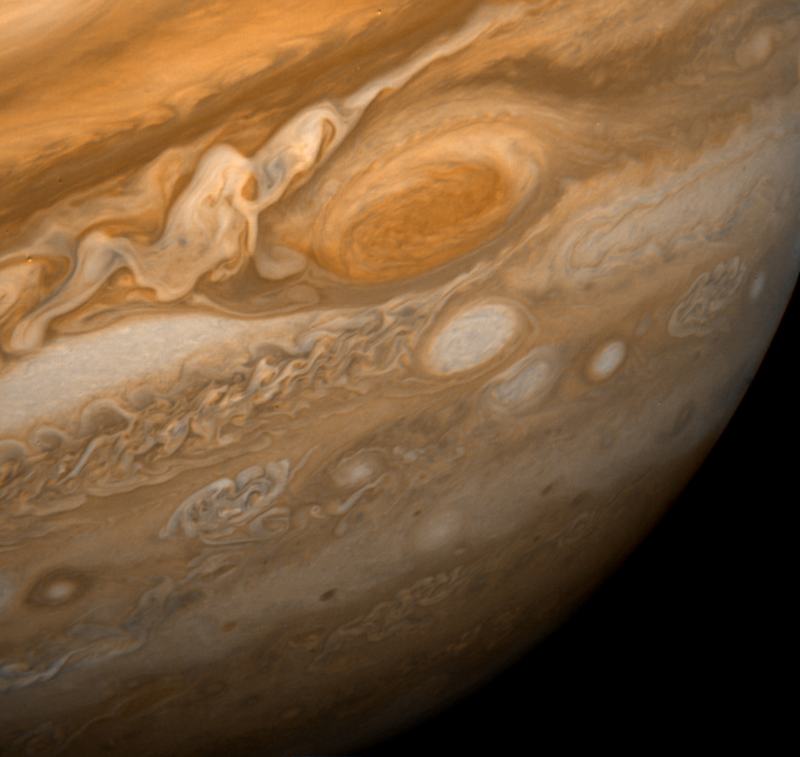
On February 25, 1979, with Jupiter still 9.2 million kilometers away, Voyager 1 beamed home the first detailed picture ever taken of the Great Red Spot, giving scientists their closest look yet at the storm. The flyby did not stop at one famous feature.
Among Voyager 1's finds was Metis, a moon orbiting just outside Jupiter's ring — the first Jovian moon any spacecraft had ever spotted. Before Voyager 1, moon-hunting around the outer planets had been a job for telescopes; afterward, it became a job for cameras flying past at close range.

Titan's Stolen Crown
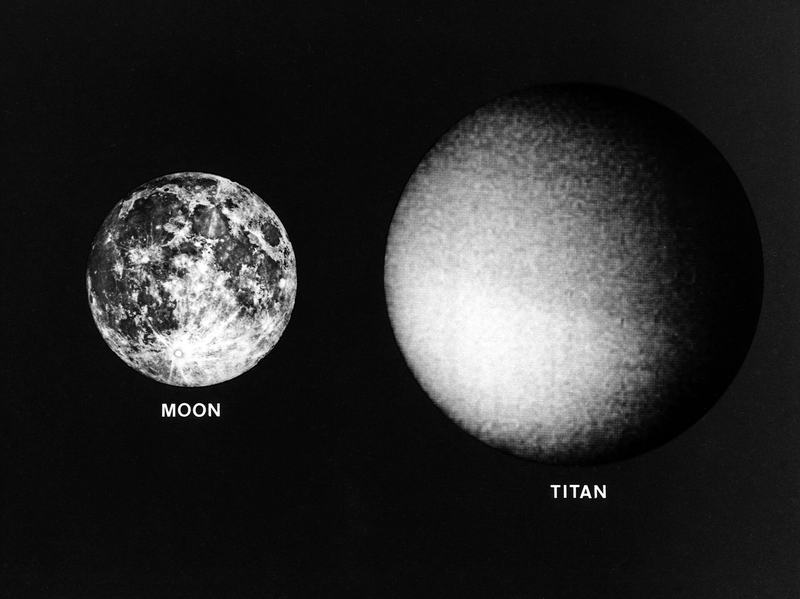
Until Voyager 1 swept past Saturn in 1980, astronomers ranked Titan as the biggest moon in the Solar System, edging out Ganymede's 5,262-kilometer (3,270-mile) diameter. Voyager 1's flyby data settled the question differently.
Titan actually comes in second behind Ganymede, though it is still bigger across than Mercury. What it lacks in mass compared with Mercury is striking: it weighs in at only 40% of Mercury's mass, because Mercury is built mostly from iron and rock while Titan is largely ice, a much lighter material. A single flyby had quietly rewritten a planetary size chart that had stood for years.

The Photograph That Became a Philosophy
On February 14, 1990, well after its planetary work was done, engineers turned Voyager 1's camera back toward home for a single wide shot of the Solar System taken from outside it — a portrait that includes the pixel of light known ever since as the Pale Blue Dot.
Getting that image took precision most casual snapshots never need: the darkest filter on board, tuned to a methane absorption band, paired with a 5-millisecond exposure, so that scattered sunlight would not wash out the picture — even at that range, Earth still nearly overwhelmed the camera.


Crossing Into Interstellar Space
Voyager 1 is also outrunning every other spacecraft ever launched, receding from the Sun at roughly 17 km/s (11 mi/s), the fastest heliocentric departure speed on record. That speed eventually carried it somewhere no machine had gone before.
On August 25, 2012, Voyager 1 pushed through the heliopause, the boundary where the Sun's outward wind gives way to interstellar gas, and became the first spacecraft ever to reach interstellar space. The moment did not come with fanfare; researchers needed changes in particle density to confirm it had actually happened.
Even before that crossing, Voyager 1 had a habit of detecting things for the first time. By December 1, 2011, its instruments had picked up something no probe had recorded before: Lyman-alpha radiation coming from the Milky Way galaxy itself, a signal that had been drowned out by closer sources until Voyager 1 got far enough away to hear it clearly.
Sounds From Beyond the Solar Wind
NASA turned Voyager 1's plasma-wave readings into audio and released the recordings in September 2013 — the first sounds ever measured outside the heliosphere, an eerie confirmation that the spacecraft really had left the Sun's bubble behind.
In May 2021, NASA announced a further pair of firsts from that same instrument: a continuous reading of how dense the interstellar material around the spacecraft actually is, and fresh recordings of interstellar sound. Nearly a decade after crossing the boundary, Voyager 1 was still finding new things to measure in a region no one had ever sampled before.
Still Awake After Five Decades
Only two of the original instrument suite are still switched on today: the plasma wave subsystem and the magnetometer, the two tools now doing the work that once belonged to a much larger set of sensors. Keeping even those running has taken deliberate intervention. In 2017, controllers fired the craft's long-dormant trajectory-correction thrusters for the first time since 1980, buying the mission another two to three years of operating life.
A Golden Message for Whoever Finds It
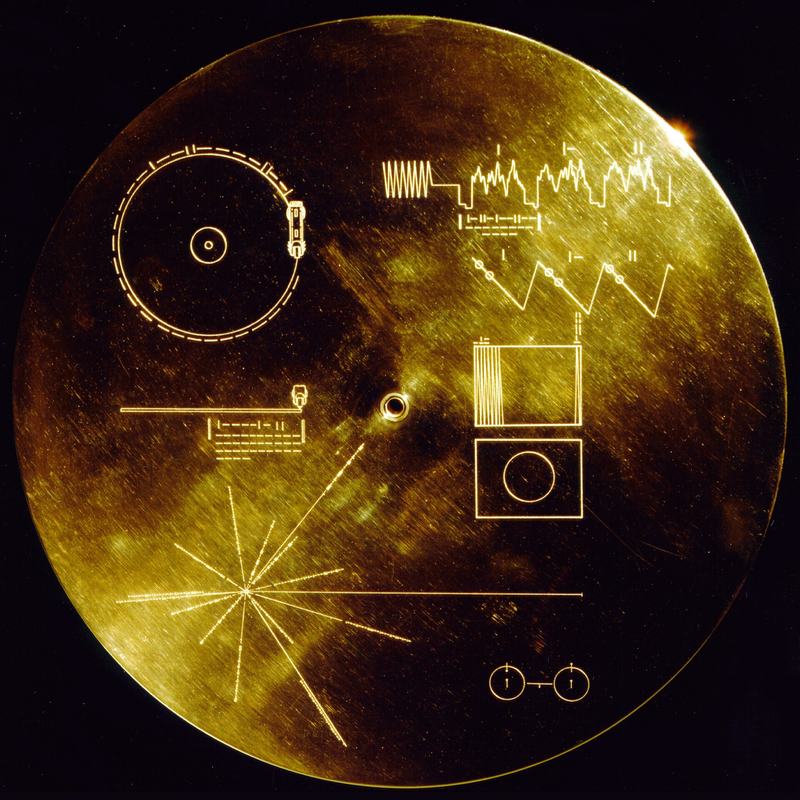
Bolted to Voyager 1's side is the Golden Record, a physical message meant to outlast the mission itself. Each disk is copper, 12 inches (30 cm) across, plated first in nickel and finished in gold, a combination chosen for durability across a timescale measured in eons rather than years.
Its aluminum cover carries an electroplated sample of ultra-pure uranium-238, a radioactive isotope whose steady decay works like a clock, letting any future finder work out roughly when the record was made. Not every song under consideration made the final cut: EMI, holder of the copyright, refused permission for the Beatles' 1969 track "Here Comes the Sun," so the record shipped without it.