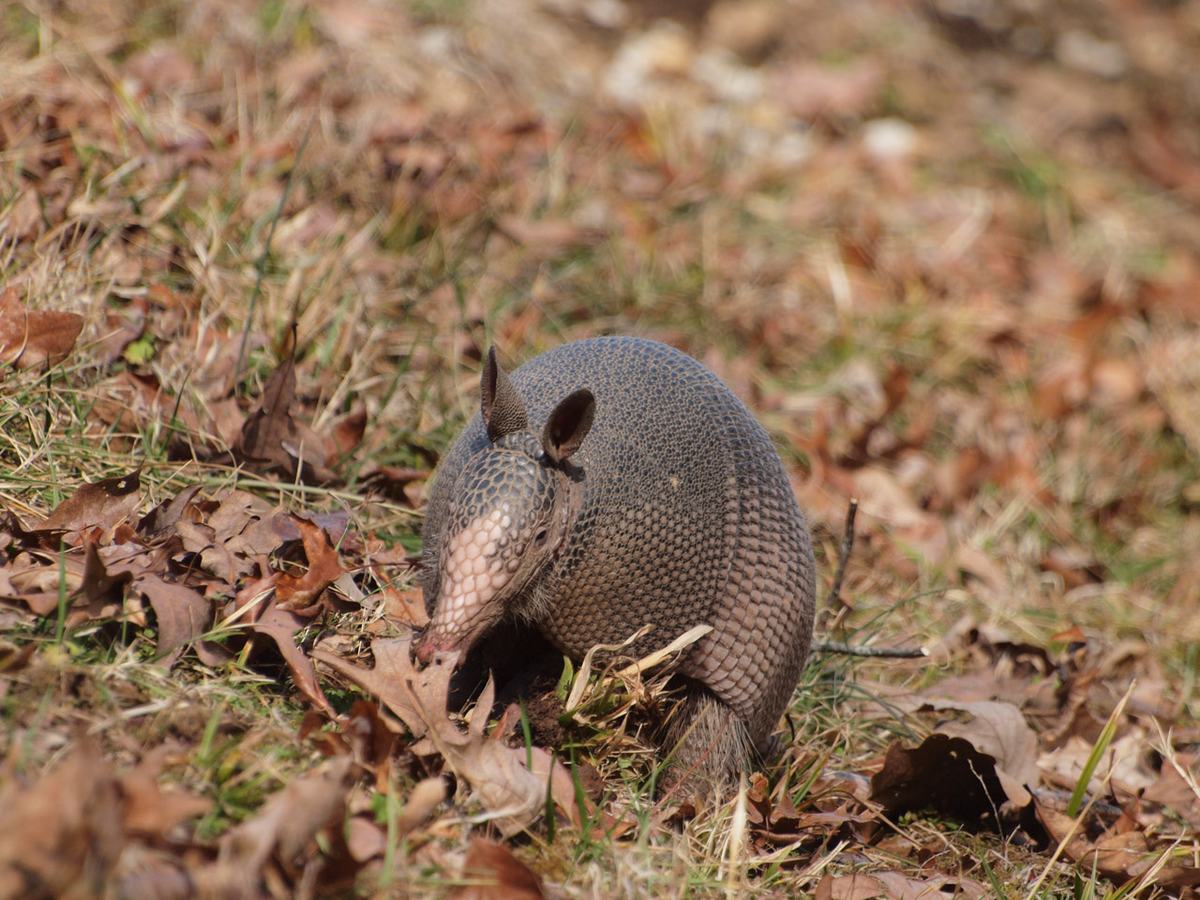
If you asked my Year 4 class to draw an armadillo, you would get something between a tank and a hedgehog wearing a suit of armour. They would not be far off. The name comes from Spanish and means "little armoured one", which is the sort of tidy honesty you rarely get from an animal's name [1]. There are around twenty species, and only one of them, the nine-banded armadillo, has made it as far north as the United States [1]. The rest keep to Central and South America, quietly getting on with it.
A Shell Made of Actual Bone
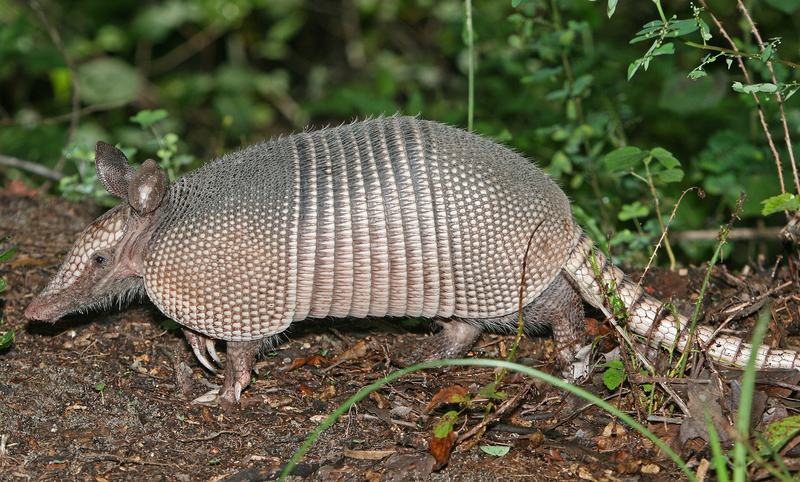
The armadillo's armour is not thick skin. It is bone. Small plates called osteoderms grow in the skin and are topped with a layer of keratin, the same stuff as your fingernails [5]. The plates are joined by flexible bands across the middle, which is where "nine-banded" comes from. So the animal is essentially wearing a bespoke roof. (My kids would love this.) It is light enough to run in and hard enough to shrug off a thorn bush.
Always Four, Always Identical
Here is the one that stops people mid-sip. The nine-banded armadillo almost always gives birth to four young, and all four are identical [3][2]. One egg is fertilised, then splits into four embryos, so the litter is a set of natural quadruplets sharing the same genes [3]. Same sex, same markings, every time. It is one of the only mammals that reproduces this way, which makes armadillos oddly useful to scientists who want four genetically matched test subjects at once.

The Leprosy Connection
Armadillos are one of very few animals besides humans known to carry the bacterium that causes leprosy, now called Hansen's disease [4]. The reason is temperature. Their body runs cool, around 34 degrees Celsius, which happens to be exactly what the bacterium likes [4]. Most human cases still have nothing to do with armadillos, but a handful in the southern United States have been linked to close contact [4]. The sensible advice, as it turns out, is simply not to handle wild ones.
Only One Kind Rolls Into a Ball
Everyone believes armadillos roll into a neat ball. Most of them cannot. Only the three-banded armadillo can tuck itself into a complete sphere, sealing head and tail together like a lunchbox snapping shut [6]. The nine-banded one, the famous American resident, simply cannot do it. Its shell has too many bands and too little give [6]. Faced with danger it runs, digs, or does something far less dignified, which brings us neatly to the next fact.
They Jump Straight Up When Startled
When an armadillo gets a fright, it leaps vertically into the air, sometimes three or four feet [1]. In the wild this startles a predator long enough to bolt. On a road at night it is a disaster, because the animal jumps up into the very bumper it might otherwise have passed safely beneath [1]. Nobody warned the armadillo about cars. It is a defence that worked brilliantly for a few million years and then met the pickup truck.

Crossing Water in Two Odd Ways
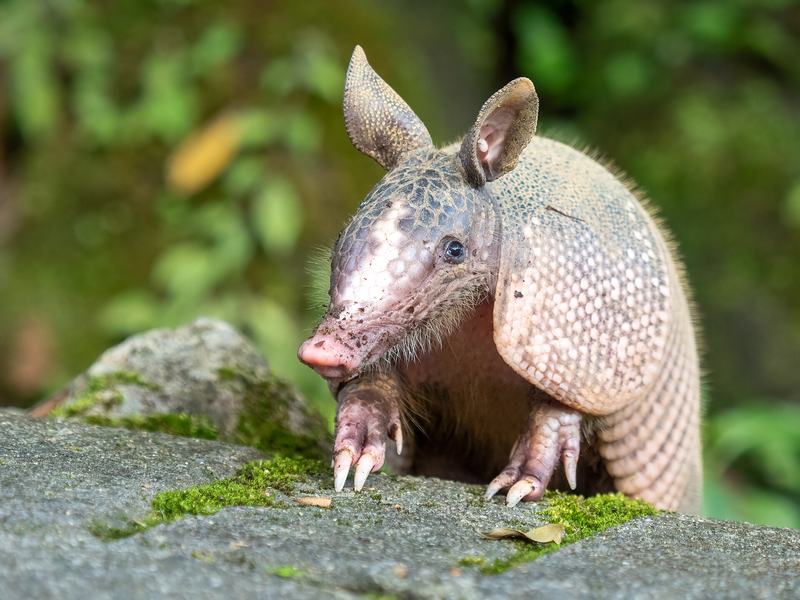
An armadillo weighs enough that you would expect it to sink, and sometimes it chooses to. It can hold its breath for up to six minutes and simply walk along the bottom of a stream [5]. For a wider river it does the opposite. It gulps air until its stomach and intestines inflate, giving it enough buoyancy to paddle across the top like a small leathery balloon [5]. Two solutions to one problem, both slightly absurd, both entirely effective.
Quietly Heading North
The nine-banded armadillo has been spreading steadily northward across the United States for over a century, well past Texas and into states that once seemed far too cold [1]. Milder winters and few natural predators have helped it settle in. Give it another few decades and it may turn up in places no field guide currently expects it. For a slow, short-legged digger, it covers ground with remarkable determination.
Ancient Cousins the Size of a Car
Armadillos are the small survivors of a much grander family. Their prehistoric relatives, the glyptodonts, were built on the same armoured plan but grew to the size of a small car, with a domed shell and sometimes a spiked, club-like tail [6]. They plodded across South America during the last Ice Age and died out only a few thousand years ago. Every armadillo trundling across a road today is, in effect, a pocket edition of a vanished giant.
Frequently Asked Questions
Do armadillos really have identical quadruplets?
Yes. The nine-banded armadillo almost always produces four young from a single fertilised egg that splits into four, so the babies are genetically identical. This trait is rare among mammals and makes the species valuable for medical research needing matched subjects.
Can you catch leprosy from an armadillo?
It is possible but uncommon. Nine-banded armadillos can carry the bacterium that causes Hansen's disease, and a small number of human cases in the southern United States have been linked to handling them. Avoiding contact with wild armadillos removes almost all of the risk.
Can armadillos roll into a ball?
Only the three-banded armadillo can curl into a complete, sealed ball. The more familiar nine-banded armadillo cannot, because its shell is too rigid across the bands. When threatened it usually runs or digs a burrow instead of rolling up.
What do armadillos eat?
Mostly insects. Armadillos use a strong sense of smell and powerful claws to dig up beetles, grubs, ants, and termites, along with the occasional worm or plant matter. Their eyesight is poor, so they rely heavily on smell to find food underground.
Sources
- Armadillos - National Geographic
- Nine-banded Armadillo - Smithsonian's National Zoo
- Why Do Armadillos Have Identical Quadruplets - Scientific American
- Hansen's Disease (Leprosy) Transmission - Centers for Disease Control and Prevention
- Armadillo - San Diego Zoo Wildlife Alliance
- Armadillo - Encyclopaedia Britannica