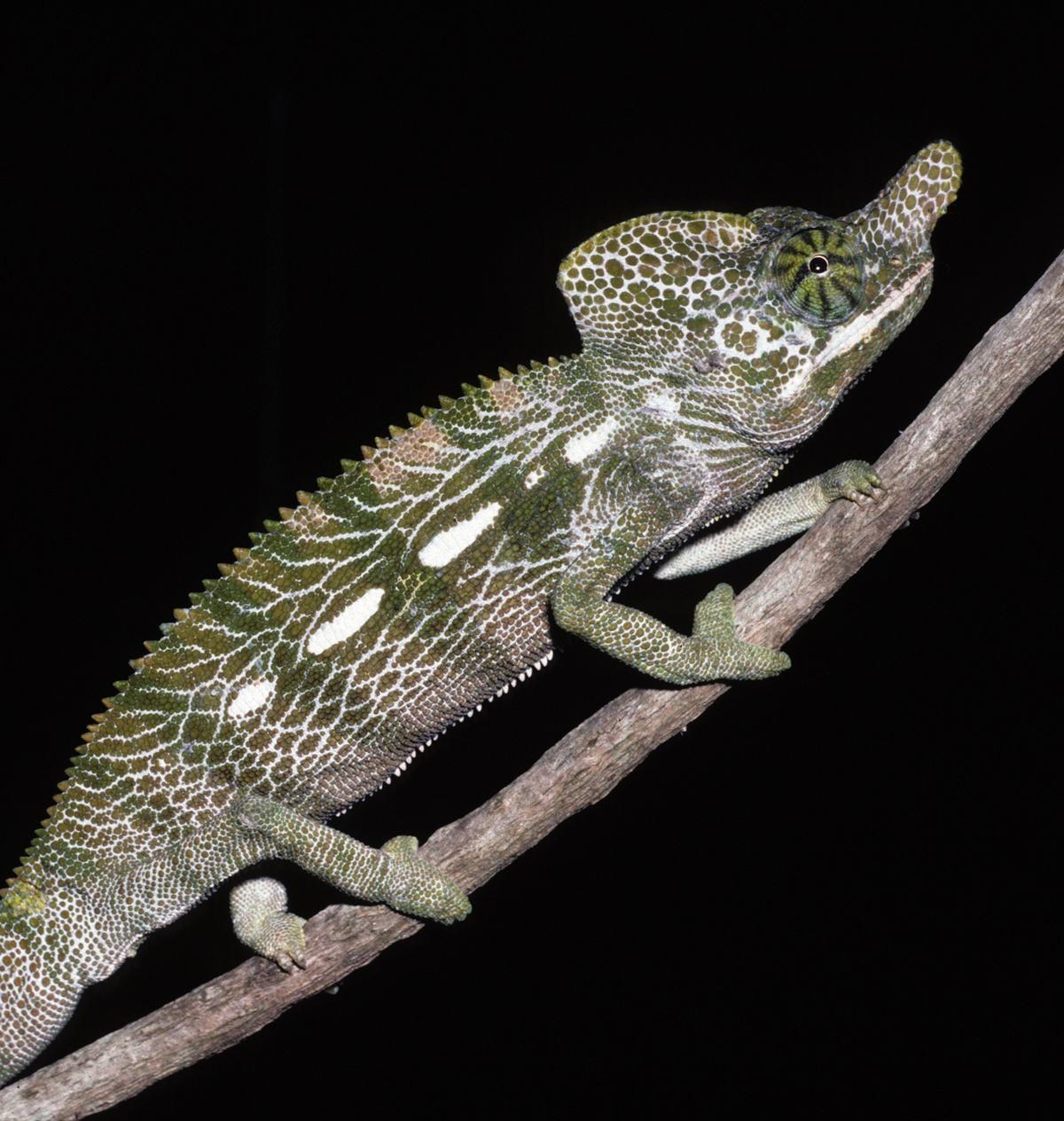
If you asked my Year 4 class why a chameleon changes colour, every hand would go up with the same answer: to hide. It is a lovely idea. It is also mostly wrong. Chameleons do change colour, constantly, but blending in is fairly low on the list of reasons. What follows is a small tour of one of the odder animals I have ever crouched in front of at a reptile house, notebook getting slowly damp.
Colour Is a Conversation
Here is the thing nobody told me at school. A chameleon's colour is closer to a mood ring than a camouflage suit. Males flare bright oranges and yellows to warn off rivals or impress a mate, then go dark and dull when they would rather be left alone [2]. They manage this without shuffling any pigment about. Instead they have a layer of skin cells packed with tiny crystals, and by stretching or relaxing that layer they change which colours of light bounce back [2][3]. (Yes, really.)
Eyes That Work Separately
A chameleon can look at you and its lunch at the same time. Each eye sits in a little cone of skin and swivels on its own, so one can watch a branch above while the other tracks a fly below [1]. Between them they cover very nearly the whole sphere around the animal, no head turning required. When the chameleon finally spots something worth eating, both eyes lock forward together to judge the distance. Then things happen quickly.

The Tongue Is a Slingshot
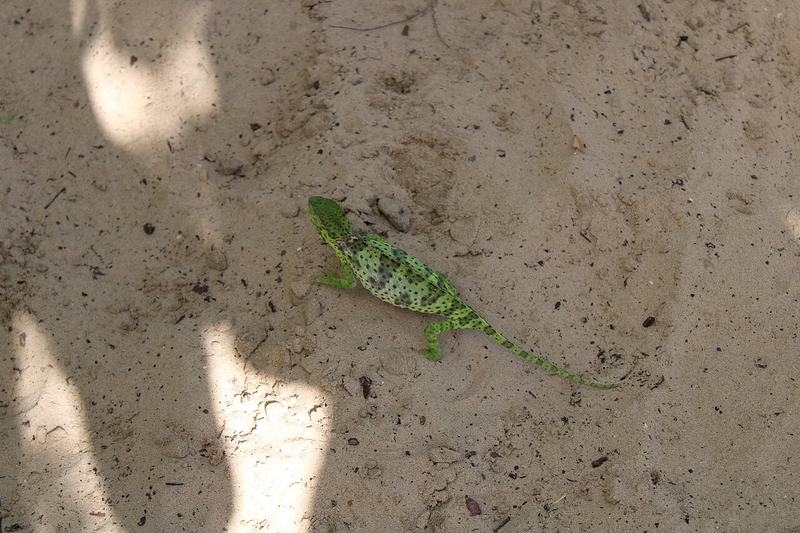
That last line was not a tease. A chameleon's tongue is a loaded spring, and it fires. In one study the little Rhampholeon spinosus shot its tongue out at a peak acceleration 264 times the force of gravity, reaching prey more than twice its own body length away [4]. Stranger still, the smallest chameleons have the fastest tongues [4]. A tiny one can out accelerate a sports car off the mark. My kids would love this, and duly did.
Feet Made for Branches
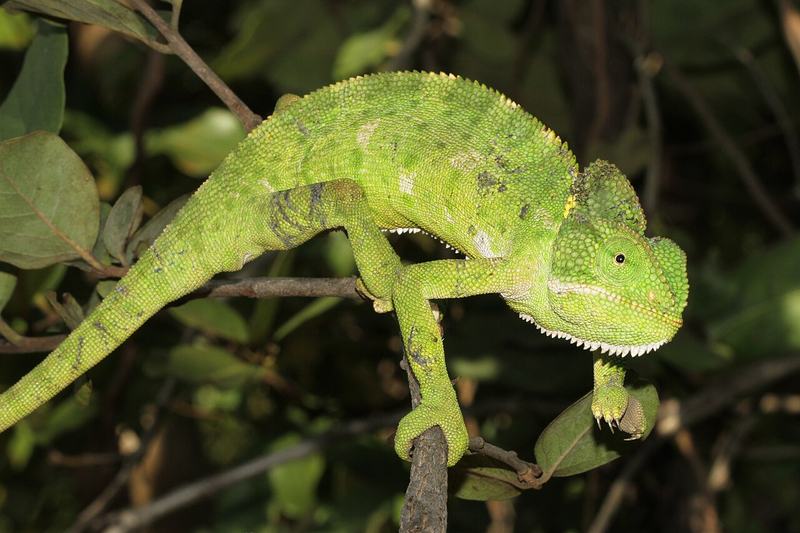
Chameleon feet look a bit like oven mitts. Each foot has five toes fused into two bundles, two on one side and three on the other, forming a natural pincer that grips a branch like a pair of tongs [1]. It makes them superb climbers and slightly comical walkers. On flat ground a chameleon rocks back and forth as it steps, as though the whole world were a branch swaying in a breeze. Which, fair enough.
.jpg)
The Tail Is a Fifth Limb
Most chameleons carry a long tail curled up like a party blower. It is prehensile, which means it can grip, and they use it as an extra hand while climbing, anchoring to one twig before reaching for the next [1]. Roll it out, roll it back. A resting chameleon often keeps its tail neatly coiled beneath it, like a spring nobody has got round to winding up yet.
Mostly a Madagascar Story
There are more than 150 species of chameleon, and roughly half of them live only on Madagascar [1]. The rest are scattered across sub-Saharan Africa, with a few reaching southern Europe, the Middle East and India [1]. Madagascar is the headquarters, though. If you want variety, from thumbnail sized leaf dwellers to lizards the length of your forearm, that island is where evolution did its showing off.
The Smallest Reptile Alive
In 2021 researchers working in northern Madagascar described Brookesia nana, the nano chameleon, which may be the smallest reptile on Earth [5]. The male's body is about 13.5 millimetres long, and from nose to tail he measures under 22 millimetres, roughly the size of a sunflower seed [5]. He sits comfortably on a fingertip. He hunts mites and springtails in the leaf litter, which is about the only prey small enough to bother with.
A Life Mostly Spent as an Egg
Labord's chameleon, from the dry south west of Madagascar, holds a genuinely strange record. Adults live only about four to five months, the shortest active lifespan known for any four limbed animal [6]. They hatch in November, grow fast, breed by February, and then the entire adult population dies off within weeks [6]. For most of the year the species exists only as eggs, waiting quietly in the ground. Nobody warned me about this one.
Frequently Asked Questions
Why do chameleons change colour?
Mainly to communicate and to manage temperature, not to hide. Colour signals mood and status to other chameleons, with bright shades showing excitement or aggression and dark shades showing stress. They shift colour by rearranging tiny crystals in a layer of their skin, which changes how light reflects rather than by moving pigment around.
Can chameleons really see in two directions at once?
Yes. Each eye moves independently, so a chameleon can watch two different things at the same time and see almost all the way around itself without turning its head. When it targets prey, both eyes swing forward together to judge distance before the tongue strikes.
How fast is a chameleon's tongue?
Very fast. The tongue can launch at a peak acceleration of around 264 times the force of gravity, and smaller species are quicker than larger ones. It can reach prey more than twice the animal's own body length away in a fraction of a second.
What is the smallest chameleon?
Brookesia nana, the nano chameleon from Madagascar, described in 2021. The male's body is about 13.5 millimetres long and just under 22 millimetres from nose to tail, making it possibly the smallest reptile ever recorded. It fits neatly on a human fingertip.
How long do chameleons live?
It varies widely by species. Many pet chameleons live around three to ten years, but Labord's chameleon in Madagascar survives only about four to five months as an active adult, the shortest known active lifespan of any four limbed vertebrate.
Sources
- Chameleon - Encyclopaedia Britannica
- Photonic crystals cause active colour change in chameleons - Nature Communications
- The chameleon reorganizes its nanocrystals to change colors - University of Geneva
- Tiniest chameleons deliver most powerful tongue-lashings - Brown University
- Extreme miniaturization of a new amniote vertebrate (Brookesia nana) - Scientific Reports
- Highly variable lifespan in an annual reptile, Labord's chameleon - Scientific Reports