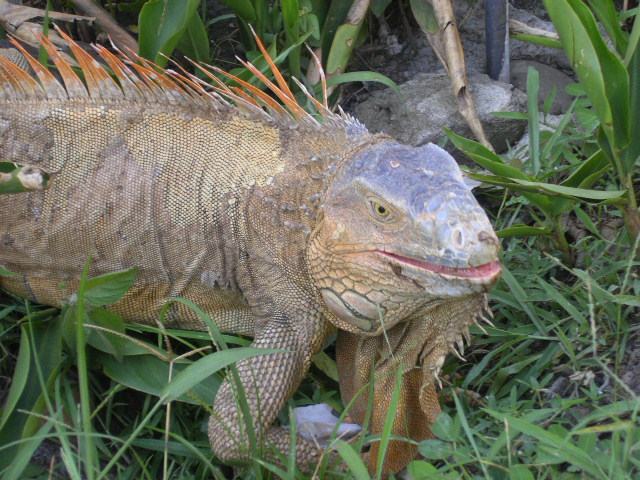
If you asked my Year 4 class to draw an iguana, they would give you a small green dragon and call it a day. Which, fair enough. But the real animal is odd in ways a drawing cannot capture. It has an eye on the top of its head, it sneezes salt, and it will happily leap out of a tree. Let us start with that extra eye.
The Third Eye On Top
Iguanas have a third eye. It sits on the top of the head, between the two normal ones, and looks like a pale, slightly cloudy scale [2]. It cannot see shapes or colour. What it can do is notice light and shadow, which is enough to spot a hawk dropping in from above [6]. It also feeds the brain information that helps set the animal's daily rhythm. A smoke alarm for the sky, more or less.
The Chin Flap Does The Talking
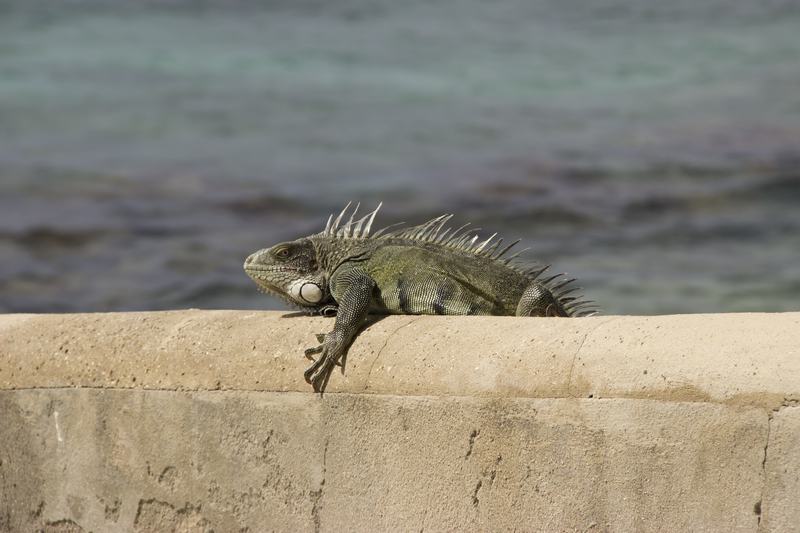
Under an iguana's chin hangs a loose flap of skin called a dewlap. It is not decoration. The iguana raises it to look bigger when something annoys it, waves it about to greet other iguanas, and uses it to soak up or shed a little heat [3]. Males have larger ones, which they bob up and down during the breeding season. A whole conversation, held with a flap of throat.
_(11717938903).jpg)
Surprisingly Good Swimmers
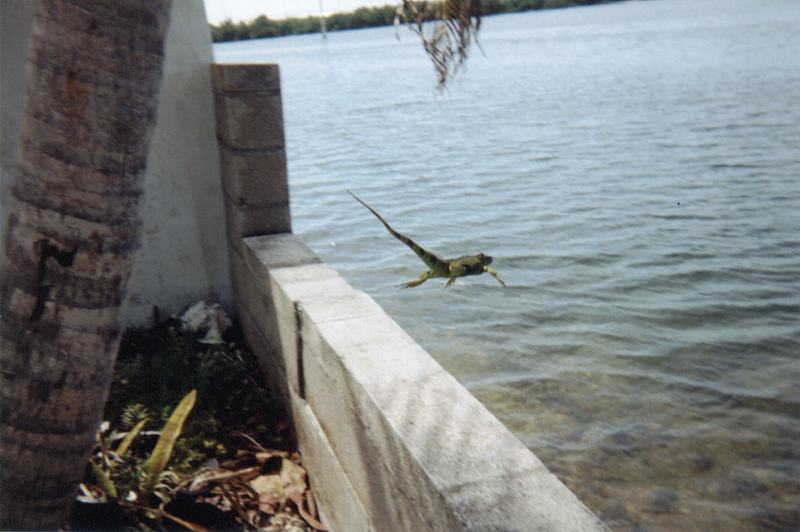
For a tree animal, iguanas are excellent in water. They tuck their legs against their sides and drive themselves along with the tail, steering like a very calm crocodile [3]. When a predator appears, an iguana in a branch above a river will simply let go and drop, sometimes from as high as 15 metres, landing in the water unhurt [5]. Falling is not an accident for them. It is a plan.

A Tail They Can Lose
If something grabs an iguana by the tail, the iguana would rather leave the tail behind than be caught. The tail breaks off at a weak point, wriggles for a moment to distract the attacker, and the iguana runs [1]. A young iguana grows most of it back, though the new one is usually a little shorter and a slightly different colour. My kids would love this. I am less sure their parents would.
Why Iguanas Fall From Trees In Florida
Iguanas are cold blooded, so when the air turns cold their muscles stop working. In Florida, where the animals are common, a cold snap can leave them stiff and unable to hold on. They drop out of the trees and lie on the ground as if dead [4]. They are usually not. Once the sun warms them, most get up and carry on. The local weather service now issues 'falling iguana' warnings, which is a real sentence.
Leaves, Flowers, And Little Else
Grown iguanas are almost strict vegetarians. They eat leaves, flowers, and fruit, and their gut is built to ferment all that greenery slowly [3]. Baby iguanas will take the odd insect, but the adults mostly do not bother [5]. This makes them one of the larger plant eating lizards around. All that bulk, built almost entirely out of salad.
They Sneeze Out Salt
A leafy diet brings in more salt and minerals than an iguana needs. Rather than deal with it all through the kidneys, iguanas have special salt glands near the nose that gather the excess and fire it out in a sneeze [5]. So a sneezing iguana is not poorly. It is doing its housekeeping. (The little crusty spots on a pet iguana's tank are the result.)
Not Actually A Florida Native
Despite the reputation, iguanas do not come from Florida. They are native to the tropical forests of Central and South America [5]. The Florida population began with escaped and released pets from the 1960s onwards, and the warm climate suited them nicely [4]. They are now treated as an invasive species there, which is a polite way of saying there are rather a lot of them.
Big Lizards, Long Lives
Green iguanas are larger than people expect. Nose to tail they can reach around 1.5 to 2 metres, most of that being tail, and a big male can weigh several kilograms [5]. Females lay large clutches, sometimes up to 70 eggs at once, then leave them to hatch on their own [5]. With luck and decent care, an iguana can live 10 to 20 years. Not bad for a garden dragon.
Frequently Asked Questions
Do iguanas really have three eyes?
Yes, in a sense. Iguanas have a parietal eye on top of the head, alongside their two normal eyes. It cannot form images or see colour, but it detects light, shadow, and movement, which helps warn of predators approaching from above and helps set the animal's daily rhythm.
Are green iguanas dangerous to people?
Not usually. Green iguanas are herbivores and prefer to flee rather than fight. A cornered iguana can bite, scratch, or swing its tail, and large ones are strong, so it is best to give wild ones space rather than try to handle them.
Why do iguanas fall out of trees when it is cold?
Iguanas are cold blooded and rely on warmth to move. When temperatures drop into single figures Celsius, their muscles seize up and they lose their grip. They fall and appear dead, but most recover once they warm back up in the sun.
What do iguanas eat?
Adult green iguanas are almost entirely herbivorous. They eat leaves, flowers, and fruit, with young ones occasionally taking small insects. Their digestive system is adapted to break down tough plant material, which is unusual for a lizard of their size.
How long do iguanas live?
Green iguanas typically live around 10 to 20 years. Lifespan depends heavily on conditions: well cared for pets and iguanas in good wild habitat reach the upper end, while many young iguanas do not survive their first year.