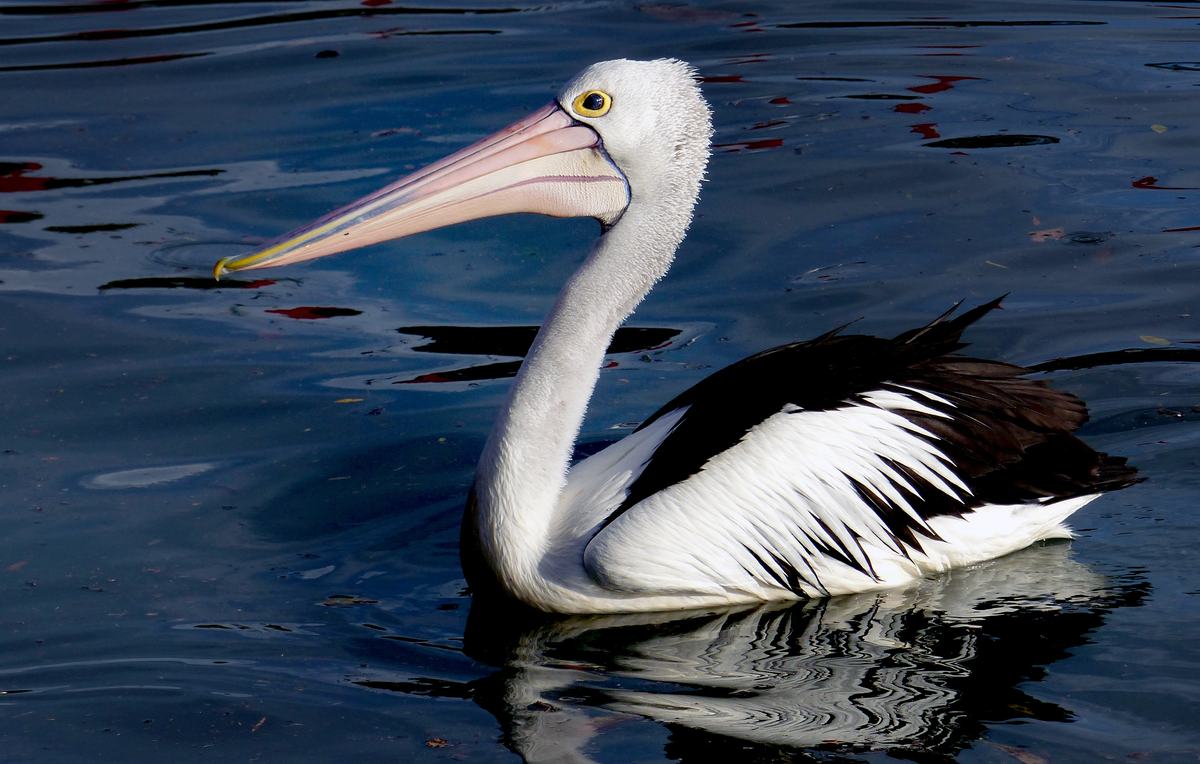
If you asked my Year 4 class to draw a pelican, you would get a seagull with a shopping bag stapled to its face. They are not entirely wrong. The pelican is one of those animals that looks like it was designed by someone who ran out of time and just made the mouth enormous. But every strange bit of it does a job, and some of those jobs are genuinely clever. Here is the pelican, told properly.
The Longest Bill in the World
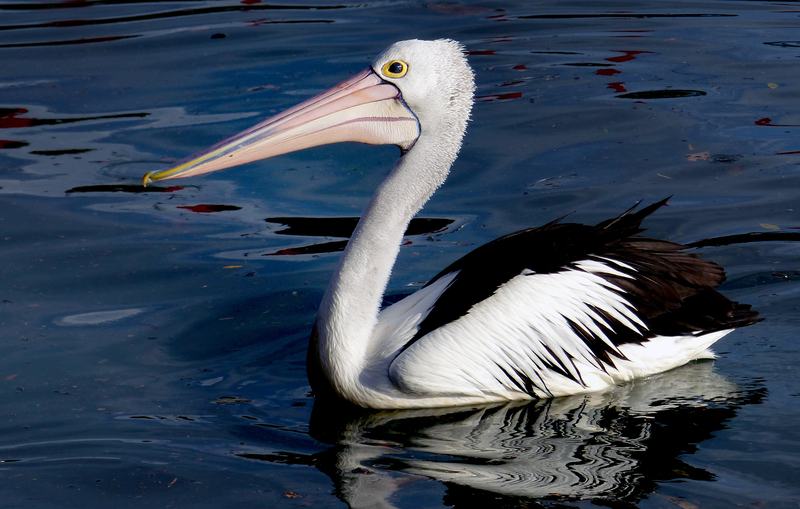
No bird on Earth carries a longer bill than the Australian pelican. A typical one measures around 34 to 47 centimetres, and the record holder came in at a full 50 centimetres, which is roughly the length of your arm from elbow to fingertip [1]. That is not a beak so much as a piece of gardening equipment. It is long, flat, and topped with a small hook, and the bird wears it about with complete unconcern. (My kids measured a ruler against their own arms for this one. Chaos.)
A Pouch, Not a Lunchbox
The stretchy pouch under the bill can hold about 11 to 13 litres of water, which is more than the pelican's own stomach can manage [2]. Here is the part people get wrong: the pouch is a net, not a lunchbox. A pelican scoops up a great mouthful of water and fish, then tips its head to drain the water out of the sides before swallowing. It does not carry fish around in there for later. It would if it could, I suspect. It simply can't.

Eight Species, One Silhouette
There are eight species of pelican, and they live on every continent except Antarctica [2]. They come in different sizes and colours, from the brown pelican of the Americas to the enormous Dalmatian pelican of Europe and Asia. But you would recognise any of them from across a lake. That heavy bill, that long neck folded back, that unbothered glide low over the water. Few birds have kept such a consistent look while spreading themselves quite so far across the map.
The Bird That Dive-Bombs the Sea
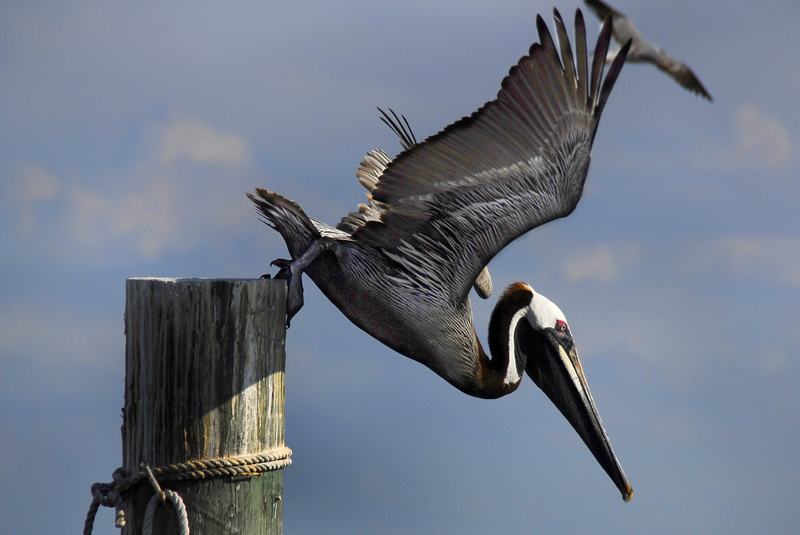
Most pelicans are polite about fishing. They swim along and scoop. The brown pelican and its close cousin the Peruvian pelican do something far more dramatic: they plunge-dive, folding their wings and dropping out of the sky like a thrown dart [3][4]. From several metres up, a bird the size of a small dog hits the water with a great white splash and comes up with breakfast. It is, frankly, showing off. And it works.
How They Survive the Landing
A dive like that ought to hurt. It doesn't, because the brown pelican is quietly armoured. Beneath the skin of its breast and belly sits a network of air sacs that act as cushions, softening the impact so the bird does not crack its own chest [3]. It also twists its body slightly to the left as it hits, which shields the windpipe and throat tucked down the right side of its neck [3]. Avian engineering, hidden under the feathers.

The Ones That Fish as a Team
The American white pelican never bothers with the dramatic dive. It is one of the largest birds in North America, with a wingspan that can reach about 2.7 metres, and it prefers teamwork [5]. A group of them will swim in a line or a horseshoe, beating the water with their wings to herd fish into the shallows, then scoop the whole lot up together [5]. It is less a hunt and more a well-organised committee. Which, fair enough. It clearly pays off.
A Face That Hasn't Changed in 30 Million Years
Here is the one that made me put my tea down. Palaeontologists found a fossil pelican beak in southern France, and it is around 30 million years old, and it is almost identical to a modern pelican's [6]. Thirty million years, and evolution looked at that ridiculous bill and decided it could not be improved [6]. The dinosaurs came and went. Mountains rose. The pelican kept exactly the same face throughout. And yet.
The Breeding-Season Bump
Come breeding season, the American white pelican grows a strange flat plate, sometimes called a horn or a nuptial tubercle, on the top of its bill [5]. Nobody is entirely sure what it signals, though it likely helps birds size one another up. The oddest part is what happens afterwards. Once the eggs are laid, the bird simply sheds the horn and carries on as though it never had one. A seasonal accessory, worn once and dropped.
Frequently Asked Questions
What do pelicans keep in their pouch?
Mostly water, and only for a moment. The pouch works as a net to scoop up fish along with a large gulp of water. The pelican then drains the water out before swallowing the fish. It does not store food in the pouch or use it to carry things.
Do all pelicans dive for fish?
No. Only the brown pelican and the Peruvian pelican plunge-dive from the air. The other six species, including the American white pelican, feed while swimming, scooping fish from at or near the surface, often working together in groups to herd their prey.
Which pelican has the longest bill?
The Australian pelican holds the record for the longest bill of any bird, typically 34 to 47 centimetres, with one measured at 50 centimetres. The bill is long, flat, and tipped with a small hook, and it is used to scoop up fish and drain water.
How big can a pelican get?
The American white pelican is among the largest birds in North America, with a wingspan of up to about 2.7 metres. Pelicans are heavy birds, but air sacs in their bones and beneath their skin keep them buoyant and help them fly and float with ease.
Sources
- Longest bills - Guinness World Records
- Pelicans - National Geographic
- How Brown Pelicans Dive After Fish Without Breaking Their Necks - Audubon
- Brown Pelican Overview - Cornell Lab of Ornithology
- American White Pelican - Audubon Field Guide
- The Earliest Known Pelican Reveals 30 Million Years of Evolutionary Stasis in Beak Morphology - Journal of Ornithology