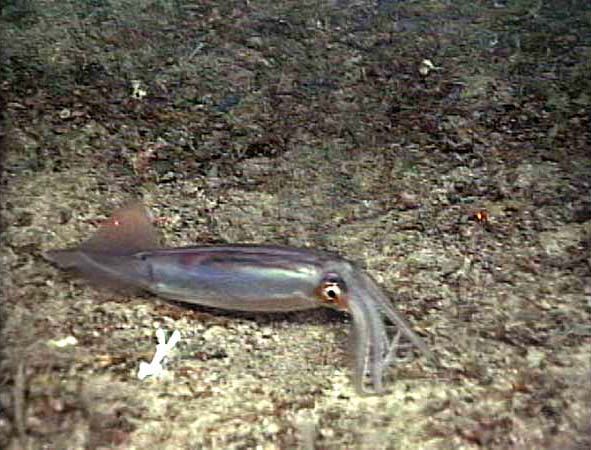
If you asked my Year 4 class to count a squid's arms, they would say eight, the same as an octopus, and say it rather smugly. They would be wrong. A squid has ten, and two of those are not really arms at all. That is the pattern with squids. You think you know what you are looking at, and then it does something faintly ridiculous. Here are a few of my favourites.
Ten Arms, and Two Are Cheating
A squid has eight arms and two longer tentacles, which is ten limbs in total [1]. The eight arms are the everyday ones, lined with suckers for gripping. The two tentacles are the specialists. They stay tucked away until dinner, then shoot out to grab prey, sometimes from as far as ten metres off, before hauling it back to the beak [1]. So the next time someone tells you a squid has eight arms, you may correct them. Gently.
Three Hearts and Blue Blood
A squid runs on three hearts, not one [1]. Two pump blood through the gills, and the third sends it round the rest of the body. Odder still, the blood is blue. Squids carry oxygen using copper rather than the iron in our own red blood, and copper turns the whole thing a rich blue [6]. It is a better system for cold, dark water with very little oxygen in it, which is exactly where most squids get on with their lives.
The Biggest Eyes on Earth
The giant squid has the largest eyes of any animal that has ever lived, each one about the size of a dinner plate and nearly a foot across [2]. There is a reason for all that glass. Down in the deep, those eyes can pick out the faint glow stirred up by a moving sperm whale from around 120 metres away [2]. When your main predator is the size of a lorry, seeing it coming early is the whole game.

As Long as a Bus
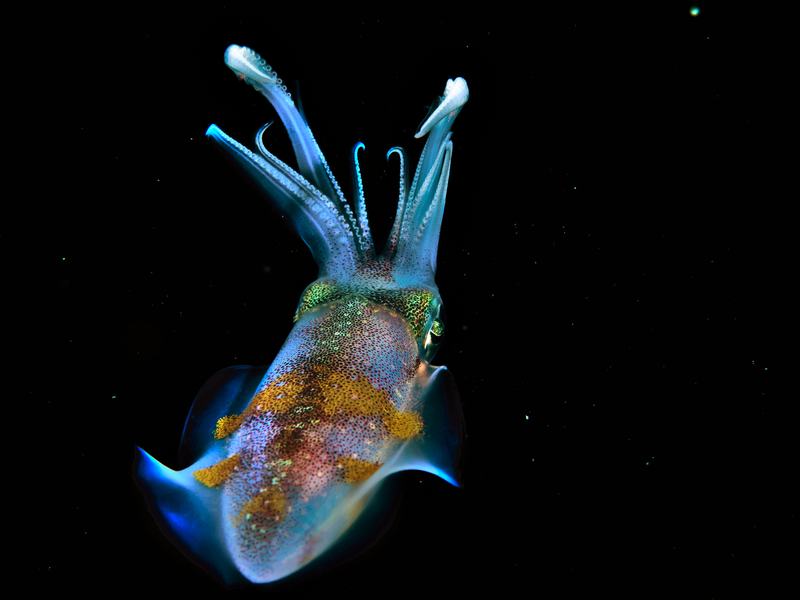
The largest giant squid on record measured almost 13 metres, close to 43 feet, which is roughly the length of a single-decker bus [1]. Most of that is tentacle rather than body, so the animal is less bulky than the number suggests. Nobody has ever weighed the very biggest, but a large female can pass a quarter of a tonne. For centuries sailors swore these things existed and were called liars. They were not.


They Swim by Jet, and Some Fly
Squids move by pulling water into the body and firing it out through a funnel, which shoots them backwards in a burst [1]. A few species take this rather too far. Japanese researchers watched shoals of oceanic squid launch clean out of the sea, spread their fins into wings, and glide for more than 30 metres [4]. In the air they hit 11.2 metres per second, which is faster than Usain Bolt at full sprint [4]. A flying squid. Nobody warned me about this.
A Nerve That Won a Nobel
Squids have the thickest nerve fibre of any animal, the giant axon, up to a millimetre across, which is enormous for a single nerve cell [3]. In the 1940s and 1950s two British scientists, Alan Hodgkin and Andrew Huxley, worked out how nerves fire electrical signals by poking a fine wire straight into this squid nerve [3]. That work earned them a Nobel Prize in 1963 [3]. Much of what we understand about our own brains, we owe to a squid.
A Squid That Glows to Vanish
The Hawaiian bobtail squid, a creature about the size of a thumb, hides by glowing [5]. It houses colonies of luminous bacteria in a special organ and shines a soft light downwards, tuned to match the moon and stars above [5]. This erases the dark shadow it would otherwise cast, so predators looking up see only more sky. Hiding by giving off light sounds backwards. As it turns out, in open water it works beautifully.
Short Lives, Sudden Ends
For all this talent, most squids barely get started. The majority live only one to two years, and many die shortly after breeding just once [1]. A female lays her eggs and, in a good number of species, that is the end of her. All that engineering, the ten limbs and the three hearts and the record-breaking eyes, and the whole life is over in a couple of seasons. And yet they have been doing this, brilliantly, for many millions of years.
Frequently Asked Questions
How many hearts does a squid have?
A squid has three hearts. Two of them pump blood through the gills to pick up oxygen, and the third pushes that blood around the rest of the body. This arrangement, shared with octopuses, suits life in cold, low-oxygen water where every bit of oxygen matters.
How long is a giant squid?
The largest giant squid ever recorded reached almost 13 metres, or close to 43 feet, about the length of a single-decker bus. Most of that length is the pair of long feeding tentacles rather than the body, so the animal is slimmer and lighter than the figure first suggests.
Do squids have bones?
No, squids have no true skeleton. Their only firm parts are a hard beak for feeding and a stiff internal strip called the pen, or gladius, which supports the body like a flexible backbone. Everything else is muscle, which is why a squid can change shape so easily.
Are squids intelligent?
Squids are among the cleverest invertebrates. They have large, complex brains, learn quickly, and communicate by rippling colours across their skin. Their close relatives the octopuses solve puzzles and use tools, and squids show similar quick problem-solving, unusual for animals with such short lifespans.
Sources
- How Big is the Giant Squid? - Smithsonian Ocean
- The Largest Eye in the World, Giant Squid - Smithsonian Ocean
- Alan Hodgkin, Andrew Huxley, Equations, and Prizes - Marine Biological Laboratory
- Squid Can Fly? Flight Behavior of the Squid Explained for the First Time - Hokkaido University
- A Lasting Symbiosis: How the Hawaiian Bobtail Squid Finds and Keeps Its Bioluminescent Bacterial Partner - National Center for Biotechnology Information
- All You Need to Know About the Giant Squid - Ocean Conservancy