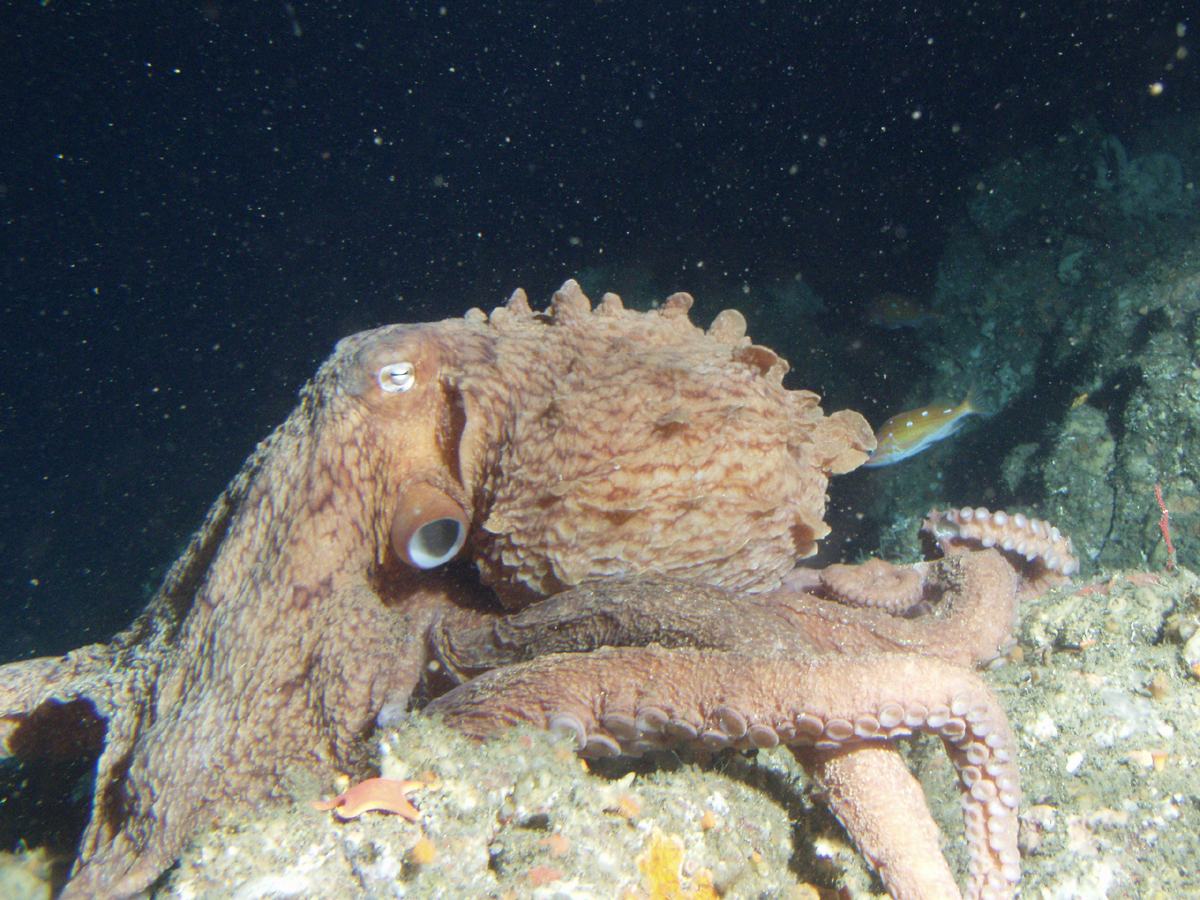
Octopuses have three hearts. Which sounds excessive, until you learn that one of them keeps switching off. When I told my Year 4 class this, one boy asked if that meant an octopus could have three heart attacks. A fair question, and one I could not answer. What I can tell you is that almost nothing about an octopus works the way you would expect, and that is precisely the fun of it.
Three Hearts, One Lazy Habit
An octopus has three hearts, and they do not share the workload evenly [1]. Two smaller hearts, called branchial hearts, pump blood through the gills. The third and largest, the systemic heart, then sends that oxygen-rich blood around the body [1]. Here is the odd part. When an octopus jet-swims, the systemic heart stops beating [2]. Swimming tires them out, so most octopuses would rather crawl. A creature with three hearts that still prefers to walk. Which, fair enough.
Blue Blood, Copper Not Iron
Our blood is red because it carries oxygen using iron, in a molecule called haemoglobin. Octopus blood is blue because it uses copper instead, in a molecule called haemocyanin [2]. This is not merely a fashion choice. Copper-based blood moves oxygen more efficiently in cold water with very little oxygen in it, which is exactly where a lot of octopuses live [1]. So the blue is practical. It just happens to look magnificent when it leaks out, a bit like something from a science fiction film.
A Brain in Every Arm
Octopuses have around 500 million neurons, which is roughly the count of a dog [3]. The surprise is where they keep them. Only about a third sit in the central brain. The other two thirds are spread down the eight arms, around 40 million per arm [3]. Each arm can feel, taste, and decide more or less on its own, without checking in with head office. So an octopus does not really have one brain. It has nine, and eight of them are busy arguing.

They Taste by Touching
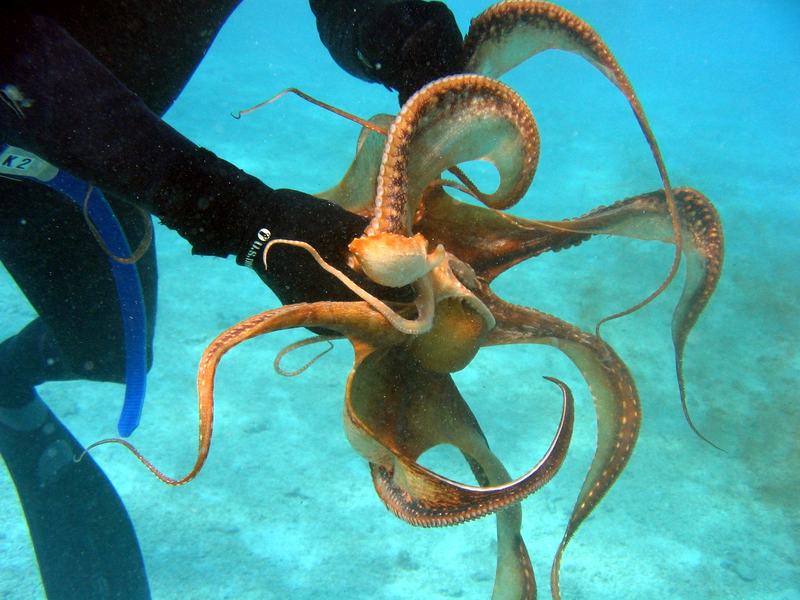
Each arm is lined with hundreds of suckers, and every sucker is packed with chemical sensors [2]. This means an octopus tastes whatever it touches. Reach into a crevice, and the arm can tell a crab from a rock before the animal has seen either. It is a strange way to experience the world. Imagine identifying your lunch entirely by pressing your fingers to it in the dark. Somehow, they manage this all day, and rather well.
Colour-Blind but Master of Disguise
Octopuses are almost certainly colour-blind. Their eyes have only one type of light-detecting cell, so in theory they see the world in grey [4]. And yet they change colour to match a reef in under a second, matching hues they supposedly cannot see. Scientists have found light-sensitive proteins in octopus skin, which suggests the skin itself may sense light [4]. So an octopus might, in a manner of speaking, see with its whole body. Nobody warned me about this.
Only One Hard Part
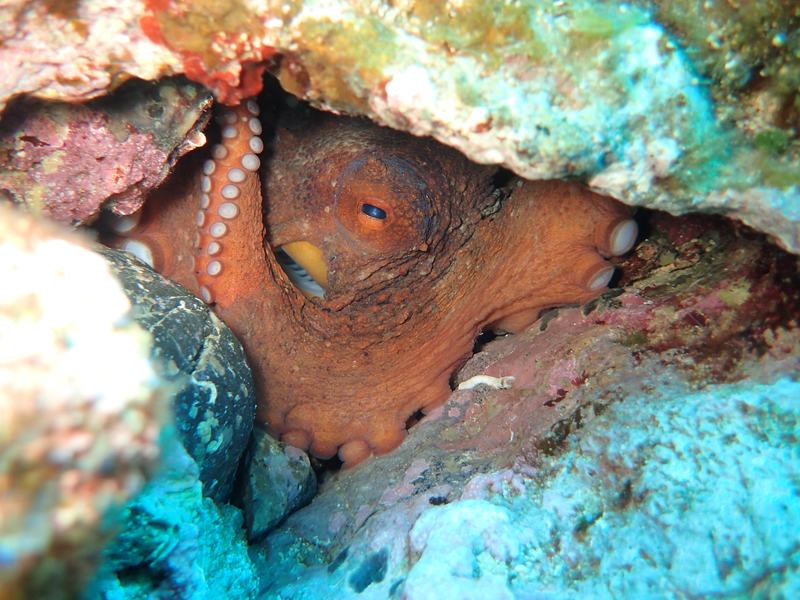
An octopus has no bones. The only hard part of its body is its beak, which sits where the arms meet and looks a little like a parrot's [5]. Because everything else is soft, an octopus can squeeze through any gap larger than that beak [2]. A large octopus can pour itself through a hole the size of a coin. This is why aquariums have such trouble keeping them in. One famous octopus named Inky escaped a New Zealand aquarium through a drainpipe and made it back to the sea [5].

Clever Enough to Cause Trouble
Octopuses are properly clever. In laboratories they open jars to reach food, solve mazes, and seem to recognise individual keepers, sometimes squirting the ones they dislike [3]. The veined octopus collects discarded coconut shells and carries them across the seabed to build a shelter later, which counts as tool use [5]. That is rare thinking for an animal with no skeleton and a very short life. My kids would love this, mostly for the squirting.
Short, Dramatic Lives
For all their talent, octopuses do not stick around. Most species live only one to two years, and even the enormous giant Pacific octopus rarely passes three to five [6]. The ending is bleaker still. A female lays her eggs, guards them without eating, and dies around the time they hatch [6]. She spends her last months protecting young she will never meet. All that intelligence, and so little time to use it. And yet.
Frequently Asked Questions
Why do octopuses have three hearts?
Two branchial hearts pump blood through the gills to pick up oxygen, and one larger systemic heart pumps that blood around the body. The split system helps octopuses push their thick, copper-based blood through the gills efficiently, which matters in the cold, low-oxygen water many of them live in.
Are octopuses really intelligent?
Yes. Octopuses solve mazes, open jars, use tools such as coconut shells for shelter, and appear to recognise individual people. With around 500 million neurons, most of them in the arms, they show problem-solving abilities unusual for an invertebrate and unmatched by most other molluscs.
How long do octopuses live?
Most octopuses live only one to two years, and the giant Pacific octopus reaches about three to five. Females stop eating while guarding their eggs and die soon after the eggs hatch, which keeps almost all octopus lifespans very short.
Can an octopus really fit through tiny gaps?
Yes. An octopus has no bones, and its only hard part is its beak. It can squeeze through any opening larger than that beak, so a sizeable octopus can pass through a hole the width of a coin. This is why they so often escape aquarium tanks.