In December 1689, a French Jesuit named Jean Richaud was tracking a comet from his post in Puducherry, on the southeast coast of India, when he noticed something odd: two points of light so close together that they seemed to be circling each other. That casual observation made Alpha Centauri only the third star pair ever confirmed to be a true binary, after Mizar AB and Acrux.
Three centuries later, the system Richaud stumbled onto turns out to be even stranger than he could have known. What looks like a single bright star to the naked eye is really three stars bundled together, sitting 4.36 light-years from Earth in the southern constellation Centaurus. Two of them, cataloged as A and B, are bright enough to pick out with nothing more than your own eyes; a third, dimmer member, Proxima Centauri, actually holds the title of the Sun's closest neighbor, at 4.2465 light-years away.
Between a pair of sun-like stars, a small and short-tempered red dwarf, and at least one planet sitting in a temperate orbit, this one patch of sky packs in enough separate stories to fill an evening.
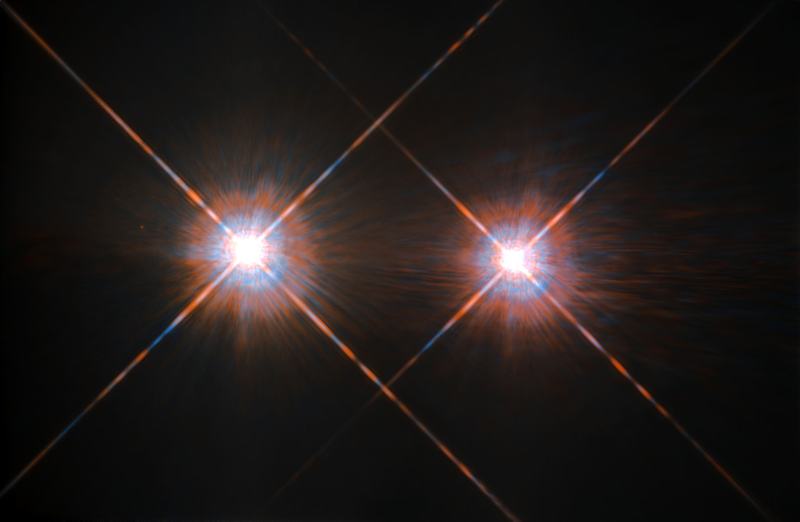

A Pair of Suns, Bound for 80 Years
Alpha Centauri A and B circle a shared center of gravity once every 80 years, almost to the day. During that long lap, the gap between them is never fixed: their shared path is stretched into an ellipse rather than a circle, so the distance between the two stars swings between 35.6 astronomical units — about how far Pluto sits from the Sun — and 11.2 astronomical units, roughly Saturn's distance.
The pair circle each other roughly 3,600 million kilometers apart, somewhat more than the distance between Uranus and the Sun. Because the orbit keeps stretching and compressing on an 80-year cycle, anyone tracking the pair through a telescope today is watching a genuinely different configuration than an observer from Richaud's era would have seen.
Sizing Up Two Stars From Trillions of Kilometers Away
Alpha Centauri A and B are close cousins of the Sun, which makes them a useful yardstick for testing how well astronomers actually understand stellar physics. Careful measurements have pinned down the radius of star A at 854,000 kilometers and star B at 602,000 kilometers — 1.227 and 0.865 times the radius of the Sun, respectively.
That level of precision, for two objects over 41 million million kilometers away, only works because A and B are so close to a solar twin: any mismatch between the measured sizes and a model's predictions exposes gaps in the same physics used to describe stars, including our own, far more broadly.

The Faint Third Star Nobody Notices
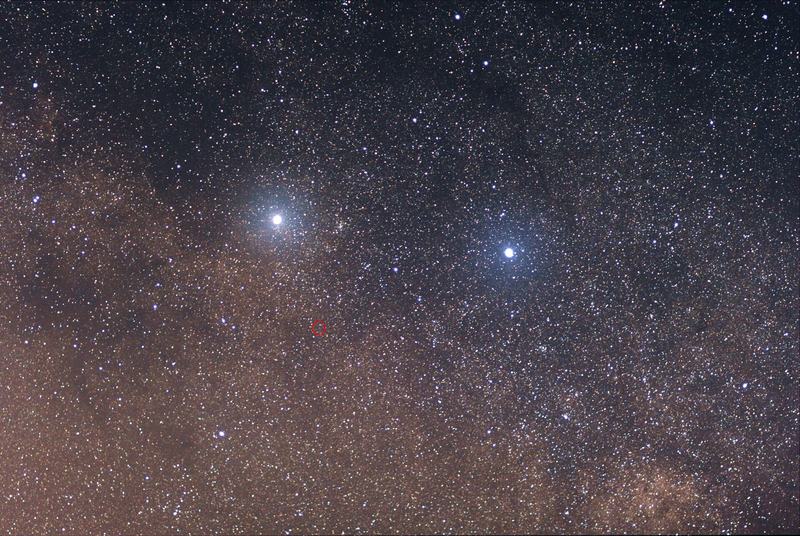
Proxima Centauri is faint enough that it was missed entirely until long after A and B were catalogued, yet it sits at the edge of the same gravitational neighborhood. The gap between Proxima and the AB pair runs to about 13,000 astronomical units, equal to roughly 430 times the radius of Neptune's orbit around the Sun.
Seen another way, Proxima sits roughly 1.5 million million kilometers closer to us than its brighter siblings do, and completing one loop around them could take on the order of millions of years — assuming gravity binds it to the pair at all. A star that far out, moving that slowly, is a reminder that "system" can mean a very loose association indeed.
A Small Star With a Short Fuse
Proxima Centauri runs remarkably cool for a star: its surface glows at only about 3,050 kelvin, and it gives off just 0.15 percent of the Sun's total light output. Physically, it measures about 14 percent of the Sun's radius and carries roughly 12 percent of the Sun's mass. Yet what it lacks in size, it makes up for in temper.
In August 2015, Proxima produced its largest recorded flare, briefly flaring to 8.3 times its normal brightness on the 13th of that month. A star that dim in ordinary light can still unleash bursts of radiation intense enough to matter for anything orbiting nearby — which, as it turns out, something is.

A Temperate World a Few Million Kilometers Out
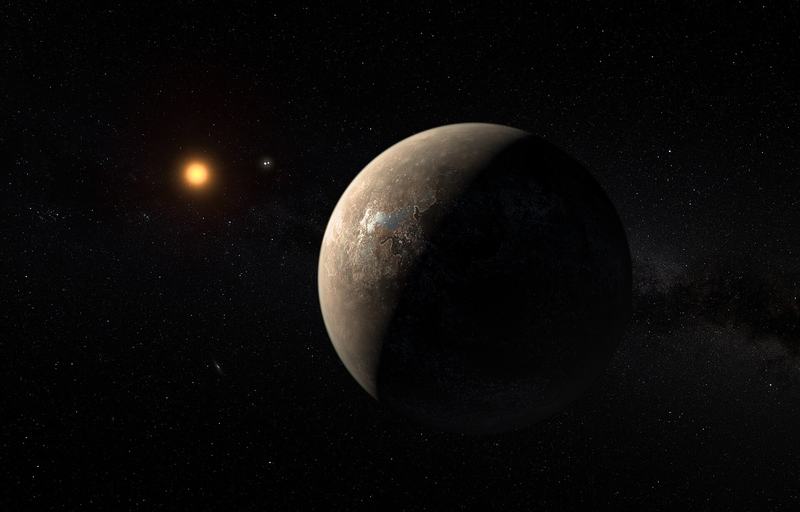
Despite Proxima's outbursts, one of its planets sits in a genuinely interesting spot. Astronomers have found a small world here, likely no lighter than 1.3 Earth masses, tucked into an 11.2-day lap around Proxima at just 0.05 astronomical units — closer to its star than Mercury is to the Sun, though tenable given how weakly Proxima shines.
That tight orbit puts the planet's equilibrium temperature in the range where liquid water could exist on its surface. It is close enough to catch every one of Proxima's flares, but it is also the nearest known planet outside our Solar System that sits anywhere close to habitable conditions.
A Second Planet, Still Waiting to Be Confirmed
Researchers have also picked up a tentative signal suggesting a second world, provisionally called Proxima c, on a much wider, roughly 1,900-day orbit some 1.5 times farther from Proxima than Earth is from the Sun. Unlike its temperate sibling, this candidate would likely be a frigid and inhospitable place.
The evidence comes from a wobble in Proxima's position of just over a meter per second, a signal that looked borderline in early data before more years of measurements pushed it toward firmer ground. If it holds up, the candidate would belong to a class of planet — the super-Earth — that is the most common known type in the Milky Way, yet is completely missing from our own Solar System.
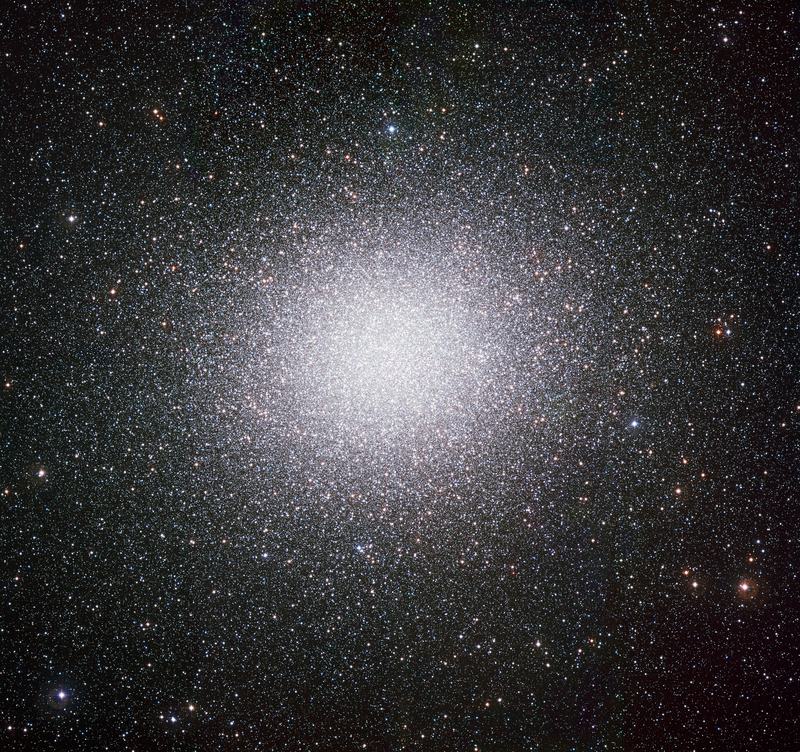

Sharing a Constellation With a Giant Cluster
Alpha Centauri shares its home constellation, Centaurus, with an object that has nothing to do with the star system itself but easily outshines it in sheer scale: Omega Centauri. It is the brightest globular cluster visible from Earth and the largest yet identified anywhere in the Milky Way, and some researchers suspect it is actually the stripped-down core of a dwarf galaxy that our galaxy long ago absorbed.
It is a useful reminder that a constellation is just a shared direction in the sky, not a shared origin — Alpha Centauri's three stars and Omega Centauri's many hundreds of thousands have nothing to do with each other beyond appearing in the same patch of southern night.