No other planet beyond our solar system sits closer to Earth than Proxima Centauri b, roughly 4.2 light-years, or 1.3 parsecs, away. That sounds close only on a cosmic scale: even Voyager 2, the fastest spacecraft humans have ever built, would need about 75,000 years to cover the distance.
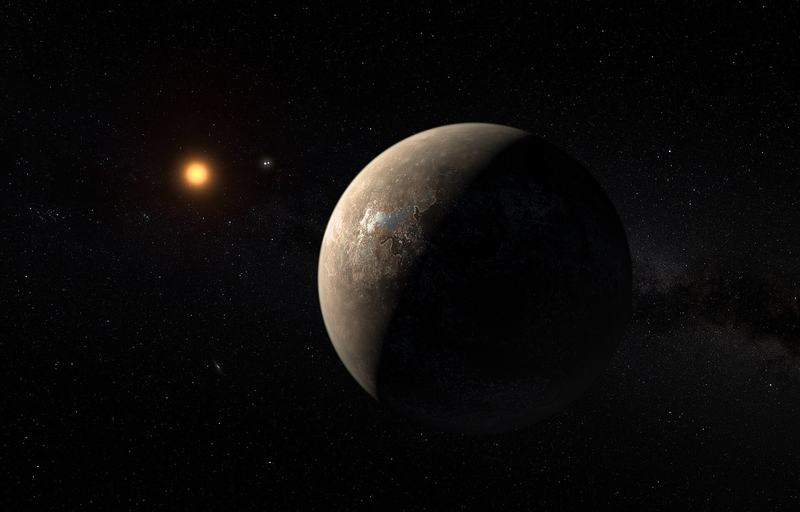
Confirmed by the European Southern Observatory in 2016, the planet orbits a small red dwarf star and has become one of the most studied worlds beyond our own. Its proximity makes it a natural laboratory for questions astronomers cannot yet answer anywhere else: can a planet hugging a dim, temperamental star still be a place worth visiting?

A Year That Lasts Just 11.2 Days
Proxima Centauri b circles its star every 11.2 days at a distance of only about 0.05 AU, a twentieth of the gap between Earth and the Sun, and carries a mass estimated at a minimum of roughly 1.3 times Earth's. Such a tight orbit sounds extreme, but it fits the star it orbits: Proxima Centauri itself has an effective temperature of only about 3,050 kelvin, a luminosity just 0.15 percent of the Sun's, a radius 14 percent of the Sun's, and a mass about 12 percent of the Sun's mass.
Because the star radiates so feebly, a planet has to sit close just to catch enough warmth. That tight embrace is exactly what put Proxima Centauri b into the conversation about habitability in the first place.
Enough Warmth for Liquid Water — Maybe
The planet's equilibrium temperature falls within the range where liquid water could exist on its surface, which is why its discovery made headlines well beyond astronomy circles. Researchers cannot rule out that water survives there, but if it does, it is unlikely to cover the whole planet.
Models suggest any liquid water would be confined to the sunniest regions: either the hemisphere that permanently faces the star, if the planet's rotation is locked to match its orbit, or a narrower tropical belt, if it instead settles into a 3:2 spin-orbit resonance like Mercury does around the Sun. Either way, "habitable" here would mean a slice of the planet, not the whole surface.
A Temperamental, Magnetic Neighbor
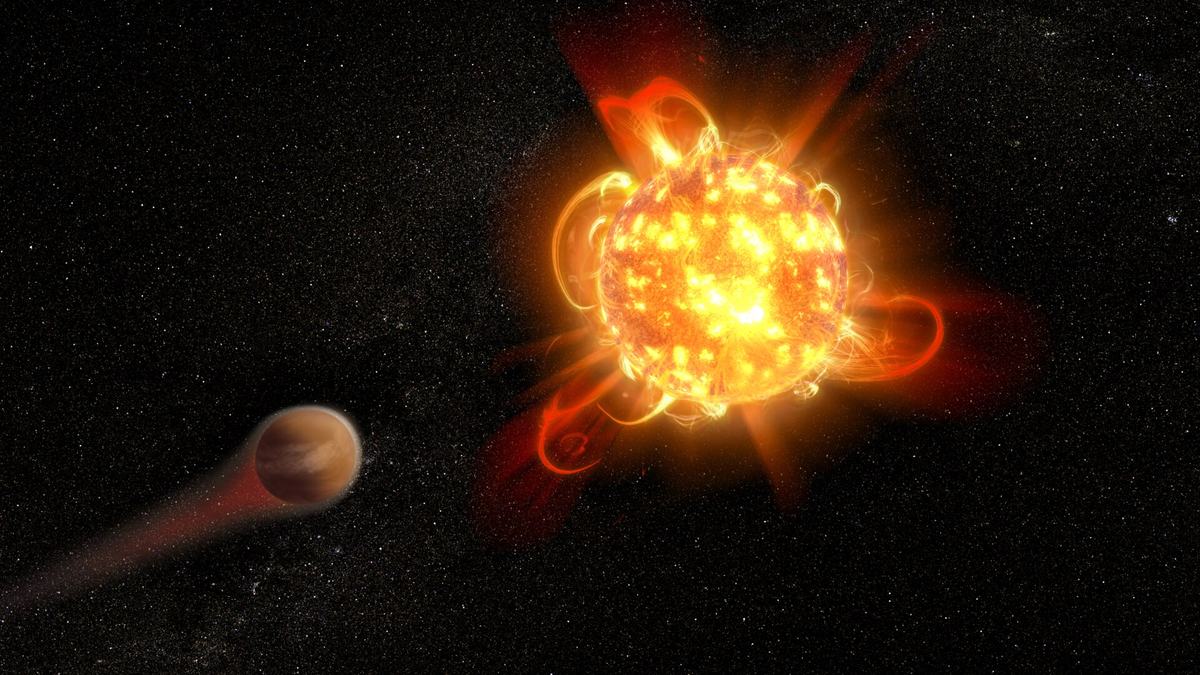
Proxima Centauri is a flare star, and not a mild one: its luminosity can swing by a factor of 100 within just a few hours, even though its average output is a tiny fraction of the Sun's. Any planet parked this close to such a volatile star has to contend with far more than a warm glow.
The star's magnetic field adds to the picture — it is considerably stronger than the Sun's, with an intensity of roughly 600 gauss that rises and falls over a seven-year cycle. A study published in May 2026 found evidence of magnetic interaction between the star and both of its known planets, Proxima Centauri b and Proxima Centauri d, suggesting the planets likely carry magnetic fields of their own. A magnetic field of that kind could matter enormously, since it is the kind of shield that might help a close-orbiting planet hold onto an atmosphere despite its star's outbursts.

Bathed in a Perpetual Red Glow
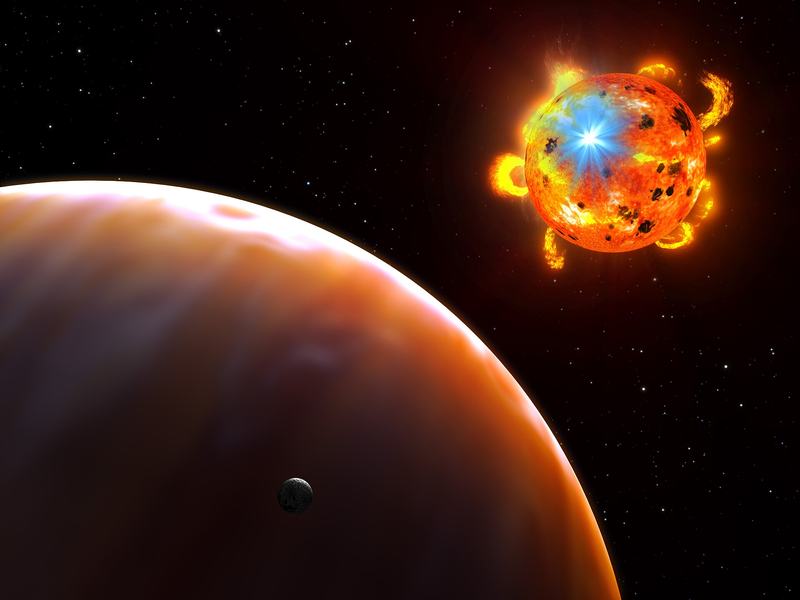
Because Proxima Centauri is a red dwarf, any observer standing on the planet would see its sky bathed in a pale red glow rather than the white daylight familiar from Earth. It is a small detail, but it captures how alien the experience of "daylight" would be on a world orbiting a star so different from the Sun.
How Astronomers Finally Found It
Hints of a planet around Proxima Centauri surfaced years before confirmation. Earlier searches around the star had already picked up on subtle anomalies, but the decisive evidence came together during the first half of 2016, when astronomers watched Proxima Centauri with the HARPS spectrograph, mounted on ESO's 3.6-metre instrument near La Silla, Chile, while other telescopes tracked the star simultaneously.
The lead researcher, Guillem Anglada-Escude, later described watching the signal firm up day by day: the initial results looked promising, the picture grew more consistent as the campaign continued, and by around a month in, the case felt settled enough to start writing up the discovery. ESO announced the confirmation of Proxima Centauri b on 24 August 2016, the culmination of multiple years of Doppler-spectroscopy monitoring of its host star. Fittingly, Proxima Centauri itself is the faintest of the three stars making up the Alpha Centauri system, a neighborhood that had already drawn astronomers' attention for over a century.


Not the Only Planet Next Door
Proxima Centauri b is not alone. A follow-up analysis of HARPS data not only recovered the original Proxima b signal cleanly but also turned up a lower-confidence detection of a second, confirmed planet, Proxima d, on a five-day orbit. The same analysis argued against a third candidate, Proxima c, which had been proposed on a roughly 1,900-day orbit — a reminder that confirming planets around even the nearest stars is a slow, contested process rather than a single clean announcement.
The Nearest Possible Interstellar Destination
Proxima Centauri b sits in the destination system of Breakthrough Starshot, a research and engineering project that aimed to send a fleet of light-sail probes called Starchips on the 4.34-light-year journey to the Alpha Centauri system. Traveling at 15 to 20 percent of the speed of light, the probes were designed to cross that distance in 20 to 30 years, plus roughly 4 more years for a radio signal to make its way back to Earth.
Compare that to Voyager 2's 75,000-year crawl toward the same neighborhood, and the ambition behind Starshot comes into focus: a fast probe could, in principle, reach and report back from Proxima Centauri within a single human lifetime.
Why the Neighborhood Matters
The durability of red dwarfs like Proxima Centauri is part of what keeps scientists interested in planets like this one. On Earth, intelligent life needed roughly 4.5 billion years to emerge, and habitable conditions here are expected to last only another 1 to 2.3 billion years. A dim, long-burning star gives a planet far more time to work with — one more reason Proxima Centauri b keeps drawing attention as the nearest test case for what a world around such a star might actually be like.
Sources
- Anglada-Escude et al., A terrestrial planet candidate in a temperate orbit around Proxima Centauri, Nature
- Artigau et al., Line-by-line velocity measurements, an outlier-resistant method for precision velocimetry, arXiv
- ESO: Planet Found in Habitable Zone Around Nearest Star
- ESO: VLT to Search for Planets in Alpha Centauri System
- Wikipedia: Proxima Centauri b
- Wikipedia: Breakthrough Starshot
- Wikipedia: Habitability of red dwarf systems