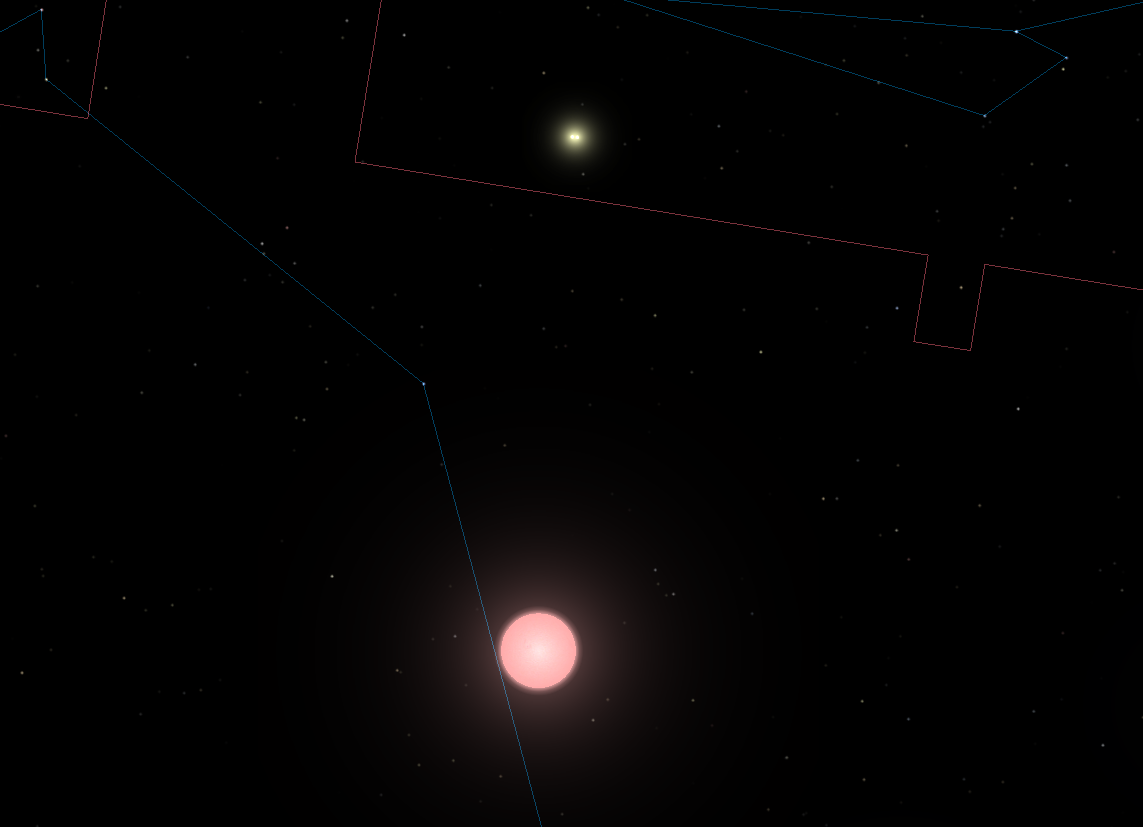
Proxima Centauri holds a strange double record: it is the nearest star to our Sun, and for most of human history nobody knew it was there. Astronomers only identified it in 1915, and even now you cannot pick it out without a telescope. Being close turns out to be no guarantee of being visible.
That contradiction runs through almost everything astronomers have since learned about Proxima Centauri. It is a small, dim red dwarf tucked next to the much brighter Alpha Centauri pair in the southern constellation Centaurus, yet it has produced some of the most closely watched planetary discoveries of the past decade. Its proximity means every new instrument aimed at the sky tends to get pointed at Proxima early, simply because a signal from four light-years away is so much easier to study than one from a hundred or a thousand. This guide walks through why a star this modest gets so much attention.
The Star Next Door You Can Never See
Proxima Centauri is a mere 4.2 light-years away from us, edging out every other known star for the title of nearest to the Sun. On a map of nearby space, nothing else sits closer.
Distance alone did not make it easy to find, though. Proxima is so faint that it went unnoticed until 1915, and it still cannot be seen without optical aid. The two facts are connected: being close only helps if a star is also bright enough to notice, and Proxima simply is not. It took purpose-built survey instruments, not the naked eye, to finally register something sitting practically on our cosmic doorstep. That late discovery date is a useful reminder that "nearest" and "brightest" are two entirely different contests in astronomy, and a star can win the first while barely qualifying for the second.
Proxima Never Truly Sits Still

Proxima Centauri is restless in more ways than one. At times it drifts toward Earth at roughly the speed of a person walking, then reverses and drifts away at that same gentle pace. That back-and-forth is not random noise; it is the gravitational signature of an orbiting planet tugging the star ever so slightly, precise enough for ground-based instruments to detect from several light-years away.
Zoom out, and Proxima is also locked into a much longer relationship. It currently sits about 12,950 AU, roughly a fifth of a light-year, from the brighter Alpha Centauri pair, circling that duo once every 550,000 years. A single orbit of that kind dwarfs any timescale we experience directly, which is part of why Proxima's motion had to be inferred from careful measurement rather than simply watched. Even that arrangement is temporary: as the two brighter stars age and shed mass, astronomers expect Proxima Centauri to break free of the system entirely in around 3.5 billion years. The star that looks permanently parked next door is, on a long enough timescale, just passing through.
Small Star, Strange Numbers
Proxima Centauri packs some unusual figures into a small package. Its diameter comes out to roughly one-seventh the Sun's, which still leaves it about one and a half times wider than Jupiter, closer to planet-sized than star-sized by ordinary intuition.
Its light output is even more modest than its size suggests. Added up across every wavelength, Proxima radiates only 0.16 percent of the Sun's total output, and just 0.0056 percent as much light in the visible wavelengths our eyes can register. That gap between total output and visible output is itself telling: most of whatever energy Proxima does put out arrives in wavelengths humans cannot see at all. Gravity, however, does not scale down the same way. Anyone able to stand on its surface would feel 162 times the pull they feel on Earth, a reminder that even a dim, undersized star still carries far more mass, and far more crushing gravity, than any rocky world ever could.
How a Wobble Turned Into a Planet
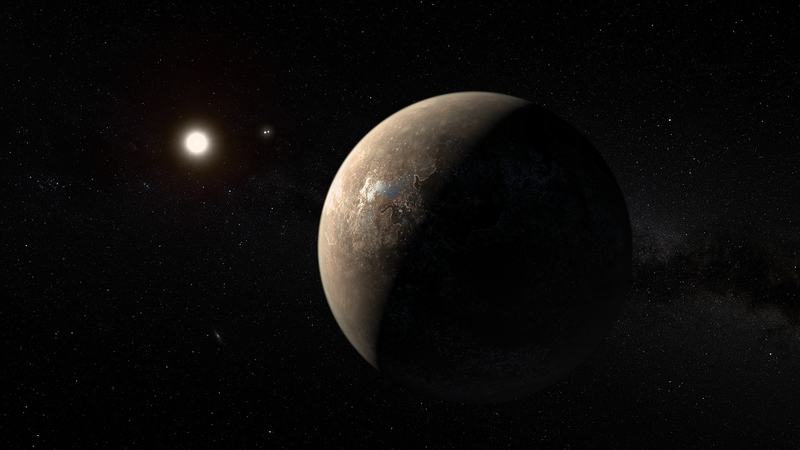

The same faint wobble that makes Proxima move at walking pace turned out to be the trail that led researchers to a planet. Investigators zeroed in on a companion world after finding its orbit put it in a temperature range where liquid water could plausibly survive on its surface. Astronomers announced the discovery of Proxima Centauri b in a paper that reached the journal Nature dated 25 August 2016, making it the nearest confirmed planet beyond our solar system.
The public search that led there had a name worth knowing: the "Pale Red Dot" campaign, a deliberate echo of the "pale blue dot" photograph of Earth that Voyager 1 captured in 1990 while leaving the solar system. Where that earlier image reduced our own world to a speck seen from deep space, the campaign borrowed the idea to hunt for a world circling a fainter, redder star.
A Planet Close to Earth's Size, and Not Alone
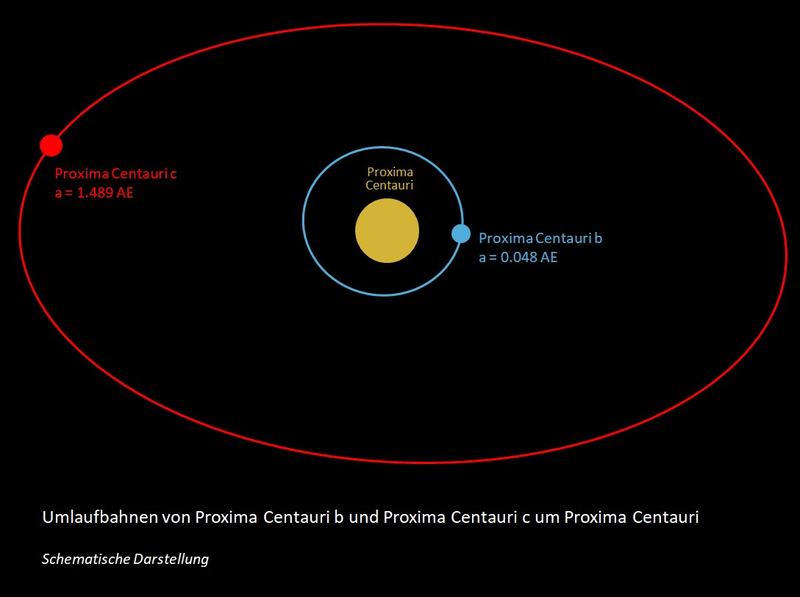
Proxima Centauri b appears to be a rocky world only slightly wider than Earth, with mass estimates putting a lower limit at about 1.06 Earths. It completes a full orbit in just 11.2 Earth days, circling at a distance of roughly 0.04848 AU, about 7.253 million kilometers out.
It also has company. In 2022, researchers confirmed a second planet, Proxima Centauri d, orbiting even tighter around the star than Proxima b does. Finding one planet around the nearest star to the Sun was already notable; confirming a second turned Proxima Centauri into a genuine multi-planet system worth mapping in detail, rather than a single lucky find.
A Star More Active Than It Looks
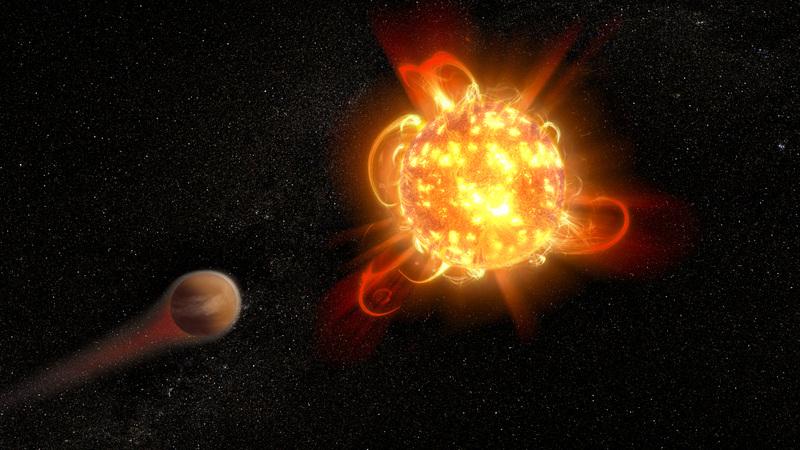

For something this small and dim, Proxima Centauri behaves with surprising intensity, and in places more dramatically than the Sun does. Researchers found that it goes through a repeating cycle of starspots, a pattern familiar from our own star's activity. The scale, though, is not comparable: at its most active, starspots can blanket at least a fifth of Proxima's entire surface at once. The Sun, by contrast, rarely loses even one percent of its surface to spots, even at solar maximum, when over 100 sunspots typically appear together.
The temper shows up in flares as well. Its eruptions can swell as large as the star itself, with temperatures reaching as high as 27 million kelvin, hot enough to radiate X-rays outward. For anything living on Proxima's planets, that mix of heavy spot coverage and violent flaring would make for a far harsher daily environment than Earth ever experiences from our comparatively calm Sun. It is a useful counterweight to the earlier habitable-zone temperature estimate for Proxima b: a planet can sit at the right distance for liquid water and still face conditions no terrestrial organism has ever had to survive.