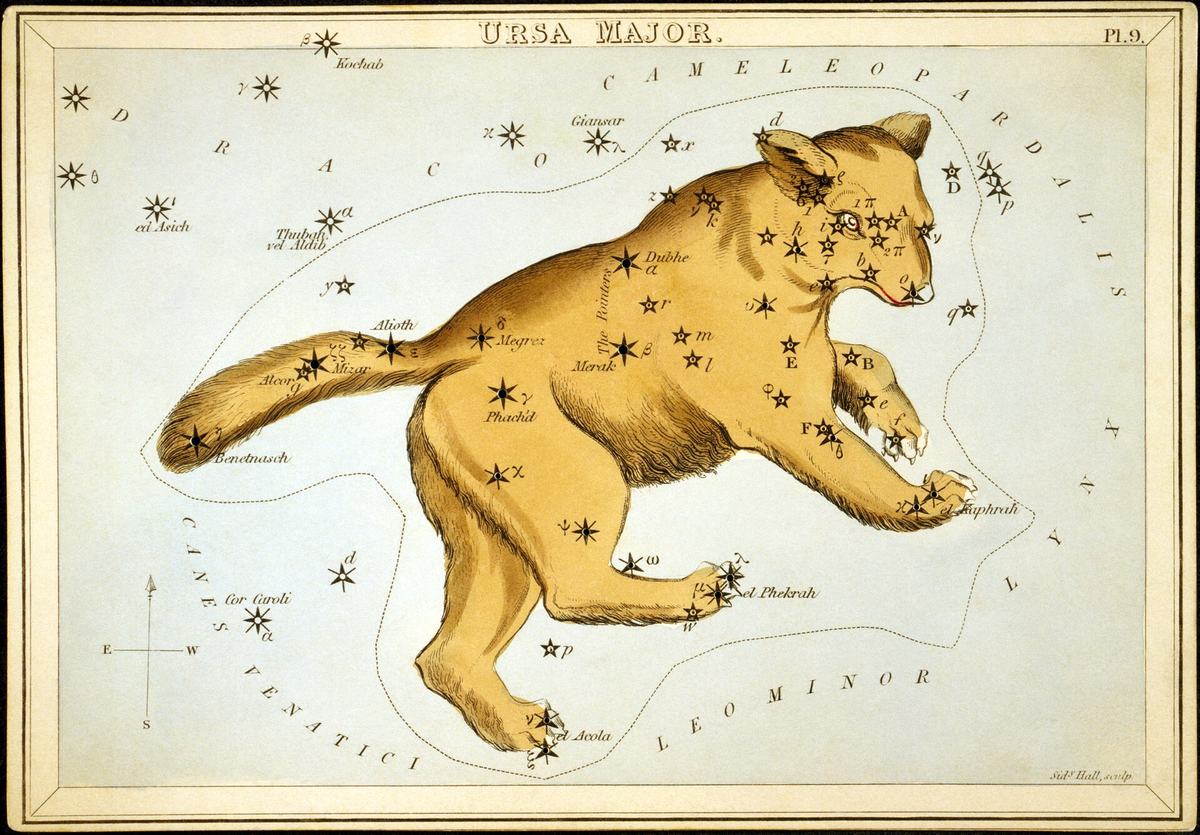
The Big Dipper is not, technically, a constellation. It is an asterism -- a recognizable star pattern with no official boundaries of its own -- carved out of the much larger constellation Ursa Major. And it will not look the same forever: in 50,000 years, its stars will have drifted into a new dipper shape facing the opposite way from the one we know now.
Seven stars make up the familiar bowl-and-handle outline that has guided travelers, storytellers, and stargazers under dozens of names across cultures and centuries. Most of those seven stars are moving through space together; two of them are not, which is exactly why the shape has an expiration date.
Look closer and the Dipper turns out to be a launching point for a lot more of the sky than it first appears -- a double star that has tested naked-eye vision for centuries, a couple of hidden stellar companions, and sightlines that lead straight to distant galaxies.
An Asterism Hiding Inside a Constellation
Most people treat "Big Dipper" and "constellation" as interchangeable, but strictly speaking they're different kinds of things. An asterism is just any star pattern people have found recognizable enough to name; it has no official boundary and doesn't need approval from anyone. A constellation, by contrast, is a defined region of sky with fixed edges, and every star inside those edges belongs to it, whether or not it's part of the pattern that gave the constellation its name.
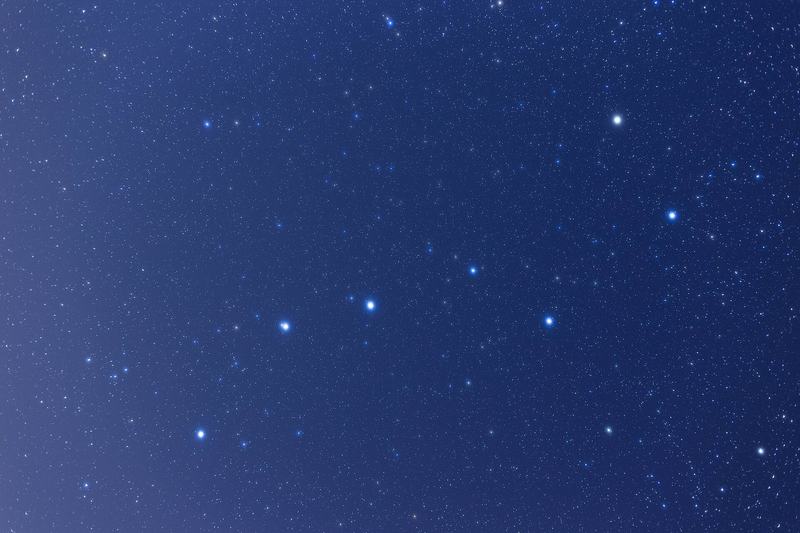

The Big Dipper's seven stars all sit inside Ursa Major, the constellation officially recognized as the Great Bear. Among the sky's 88 modern constellations, Ursa Major ranks third biggest, spanning 3.10% of the entire sky -- an area of 1,279.66 square degrees. The Dipper is just the brightest, easiest-to-trace piece of that much larger bear-shaped region, which is a large part of why casual stargazers know the Dipper by heart and the rest of Ursa Major hardly at all.
A Shape That Won't Last
Because the Dipper's stars are creeping across the sky at their own individual speeds, the shape overhead tonight is really a snapshot rather than a fixture. Relative motion among those stars will keep bending and stretching the outline over the next 100,000 years. Zoom out further and the change becomes dramatic: within 50,000 years, the current pattern will have dissolved entirely, replaced by a new dipper-like shape pointing the opposite way from today's.
Not every star in the group is moving in step with the rest. Dubhe, at the front corner of the bowl, and Alkaid, at the tip of the handle, drift in the opposite direction from the other five stars, which is exactly why they're the ones pulling the shape apart. Those five middle stars belong to what astronomers call the Ursa Major Moving Group, a cluster of stars traveling together through space -- meaning most of the Big Dipper is, unusually for an asterism, also a genuine family of related stars.
The Star That Tests Your Eyesight
Look at the bend in the Dipper's handle and you'll find Mizar, a star long used as an informal test of naked-eye vision because a fainter companion sits right beside it. That companion, Alcor, lines up with Mizar as seen from Earth, but in reality sits roughly 1 light-year farther away -- the two only look like close neighbors from our vantage point.
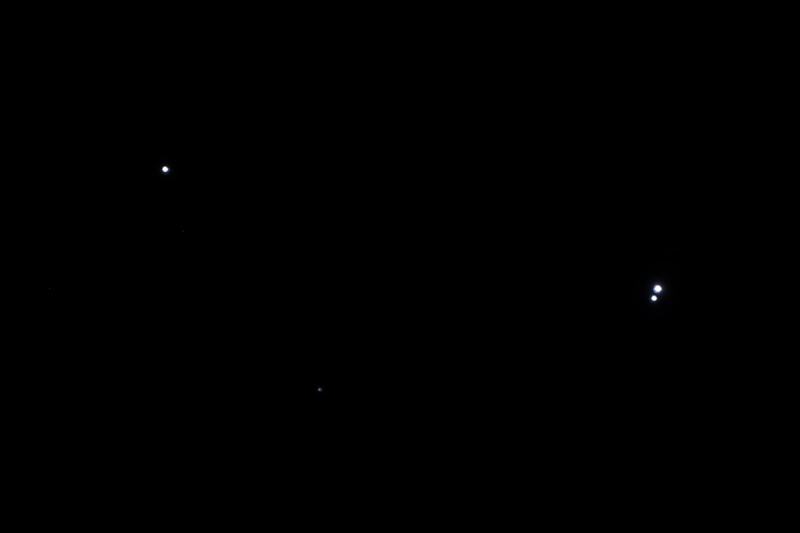

Mizar has a track record of firsts. It was the first double star confirmed through a telescope, in 1617, and Italian astronomer Giovanni Battista Riccioli's description of it in 1650 is often cited as the earliest known claim of a binary star system. Observations kept improving: in 1889, Mizar became the first star shown to be a spectroscopic binary, a pair too close together to split visually but detectable through the wobble in its light. Counting every piece, the Mizar system is built from four separate stars.
The count around Mizar and Alcor kept climbing well into the modern era. In 2009, astronomer Eric Mamajek and colleagues at the University of Rochester were hunting for exoplanets when they discovered that Alcor itself has a hidden companion, making the whole system six stars in total -- four in Mizar, two in Alcor -- rather than the two points of light visible to the unaided eye.
Pointers to the Rest of the Sky
The Dipper isn't just decorative; it also works as a signpost. Trace a line from Phecda through Megrez, the two stars where handle meets bowl, and keep going: it leads to Thuban, a much fainter star over in Draco that held the title of Earth's pole star some 4,000 years ago -- one more reminder that even the sky's fixed points only stay fixed for a while.
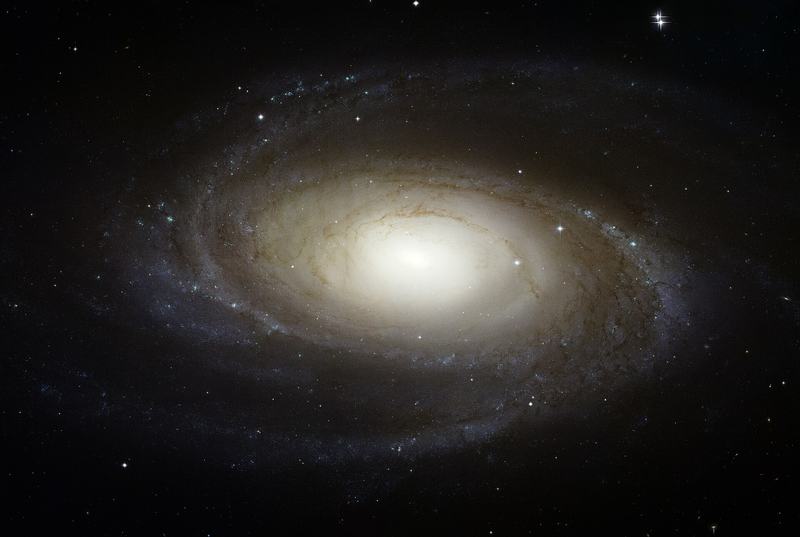

Two more sightlines turn the Dipper into a map toward deep space. Cut diagonally across the bowl from Phecda to Dubhe and keep going the same distance again, and the path lands on the galaxy pair M81 and M82. Head to the opposite end instead, and Alkaid marks the spot between two more spiral galaxies: the Pinwheel Galaxy, M101, to the north, and the Whirlpool Galaxy, M51, to the south.
A Sky Chart Older Than Written History
The version of the night sky most Western stargazers inherited traces back to ancient Greece, and the paper trail is unusually well documented. Around 275 B.C., the poet Aratus wrote Phaenomena, and this poem is credited with popularizing the era's constellation lore across the Greek world.
That poem wasn't entirely original material, either. The astronomer Hipparchus's only surviving book, The Commentary, dated to 147 B.C., states that Aratus had largely borrowed his descriptions from an earlier, now-lost work with the same title by Eudoxus, dated to 366 B.C. Layer upon layer, the same handful of star patterns kept getting copied forward. This whole tradition was eventually formalized: in 1922, the International Astronomical Union settled on 88 official constellations, building most of the list on the framework laid out in Ptolemy's Almagest.
A Guide Sung Into Freedom
The Dipper's usefulness as a direction-finder shows up far outside astronomy books, too. "Follow the Drinkin' Gourd," an African American folk song that uses the Big Dipper as a navigational aid, was first published in 1928. It's a reminder that the same seven stars used to hunt down distant galaxies were also, for a very different audience, a simple compass fixed in the night sky.