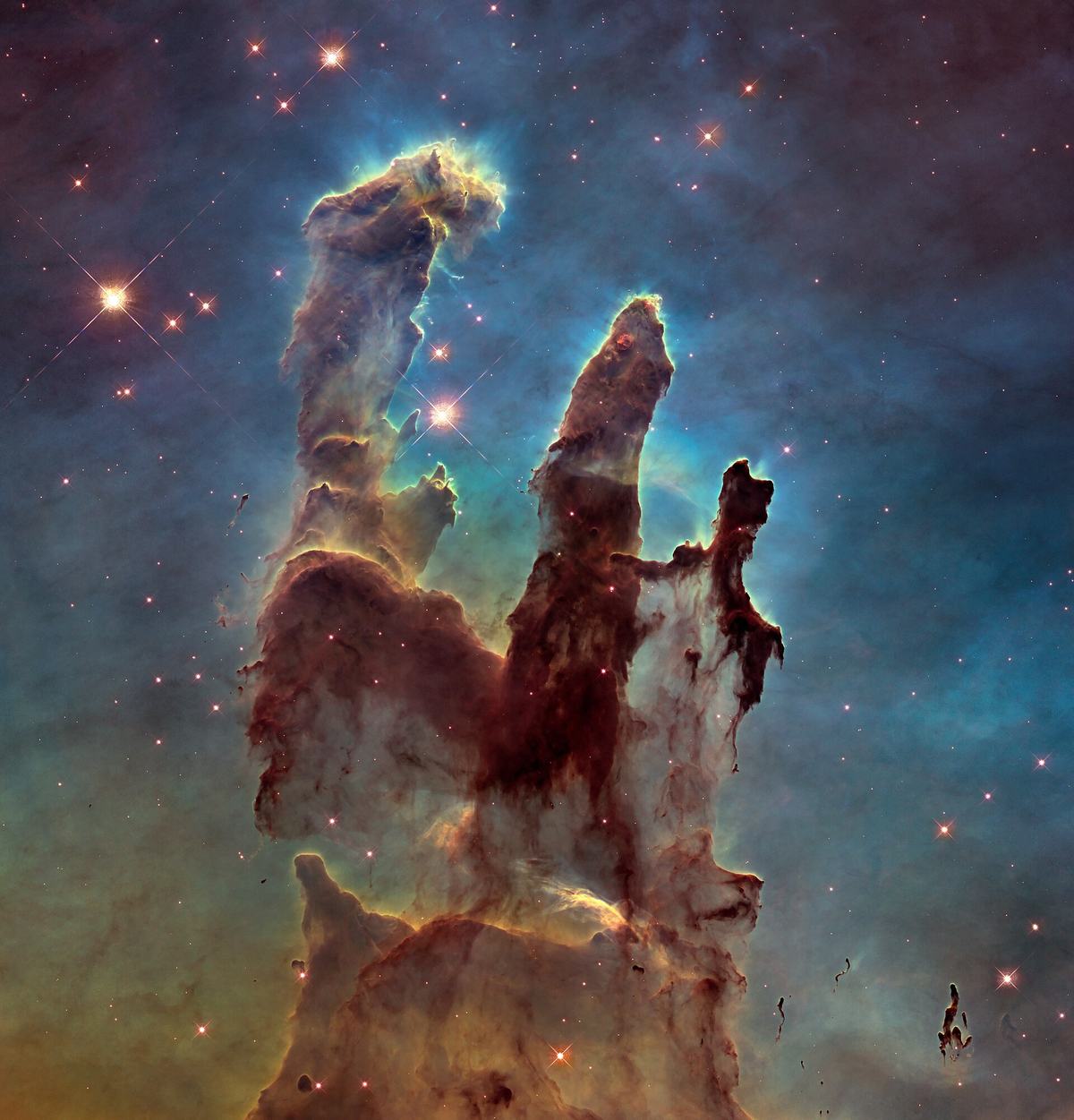
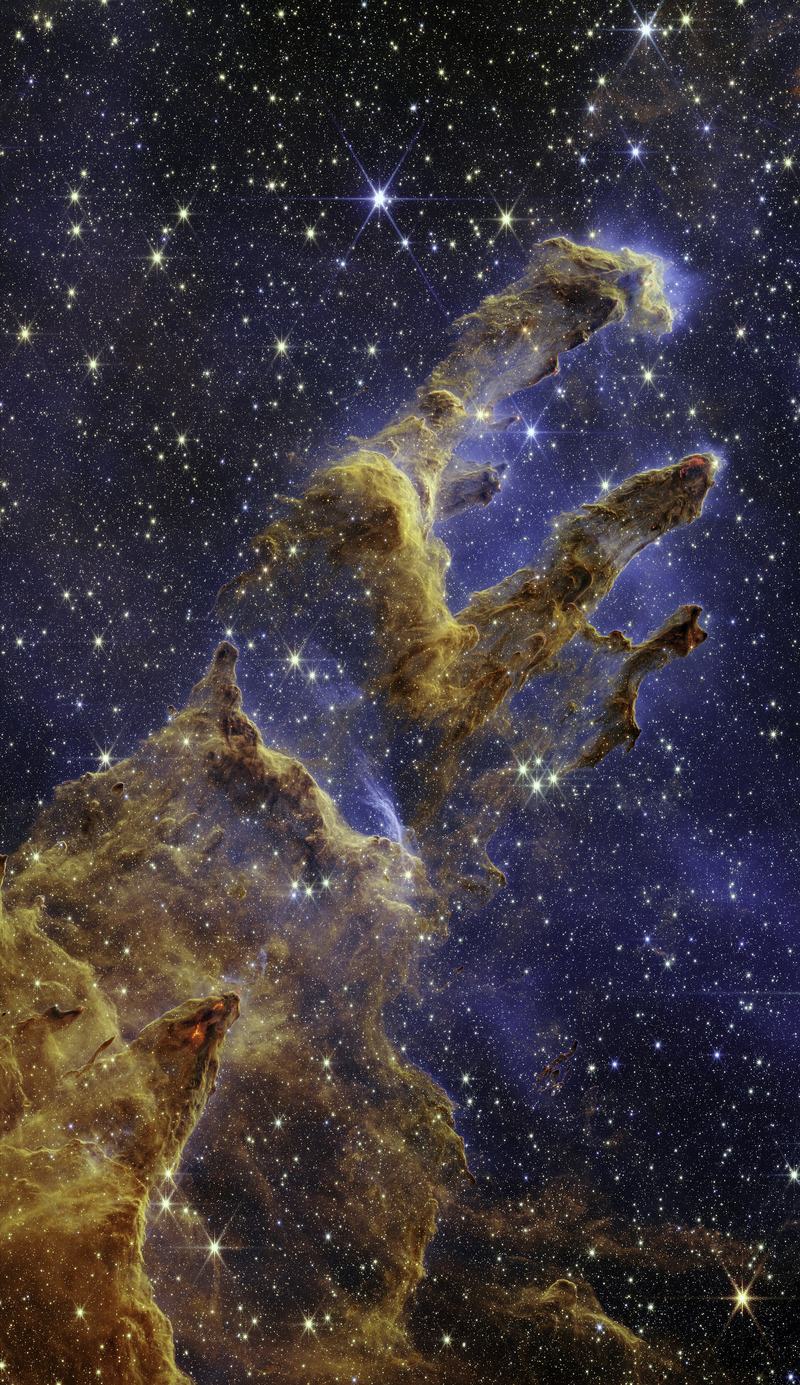
The image that made the Eagle Nebula a household name -- three dark towers of gas rising out of a glowing cloud -- was not a Hubble original. Those "elephant trunks" had already been spotted in 1920 by astronomer John Charles Duncan, on a photographic plate exposed through the Mount Wilson Observatory's 60-inch telescope. They are called the Pillars of Creation because the gas and dust they are made of are in the process of creating new stars, while also being eroded by light from nearby stars that have recently formed.
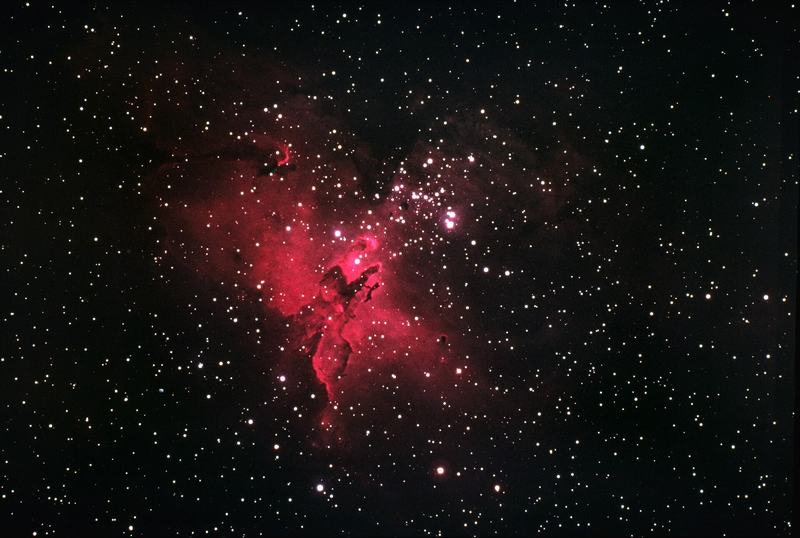
The nebula itself carries three catalog numbers at once. It is Messier 16 (M16) to stargazers, NGC 6611 for the young star cluster at its heart, and IC 4703 for the glowing hydrogen gas surrounding that cluster -- also known as the Star Queen Nebula. It sits about 5700 light-years from Earth, in the constellation Serpens, and it is still actively forming stars today.
This guide focuses on what makes the Eagle Nebula itself distinctive: its scale, the cluster buried inside it, the pillars' long observation history from a 1920 glass plate to the James Webb Space Telescope, and the ongoing process quietly eroding those famous towers.
A Star Cluster Buried in Its Own Nursery
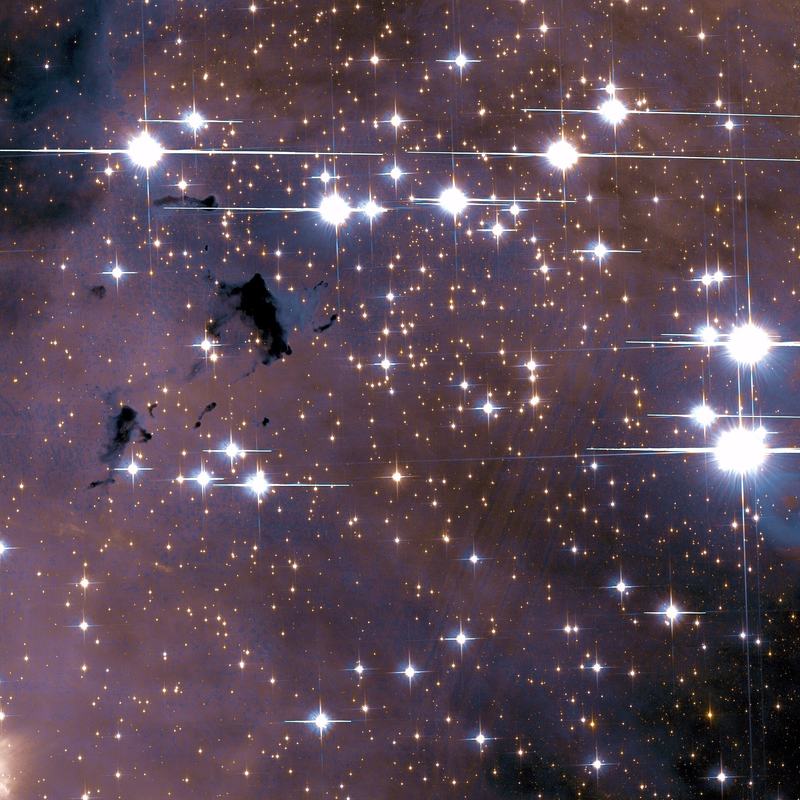
The Eagle Nebula's glowing gas and the star cluster inside it are technically two different catalog objects. The gas cloud is a diffuse emission nebula, or H II region, catalogued separately as IC 4703, while the roughly 8100 stars born within it form the open cluster NGC 6611. Most of those stars are concentrated in a gap in the molecular cloud to the north-west of the Pillars -- meaning the cluster and the pillars occupy different corners of the same nursery rather than overlapping.
The brightest member of that cluster, a star cataloged as HD 168076, shines at an apparent magnitude of +8.24. That is too faint for the naked eye, but easily visible with good binoculars -- one of the more approachable deep-sky targets for backyard observers willing to point their optics toward Serpens.

Seventy Light-Years Wide, Anchored in the Serpent's Tail
The Eagle Nebula lies in Serpens, one of the odder entries on the constellation map: it is the only one of the 88 modern constellations split into two disconnected pieces, Serpens Caput (the head) to the west and Serpens Cauda (the tail) to the east. The nebula belongs to the tail half, sitting in the direction of the Galactic Center, around 5700 light-years away.
At that distance, the nebula's true size becomes clear -- it measures 70 light-years by 50 light-years, large enough to contain not just the star cluster but the three separate dust clouds that make up the Pillars of Creation. A single nebula this size dwarfs the pillars themselves, which are just one dramatic feature carved into a much bigger cloud.
.jpg)
A Gas Spire Nine Light-Years Long
Scale shows up again in a less famous feature of the nebula: a spire of gas visible coming off its northeastern side, stretching approximately 9.5 light-years -- about 90 trillion kilometers -- from base to tip. It is a reminder that the Pillars of Creation, however iconic, are not the only structure of their kind inside the Eagle Nebula; the same forces sculpting the pillars are shaping gas throughout the region.
The Pillars Were Found Decades Before Hubble Made Them Famous
Long before Hubble existed, the pillar-like "elephant trunks" of gas and dust were already on record. John Charles Duncan identified them in 1920 from a plate taken with the Mount Wilson Observatory's 60-inch telescope, well ahead of the picture most people associate with them today.
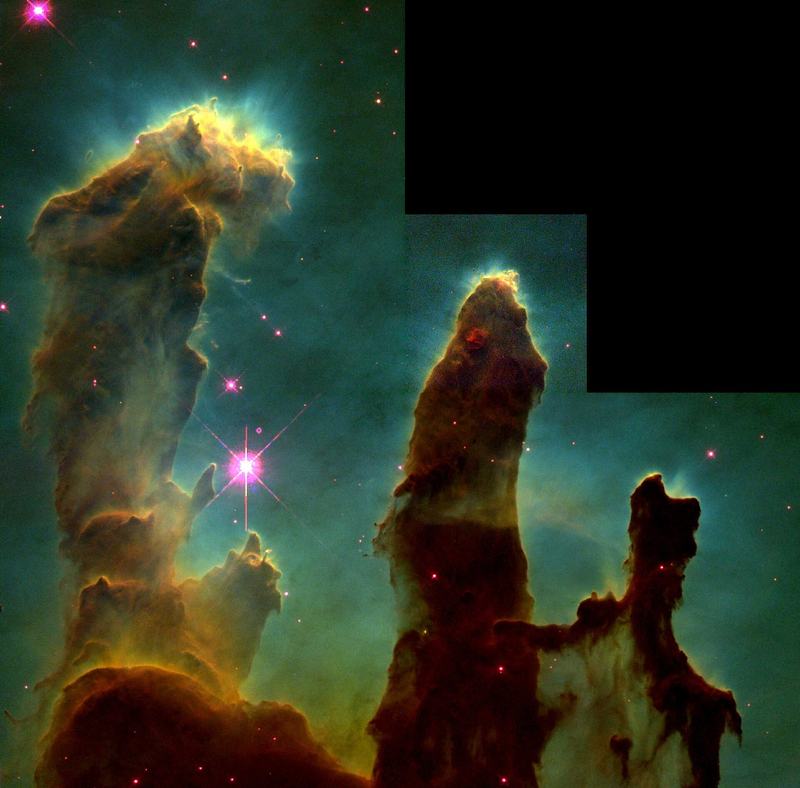
That picture came in 1995, when astronomers Jeff Hester and Paul Scowen used the Hubble Space Telescope to image the region, an observation that greatly improved scientific understanding of the processes at work inside the nebula. Taken on April 1, 1995, the resulting photograph was later named one of the top ten photographs from Hubble by Space.com -- cementing an image of formations that stargazers on the ground had already glimpsed generations earlier.

Inside the Camera That Shot an Icon
The 1995 Pillars of Creation photo was not a single exposure. It is a composite of 32 different images, captured by four separate CCD sensors inside Hubble's Wide Field and Planetary Camera 2. Piecing together dozens of frames from four sensors is part of why the image reads as such a seamless, detailed portrait of the pillars -- what looks like one photograph was actually assembled from many.
Revisiting the Pillars: 2015 and the James Webb Era
Hubble did not stop at one look. To mark the 25th anniversary of the telescope's launch, astronomers assembled a larger and higher-resolution photograph of the Pillars of Creation, unveiled in January 2015 at the American Astronomical Society meeting in Seattle. That image came from Hubble's Wide Field Camera 3, installed in 2009 -- a newer instrument than the one used in 1995, in visible light.
The pillars got another close-up in October 2022, when it was revealed that the James Webb Space Telescope had captured its own image of the structure using the NIRCam instrument aboard the spacecraft. Between a 1920 photographic plate, Hubble's 1995 and 2015 images, and Webb's 2022 view, the Pillars of Creation have now been documented across more than a century of astronomical technology.
.jpg)
Where New Stars Sculpt Their Own Nursery
The pillars are not static monuments -- they are actively being reshaped. The stars being born in the Eagle Nebula, together with others roughly 5 million years old, average about 45,000 kelvins in temperature and produce prodigious amounts of radiation that will eventually destroy the dust pillars themselves. The very structures that made the nebula famous are, slowly, being unmade by the stars forming around and within them.
Part of that erosion process has a name: photoevaporation, where energetic radiation ionizes gas and causes it to disperse away from the source of that radiation -- typically ultraviolet light pouring off hot young stars into surrounding clouds of gas and dust. The Eagle Nebula holds a specific claim to fame within that story: evaporating gaseous globules, or EGGs, dense knots of gas being sculpted and dispersed by radiation, were first discovered here. The pillars, in other words, are less a fixed monument and more a visible snapshot of a nursery consuming its own walls.