Eris is the most massive and second-largest known dwarf planet in the Solar System. It is also the largest known object in the Solar System that has never been visited by a spacecraft — a title it holds simply by being so far from everything else worth visiting first.
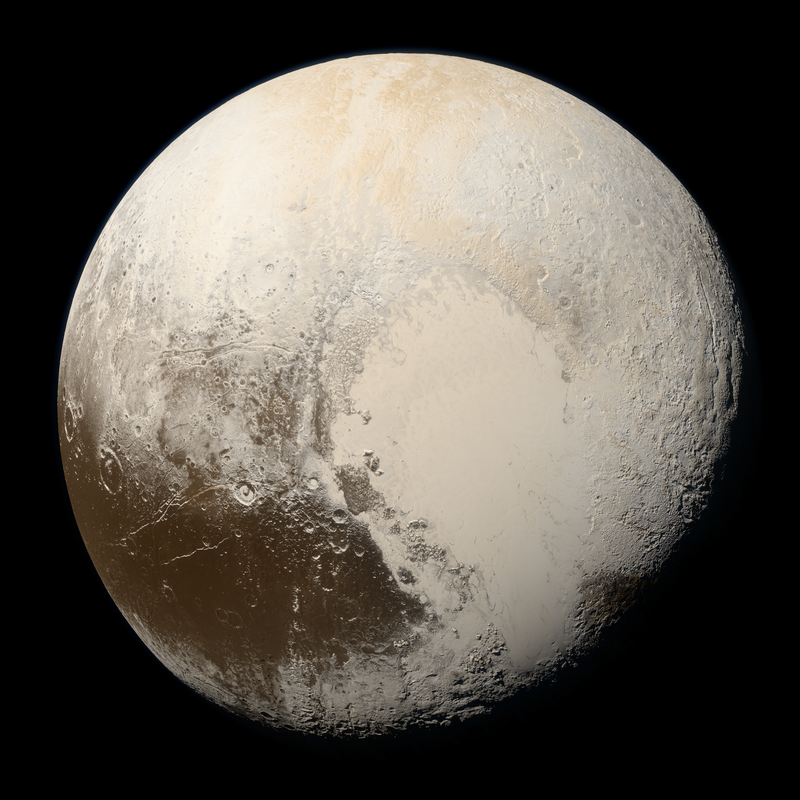
What makes Eris genuinely strange is a mismatch: it is a little smaller than Pluto when measured across, yet it outweighs Pluto by 27%. A world that loses on size but wins on mass is an odd thing to hold in your head, and it is exactly the kind of oddity that forced astronomers to sit down and finally define what a "planet" actually is.
That definition problem is not incidental to Eris's story — it is the whole story. Finding a body out past Neptune that seemed to rival Pluto in size left the International Astronomical Union with a choice: call Eris the tenth planet, or draw a new line that put both Eris and Pluto on the other side of it. They chose the line, and Eris became the reason Pluto lost its old job title.
A Discovery Built From Old Images
Eris was discovered by the team of Mike Brown, Chad Trujillo, and David Rabinowitz on January 5, 2005, from images that had actually been taken back on October 21, 2003. More than a year passed between the moment the light hit the telescope and the moment anyone recognized what was in the picture — a reminder that a lot of astronomical discovery happens not at the telescope but afterward, at a desk, sifting through data nobody had gotten around to fully checking yet.


A Name Chosen for Chaos
Eris was named in September 2006 after the Greco-Roman goddess of strife and discord. It is hard to imagine a more fitting choice: this single object's discovery is what pushed the IAU into the fight over Pluto's planetary status, and the goddess of discord ended up naming the object that caused it.
Smaller in Width, Bigger in Weight
Pinning down Eris's exact size took years. Its diameter was finally measured at 2,326 ± 12 km, with the definitive results announced in October 2011 after astronomers timed how long Eris blotted out the light of a distant star as it passed in front of it — a technique far more precise than trying to measure a faint, distant disc directly through a telescope.
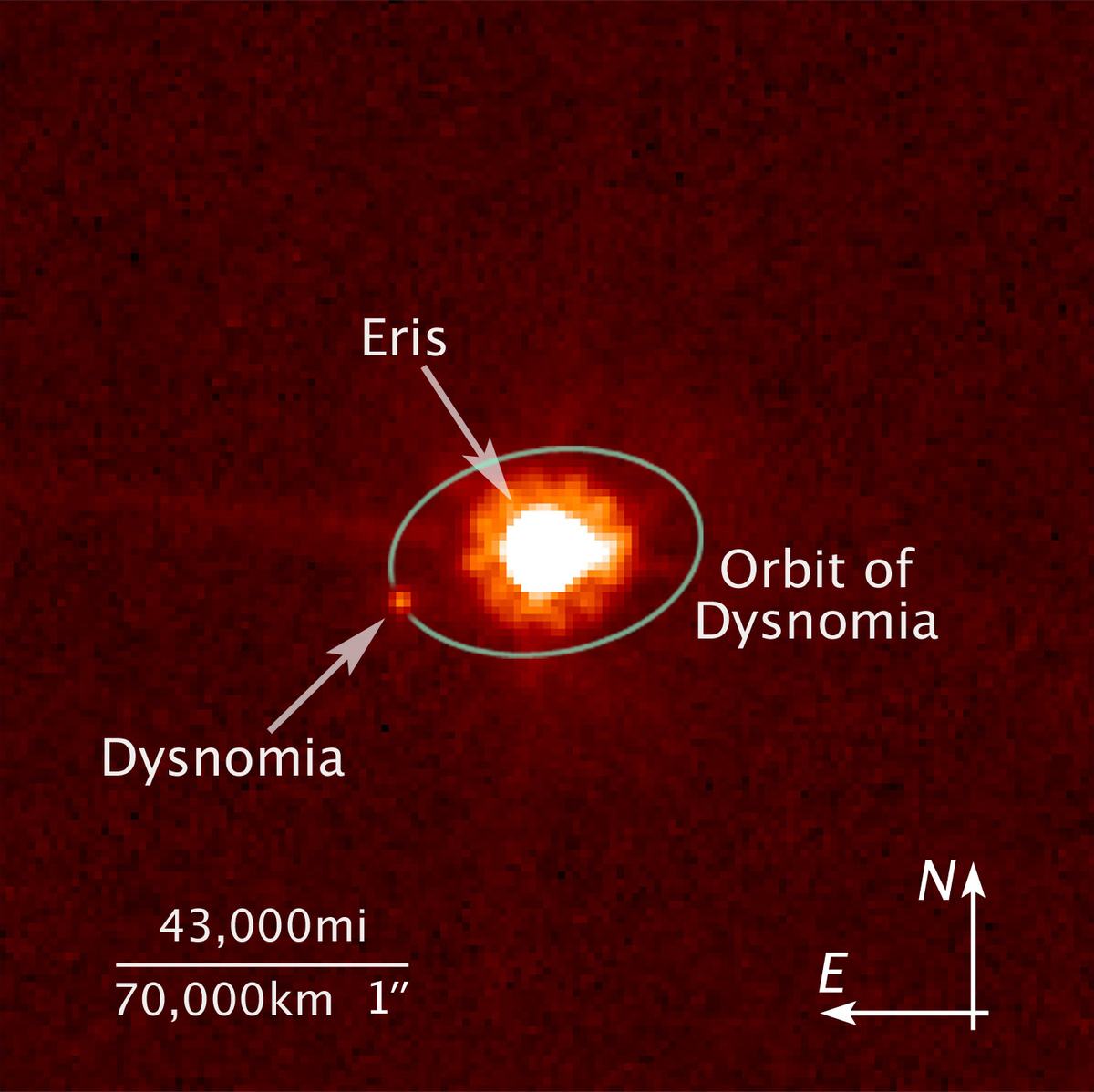
That measurement settled the comparison with Pluto: Eris is a little smaller than Pluto, which measures 2,376.6 ± 1.6 km across, although Eris is still the more massive of the two. The mass figure comes from watching Eris's moon, Dysnomia, orbit it — using the moon's motion to weigh the planet, the same trick astronomers use throughout the Solar System. Based on Dysnomia's orbital period of 15.774 days, Eris turns out to be 27% more massive than Pluto, despite being physically the smaller world.
.jpg)
A 558-Year Trip Around the Sun
Eris has an orbital period of 558 years — more than double Pluto's 248-year orbit — and it does not trace anything close to a circle. Its aphelion, or farthest point from the Sun, is 97.7 AU, while its perihelion, the closest approach, is 38.4 AU. That means Eris spends much of its centuries-long orbit at more than double the distance it reaches at its closest, swinging between a relatively crowded part of the outer Solar System and a region far beyond where most known objects venture.
Eris's path is also tilted at an angle of about 44 degrees to the ecliptic, unlike the eight planets, whose orbits all lie roughly in the same flat plane as Earth's. A tilt that steep sets Eris apart even from most other distant worlds, and hints at a violent, chaotic history of gravitational encounters rather than a calm, orderly formation in place.
A Cold World Studied From Earth and Space
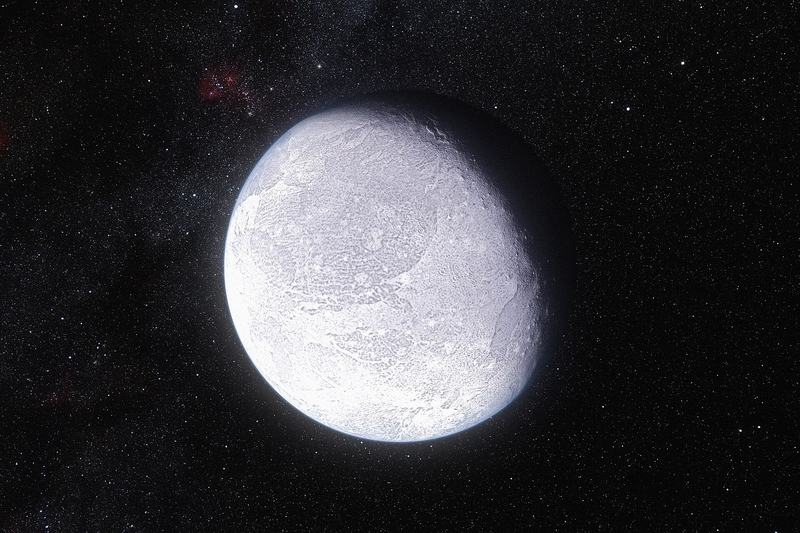

Because of its enormous distance and elongated orbit, Eris's surface temperature is estimated to vary from about 30 to 56 K — cold enough that, depending on where Eris is in its 558-year lap around the Sun, gases that would be solid ice for most of the orbit can behave differently near perihelion.
In 2022, near-infrared spectroscopy of Eris by the James Webb Space Telescope revealed deuterated methane ice on its surface, at abundances lower than those found in Jupiter-family comets like 67P/Churyumov-Gerasimenko. That comparison matters: it means Eris's methane didn't simply arrive the same way cometary ice did, and studying exactly how it differs helps astronomers work out what kind of material was available when Eris formed.
Locked in Step With Its Moon
Eris is tidally locked to its moon Dysnomia, meaning its rotation period is synchronous with the moon's orbital period of 15.78 Earth days. Eris and Dysnomia effectively face each other permanently as they orbit their shared center of mass — the same kind of mutual lock that ties Pluto and its largest moon, Charon, together.
Dysnomia itself is no small companion. Its diameter was refined by ALMA radio-telescope observations in 2018 to 615 km, which works out to 24% to 29% of Eris's own diameter — a substantial fraction for a moon, rather than a small chip of debris. Of the known moons of dwarf planets, only Charon is larger, which makes Dysnomia the second-largest moon of a dwarf planet found so far.
A Possible Second, Unseen Moon
Dysnomia's orbit itself has thrown up a puzzle. In 2023, Marina Brozović and Robert Jacobson proposed that Dysnomia's non-Keplerian orbit — meaning its path does not trace a simple, fixed ellipse the way a lone moon's orbit should — was most likely caused by an unseen inner moon tugging on it through a mean-motion orbital resonance. Nobody has directly seen this hypothetical second moon; its presence is inferred purely from the way it appears to be nudging Dysnomia off a tidy elliptical path.
Visited Only From a Great Distance
Eris was observed from afar by the outbound New Horizons spacecraft in May 2020, as part of its extended mission following its successful Pluto flyby in 2015. It was a glimpse rather than a visit — New Horizons was already well past Pluto and continuing outward, and Eris still holds its distinction as the largest known Solar System object no spacecraft has actually flown past. For now, everything known about Eris has been learned from Earth, or from a great distance away.