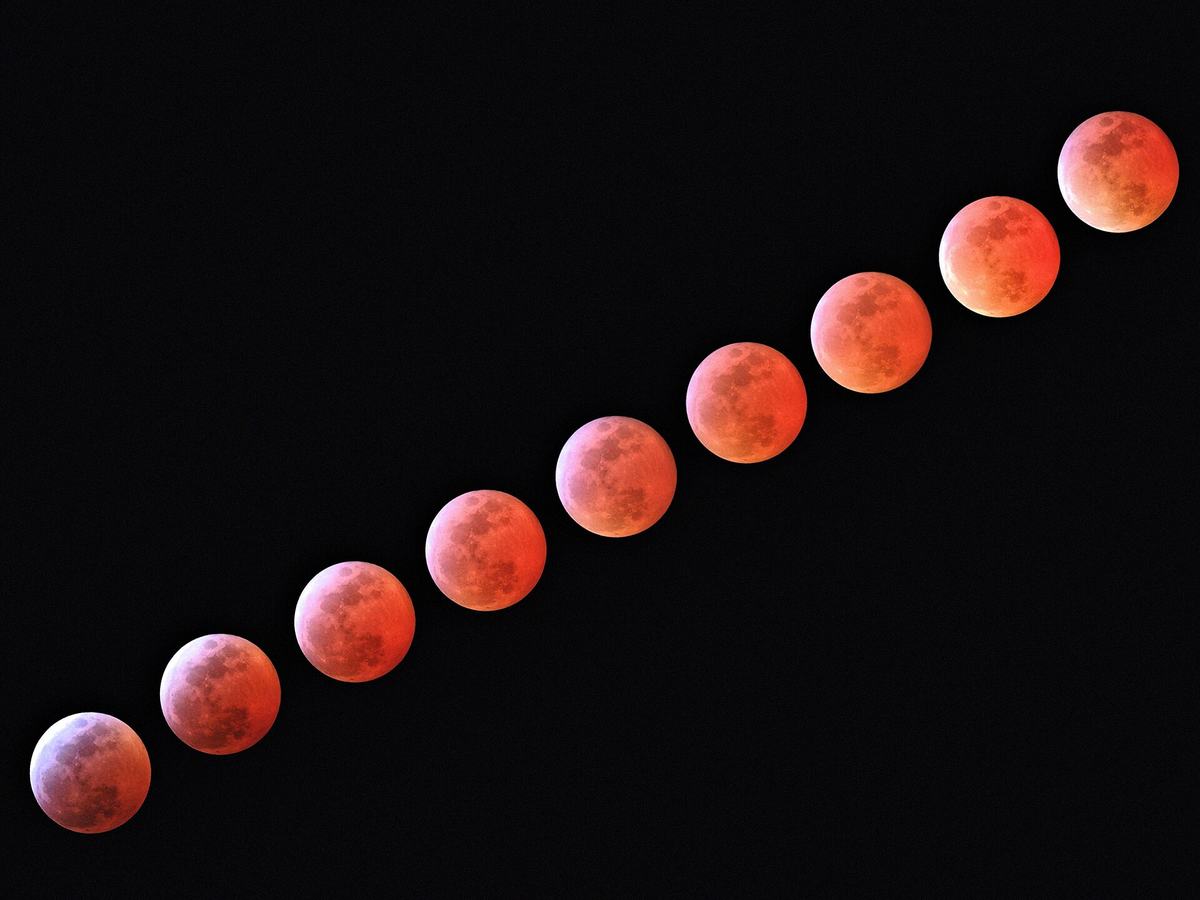
A lunar eclipse is not the Moon going dark. It is the Moon sliding through a shadow so large that, on the far side of Earth, it stretches roughly 1.4 million kilometers into space — and instead of vanishing, the Moon usually just turns a deep, rusty red.
That shadow is Earth's own, cast by sunlight the same way any object casts one. What makes a lunar eclipse worth watching is everything in between: how long the Moon lingers in that shadow, why it changes color instead of going black, and how ancient sky-watchers turned its rhythm into a working calendar centuries before anyone understood why it happened.
This guide walks through the mechanics of a lunar eclipse — the shadow, the color, the timing — and a few of the odder corners, from a prophecy built around four consecutive eclipses to catching the Sun and the eclipsed Moon in the sky at the same moment.
A Shadow That Reaches Well Past the Moon
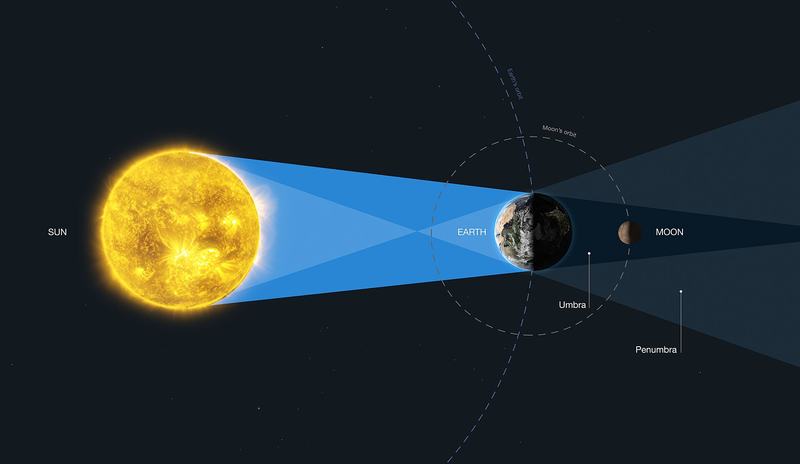

Earth is about 3.7 times wider than the Moon, and that size difference matters more than you would expect: it makes the cone of Earth's full shadow, called the umbra, stretch roughly 1.4 million kilometers out into space before it tapers to a point. That is far more room than the Moon needs to disappear into.
The Moon's own shadow works the opposite way. Because the Moon is so much smaller, its umbra comes to a point after only about 384,402 kilometers — coincidentally close to the actual Moon–Earth distance, which is why a total solar eclipse's path of totality on Earth is only ever a narrow strip. Earth's shadow has no such problem; it swallows the Moon whole, with room to spare.
Why the Eclipsed Moon Turns the Color of Rust
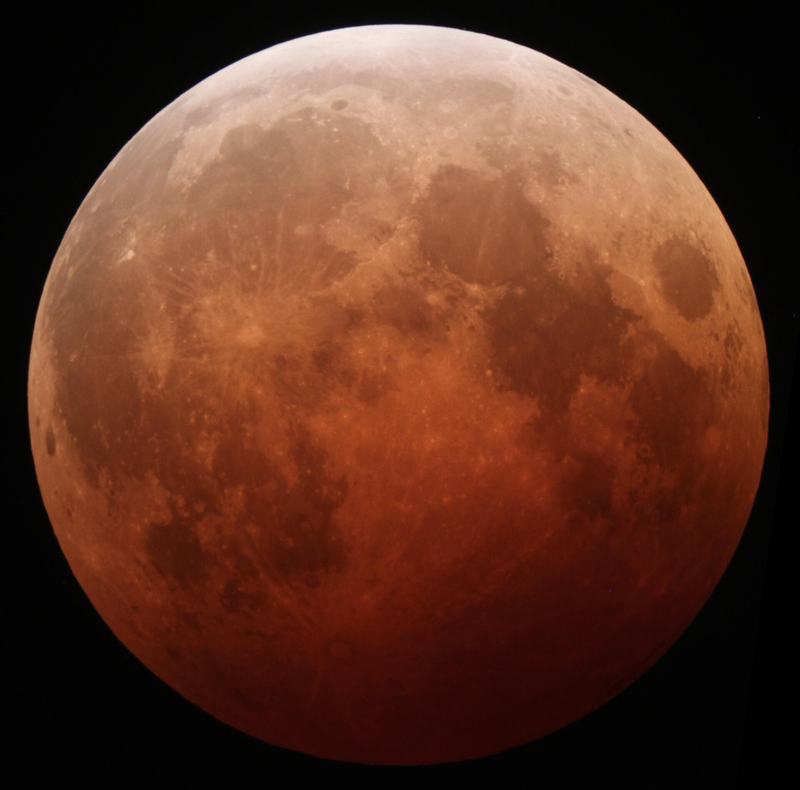

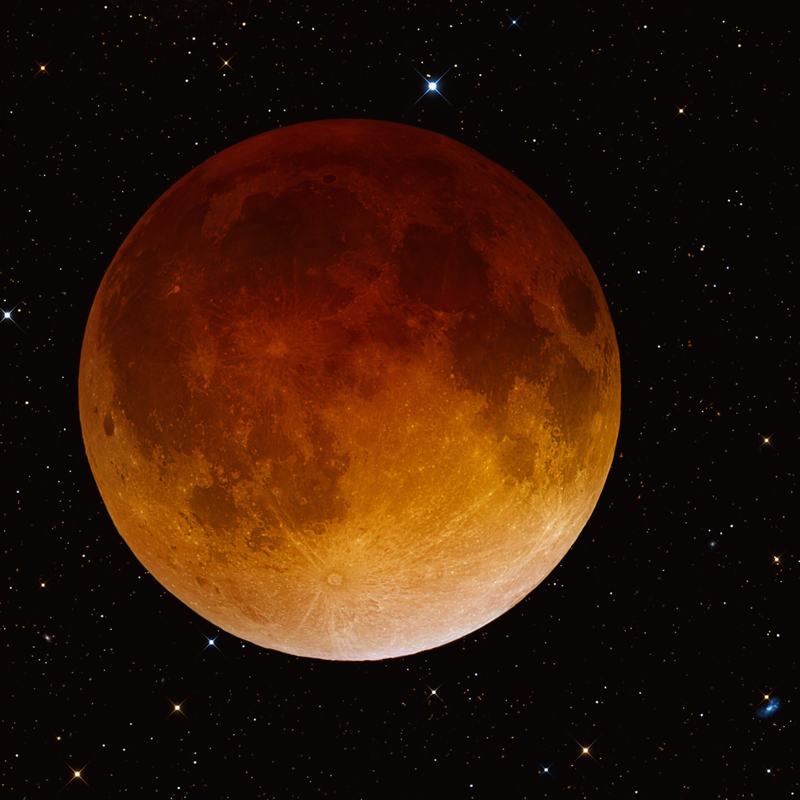
If Earth had no atmosphere, a totally eclipsed Moon would simply go black. Instead, sunlight grazes through the edges of Earth's atmosphere on its way toward the Moon, and that thin layer of air acts like a filter: blue wavelengths scatter away over the distance, leaving mostly warm, reddish tones to complete the trip. What lands on the Moon is essentially the light of every sunrise and sunset on Earth happening at once, bent around the planet and refocused on the lunar surface.
Astronomers actually grade how vividly that plays out. French astronomer André Danjon devised a scale, still used today, for rating how dark or bright a totally eclipsed Moon appears. At the faint end, L=0, the Moon can be nearly invisible at mid-totality. At the bright end, L=4, it glows a vivid copper-red or orange instead. The same eclipse mechanics, the same red light — but how much dust and cloud happen to be sitting in Earth's atmosphere that week can shift the result from one extreme to the other.
Partial, Penumbral, and the Real Thing
Not every lunar eclipse delivers that full red spectacle. A partial lunar eclipse happens when the Sun, Earth and Moon are not quite in a straight line, so the Moon crosses only part of Earth's umbra while the rest stays in sunlight. A penumbral eclipse is subtler still — the Moon passes only through the lighter outer fringe of Earth's shadow, dimming slightly without the deep color change. About one-third of all lunar eclipses are penumbral, and only 3% of those penumbral eclipses are so deep they qualify as total penumbral eclipses — meaning most eclipses you might read about as "a lunar eclipse tonight" are actually the faint kind, easy to miss unless you know to look.
A Slow Moon Makes for a Long Night

Totality lasts as long as it does because the Moon is, relatively speaking, a slow-moving target. It drifts along its orbit at only about 1.03 km/s — barely more than its own diameter per hour — which is slow enough that totality inside Earth's dark umbra can stretch to nearly 107 minutes in the most favorable alignments. Counting the fainter partial phases on either side, the whole event, from the Moon's first touch of the shadow to its last, can run as long as 236 minutes.
The July 27, 2018 eclipse showed just how long that can get in practice: the Moon spent 1 hour and 43 minutes fully inside Earth's umbra, out of a 3-hour, 55-minute eclipse overall — one continuous, gradually reddening show for anyone patient enough to watch start to finish.
Predicting the Unpredictable: The Saros Cycle
Long before anyone knew what an umbra was, Babylonian and later Greek astronomers noticed that eclipses repeat on a rhythm. That rhythm is called a saros: a period of 18 years and 11 days after which the geometry of Sun, Earth and Moon lines up almost the same way again. Each saros cycle typically contains 70 eclipses in total, 29 of them lunar — a pattern regular enough to predict eclipses thousands of years out, without any physics beyond patient record-keeping.
NASA has since turned that predictability into reference works of its own. A companion catalog, the Five Millennium Canon of Lunar Eclipses, tabulates every lunar eclipse from 2000 BCE to 3000 CE, and its supplemental Five Millennium Catalog runs to 201 pages of eclipse-by-eclipse detail — a five-thousand-year appointment book for a shadow.
Catching Sun and Moon in the Same Glance
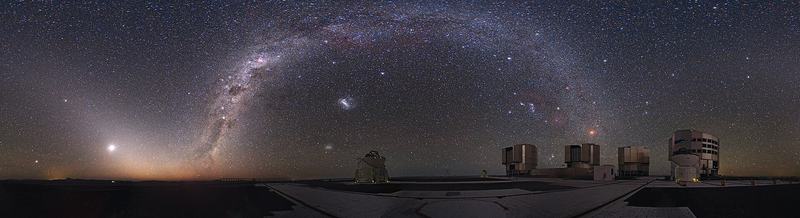
A lunar eclipse can only happen at full Moon, with Earth positioned between Sun and Moon — which should make it impossible to see both objects in the sky at once. Atmospheric refraction occasionally breaks that rule anyway, in an effect called a selenelion: for a few minutes just after sunrise or just before sunset, the rising or setting Sun and the eclipsed Moon can both appear just above opposite horizons at the same time, each bent slightly above its true position by the air itself. It is a brief optical loophole in an otherwise strict piece of orbital geometry.
When Four Eclipses Became a Prophecy

Lunar eclipses have unsettled people for millennia — according to the Book of Songs, a red moon swallowed by darkness was taken as a warning of coming famine or disease. That instinct resurfaced in 2014, when the total lunar eclipse of April 15 opened a tetrad: four consecutive total lunar eclipses, completed by eclipses on October 8, 2014, April 4, 2015 and September 28, 2015. Christian preachers John Hagee and Mark Biltz built their blood moon prophecies around that series of full moons.
Tetrads themselves are not that rare — since the 1st century AD, 62 of them have occurred — but the 2014-2015 one drew outsized attention because it lined up with significant religious feast dates, something only 8 of those 62 tetrads have done. The eclipses were unremarkable astronomically; the calendar coincidence was the whole story.
A 400-to-1 Coincidence
One more number ties the whole picture together, even though it belongs more to solar eclipses than lunar ones. Measured across their disks, the Sun is roughly 400 times as wide as the Moon — and yet the Moon orbits roughly 400 times closer to Earth than the Sun does. Two unrelated numbers landing on the same ratio is why the Sun and Moon appear almost exactly the same size from Earth, which is the reason solar eclipses can go total at all. It has nothing to do with why the Moon turns red during its own eclipse — but it is the same orbital neighborhood that makes lunar eclipses possible in the first place, since a full Moon can only fall into Earth's shadow because Earth sits between two bodies whose apparent sizes happen to match so closely.