In 1277, the bishop of Paris announced that any scholar teaching there could be only one universe risked excommunication — because that claim denied God the power to create as many worlds as he pleased. Centuries before telescopes or satellites, the multiverse was already a subject serious enough to threaten careers over.
Today the multiverse is a genuine, if contested, corner of physics: a family of ideas about why our universe might not be the only one, built on inflation theory, quantum mechanics, and searches for faint patterns in the oldest light in the sky. None of it is settled science, and some of the loudest critics are physicists themselves. But the story of how the idea got here, and what people have actually tried to test, is stranger than most science fiction.
An Idea Almost as Old as Atoms
The notion that reality might contain more than one universe is not a modern invention. It traces back to the same ancient Greek thinkers who first floated the existence of atoms — reasoning that if matter could be built from indivisible pieces scattered through infinite space, there was no obvious reason for that space to contain only one cosmos.
Not everyone agreed. Aristotle pushed back hard, insisting that logic itself demanded a single universe and nothing more. His argument won out for well over a thousand years, shaping Western thought so thoroughly that by the Middle Ages it had become close to official doctrine — until the church itself decided otherwise. The 1277 declaration from the bishop of Paris flipped the script entirely: suddenly it was Aristotle's one-universe view that was the risky position to defend, since it seemed to put a limit on divine power.
A Word Coined Before the Physics Existed
The term "multiverse" itself predates the modern scientific debate by decades. It was the American philosopher and psychologist William James who first used the word, in 1895 — though he meant something quite different from bubble universes or quantum branches. The physics would not catch up to the vocabulary for the better part of a century.
The Universe That Keeps Inflating
Modern multiverse theories mostly trace back to inflation: the idea that the infant universe went through a burst of extremely rapid expansion, worked out by physicists Alan Guth and Andrei Linde, among others, not long after 1980. That single idea reshaped how physicists picture the first moments after the Big Bang.
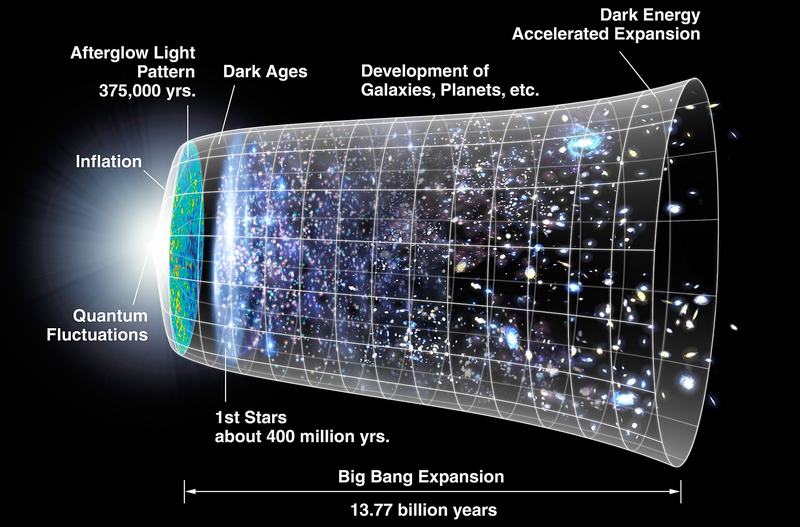

Here is the part that leads straight to a multiverse: inflation does not have to end everywhere at once. In our own cosmic neighborhood, it stopped 13.7 billion years ago, but calculations suggest it is still happening in far-flung regions, continually spinning off new "normal" pockets of space-time like ours. If that picture holds, our entire observable universe is just one bubble in an endlessly frothing sea, and we can only ever see a small part of the bubble we happen to be in.
That is a genuinely strange implication: it means the Big Bang was not a single, one-time event but something happening constantly, somewhere, forever — just not anywhere we can currently point a telescope.
Hunting for Bruises From Other Universes
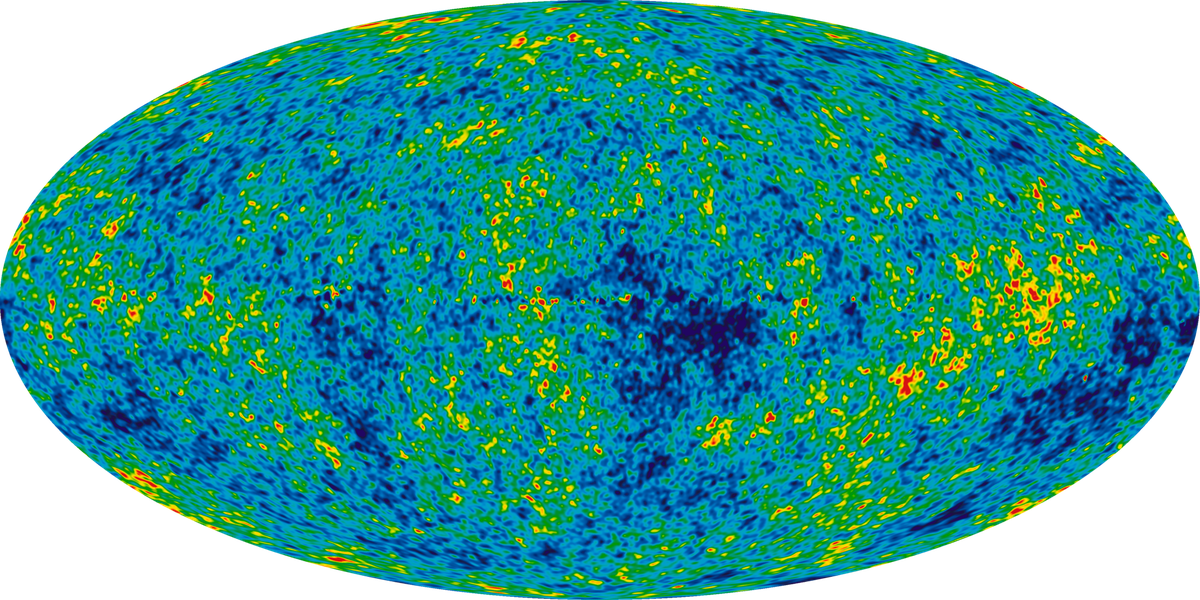
If other bubble universes exist and our bubble ever brushed up against one, physicists reasoned, the collision should leave a mark on the cosmic microwave background — the faint afterglow of the Big Bang that fills the whole sky. That idea led to one of the few genuine attempts to test the multiverse observationally rather than just argue about it philosophically.
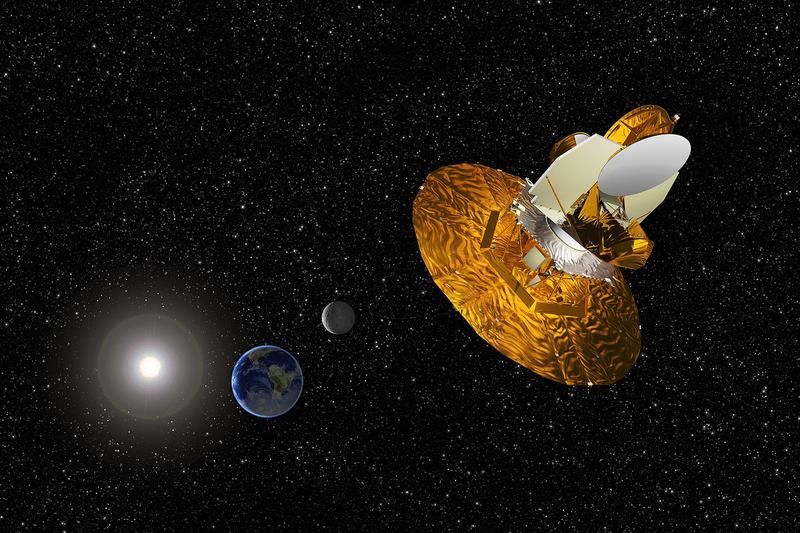
A pair of papers appeared in two leading physics journals, Physical Review Letters and Physical Review D, laying out for the first time an actual method for hunting other universes. Crunching 7 years of data from NASA's WMAP satellite, the team came up with the first ceiling on how many collision marks might be lurking somewhere in that background radiation.

The result was a firm null: the data ruled out augmenting the standard cosmological model with bubble collisions, and pinned the average number of detectable ones across the entire sky at fewer than 1.6, with 68% confidence. It is not proof that other universes don't exist — only that, if our bubble has ever collided with a neighbor, the WMAP data doesn't show it clearly. Researchers noted that bubble universes which drift close enough can and do briefly stick together, the way soap bubbles do, which is exactly the kind of event this search was built to catch.
A Signal That Might Not Be Noise
A separate, unrelated claim briefly reignited the debate. After combing through the spectrum of the cosmic microwave background, the astrophysicist Ranga-Ram Chary reported a signal roughly 4,500 times too bright, judging by the known numbers of protons and electrons thought to have existed way back in the universe's infancy.
What made the anomaly interesting was its shape: it fit better with a cosmos where the ratio between matter particles and photons runs about 65 times above the value measured in our own universe — not a small statistical wobble, but a mismatch with a different set of physical constants entirely. Chary put the odds that it was simply noise at 30%, while allowing for a far more dramatic possibility: that a neighboring universe had spilled some of its own matter particles into ours.
Chary was careful not to oversell the finding, writing that claims as unusual as evidence for alternate universes demand an equally high burden of proof. Nearly a decade later, no follow-up analysis has confirmed the signal as genuine evidence of anything beyond our own universe — a reminder of how quickly an intriguing anomaly can fade once more data comes in.
Many Worlds, One Physicist
Not every multiverse idea comes from cosmology. Quantum mechanics has its own version, born from a puzzle about what happens when a measurement is made. The physicist Hugh Everett proposed, in 1957, that every possible outcome of a quantum event actually happens, each in its own branching version of reality — a framework now usually called the many-worlds interpretation, though some physicists still refer to it by its older names, the relative state formulation and the Everett interpretation.
Rather than a single history unfolding, Everett's picture describes an ever-branching tree of realities, with every version equally real to the observers inside it. It remains one of the most debated interpretations of quantum theory precisely because it can't be tested directly — the other branches are, by construction, forever out of reach.
Why We Might Live in a Finely Tuned Universe
If a multiverse really does churn out countless universes with different physical constants, it raises an obvious question: why does ours happen to have the right constants for stars, planets and chemistry to exist at all? One common answer leans on what's called the anthropic principle — the reasoning that we should not be surprised to find ourselves in a universe capable of supporting the kind of life that can ask the question in the first place, however rare such a universe might be among all the possible ones.
The phrase itself is younger than you might expect: it first appeared in physicist Brandon Carter's contribution to a 1973 symposium in Kraków, more than a decade after the underlying idea had already been floating around cosmology. Since then it has become one of the most cited, and most argued-over, concepts tied to the multiverse — a way of explaining our own existence without requiring anyone to have deliberately tuned the universe for us.
None of this settles whether other universes are real. What it does show is that the multiverse has moved, however slowly, from a medieval argument about the limits of God's power to a set of testable predictions about faint patterns in the sky — even when, so far, those tests keep coming back with no clear signal at all.
Sources
- Long Live the Multiverse! | Scientific American
- The Case for Parallel Universes | Scientific American
- Is our universe inside a bubble? First observational test of the 'multiverse' | ScienceDaily
- First Observational Tests of Eternal Inflation (arXiv)
- Cosmologist thinks a strange signal may be evidence of a parallel universe | phys.org
- Wikipedia: Multiverse
- Wikipedia: Many-worlds interpretation
- Wikipedia: Anthropic principle