Look up on a clear night and every star, planet and glowing nebula you can see belongs to a small minority. Dark matter constitutes 85% of the total mass of the universe, while dark energy and dark matter together add up to 95% of its total mass–energy content. Ordinary matter — everything made of atoms, including every star and every reader of this page — is a rounding error by comparison.
The universe is everything: all matter, energy and the structures they form, from subatomic particles to galactic filaments. It has been expanding for 13.8 billion years, starting from a dense fireball in the Big Bang, and cosmologists have spent the last century mapping out just how strange that expansion, and its contents, really are.
A Bubble 93 Billion Light-Years Wide
The part of the universe we can actually observe is a sphere centered on Earth. The proper distance between Earth and the edge of that observable universe is 46 billion light-years, making the whole bubble about 93 billion light-years across. That number surprises people who assume "13.8 billion years old" should cap the visible universe at 13.8 billion light-years in radius.
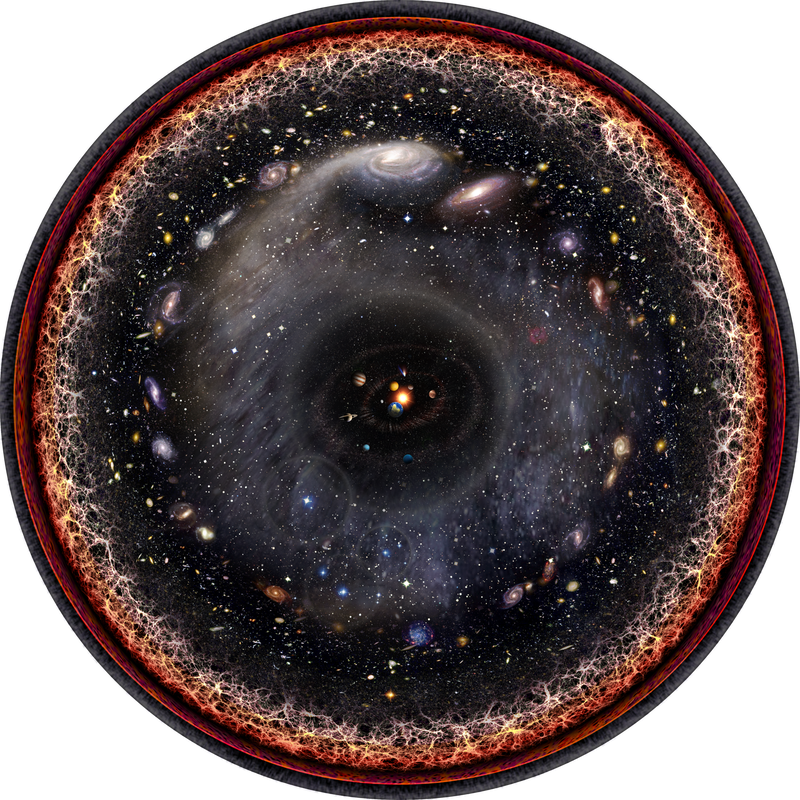

The resolution is that light and space are doing two different things. Light from the edge of the observable universe has been traveling for close to the 13.8-billion-year age of the universe, but the proper distance to that edge is larger, because the edge and Earth have kept moving apart as space itself expanded during the journey. The light is old; the space it crossed has kept stretching underneath it.
Nobody knows how big the total universe is — only how much of it we can see from here. The 93-billion-light-year figure is a horizon, not a wall.
More Stars Than Grains of Sand on Every Beach
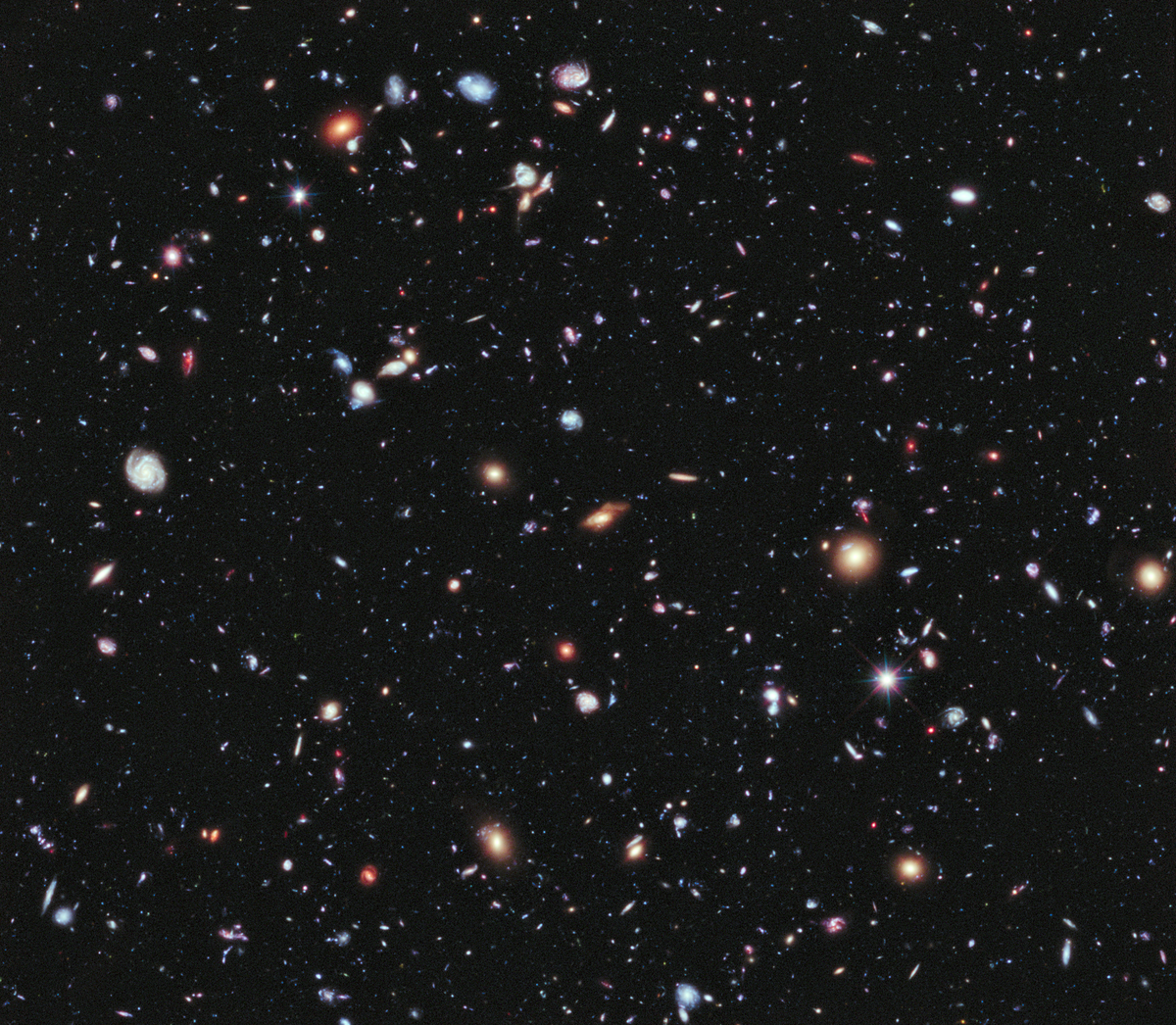
Inside that horizon, the numbers get almost absurd. The observable universe contains as many as an estimated 2 trillion galaxies and, overall, as many as an estimated 10^24 stars — more stars than all the grains of sand on every beach on Earth.
That comparison is not a rhetorical flourish; it is the kind of number that stops meaning anything the moment you try to picture it. Two trillion galaxies is roughly 250 galaxies for every person currently alive, and each of those galaxies can itself hold hundreds of billions of stars. The Milky Way is one galaxy among that count, orbiting nothing special, in no special place.
A Universe That Is 95% Invisible
Here is the part that keeps physicists up at night: most of that mass–energy is not made of atoms at all. The mass–energy density of the universe is 68% dark energy, 27% dark matter, and 5% ordinary matter — the stuff of stars, planets and people.
.jpg)
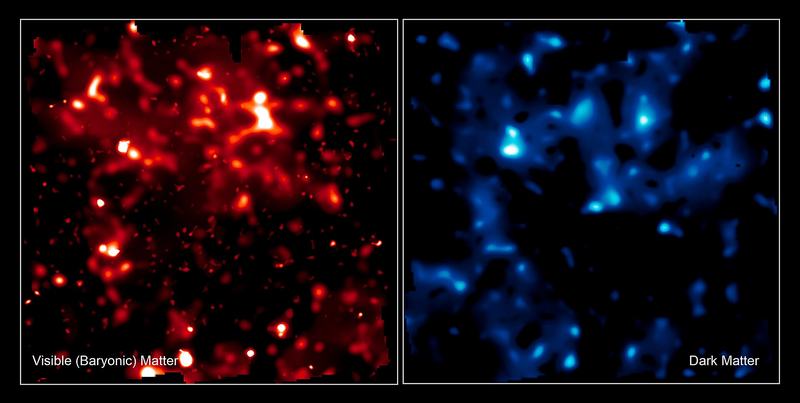
Dark matter alone is estimated to constitute 26.8% of the total mass–energy of the universe but 84.5% of the total matter in it. In other words, when astronomers talk about "matter" in the cosmic sense, five out of every six units of it is dark matter, not atoms. It does not emit, absorb or reflect light, and its presence is inferred entirely from its gravity — it just does not show up in the 5% we can directly detect.
Even the 5% labeled "ordinary matter" is misleading if you picture stars. The great majority of ordinary matter in the universe is unseen, since visible stars and gas inside galaxies and clusters account for less than 10 percent of the ordinary matter's contribution to the mass–energy density of the universe. Most of the atoms in existence are not glowing anywhere — they are diffuse gas scattered between and around galaxies, never dense enough to ignite.
Ten Billion to One: How Matter Won
Physics predicts that the Big Bang should have created matter and antimatter in equal amounts, which would have annihilated each other into pure energy and left nothing behind — no galaxies, no stars, no readers. It obviously did not work out that way: the universe has 10 billion times more matter than antimatter.
That lopsided ratio is one of cosmology's open puzzles, and it is also the reason anything exists at all. Even with matter's ten-billion-to-one edge, the universe that resulted is still remarkably sparse. The average density of the universe, spread across all that space, is about 1 proton per 200 litres — emptier than the best vacuum chamber ever built on Earth.
The Universe's Oldest Photograph
The cosmic microwave background, or CMB, is the closest thing cosmology has to a baby picture. It is the afterglow radiation left over from roughly 380,000 years after the Big Bang, when the temperature of the universe first fell to the point where nuclei could combine with electrons to create neutral atoms, letting light travel freely for the first time.
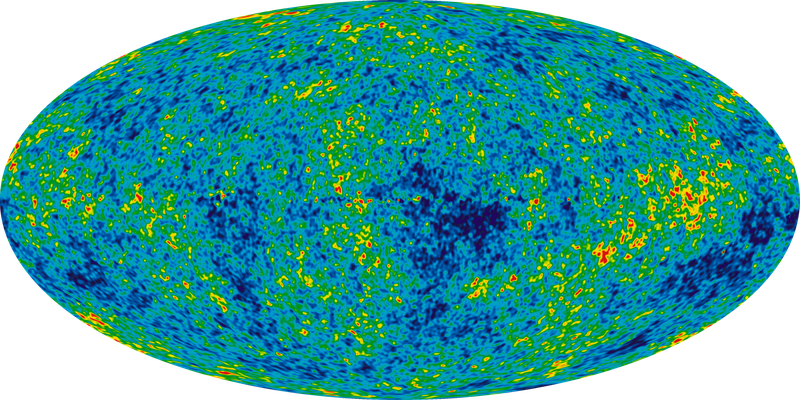

That afterglow has been cooling ever since. Today the CMB has a thermal blackbody spectrum at a temperature of 2.72548±0.00057 K — a few degrees above absolute zero, uniform across the entire sky.
It was found almost by accident. The discovery of the CMB in 1964 by American radio astronomers Arno Allan Penzias and Robert Woodrow Wilson was the culmination of work initiated in the 1940s; they were trying to eliminate noise from a radio antenna and instead stumbled onto the leftover heat of the Big Bang itself.
The CMB is also almost, but not quite, perfectly smooth. It is isotropic to roughly one part in 25,000, with root mean square variations of just over 100 μK once the dipole caused by our own motion is subtracted out. That dipole is itself a fact worth knowing: it is caused by the Sun's own peculiar velocity of 369.82±0.11 km/s relative to the comoving cosmic rest frame, as the Solar System drifts toward the constellation Crater near its boundary with Leo. Even standing still on Earth, you are being carried through the universe's oldest light at that speed.
The Push That's Winning
Dark energy is the strangest ingredient in the mix, precisely because it is so thin. Dark energy's density is very low, about 7×10⁻³⁰ g/cm3, much lower than the density of ordinary matter or dark matter within galaxies. A single galaxy packs vastly more mass into its volume than dark energy manages across the same space.
And yet it dominates the universe's overall energy budget, because unlike matter it does not thin out as space expands — it fills every new cubic meter of space at the same low density, and space keeps making more cubic meters. The proof that this push is real, rather than theoretical, came in 1999: the Supernova Cosmology Project found evidence that the expansion of the universe is accelerating, rather than slowing down under its own gravity as astronomers had assumed. Something was pushing back against gravity on the largest scales, and it has been winning ever since.
The Far Edge of What We Can See
At the outer limit of the observable universe sits the current record holder for distance: the most distant astronomical object identified is a galaxy classified as MoM-z14, at a redshift of 14.44. Its light left home when the universe was a small fraction of its current age, and has been traveling toward us ever since.
.jpg)
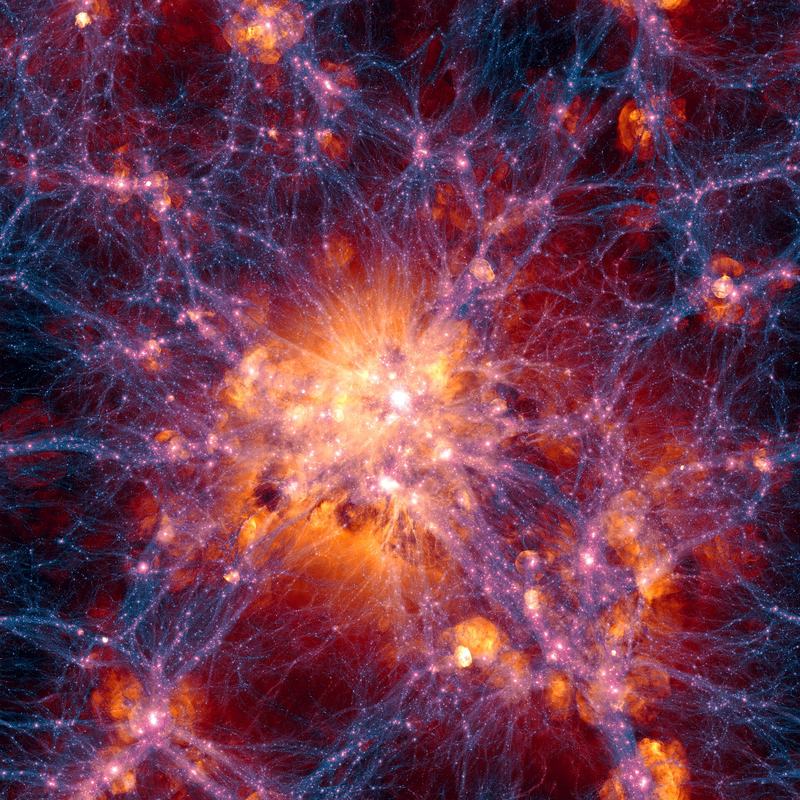
Zoom back out to the scale of galaxy clusters and superclusters, and the universe's structure eventually runs out. At scales between 30 and 200 megaparsecs there seems to be no continued large-scale structure in the universe, a phenomenon referred to as the End of Greatness — beyond that size, the cosmic web of filaments and voids gives way to a universe that looks statistically the same in every direction. Structure has a ceiling; uniformity does not.