Voyager 1, the most distant spacecraft ever launched, will not reach the Oort cloud for about 300 years — and once it arrives, crossing all the way through would take about 30,000 years. No human-made object has come remotely close to this region, and none will for a very long time. Yet astronomers are confident it exists.
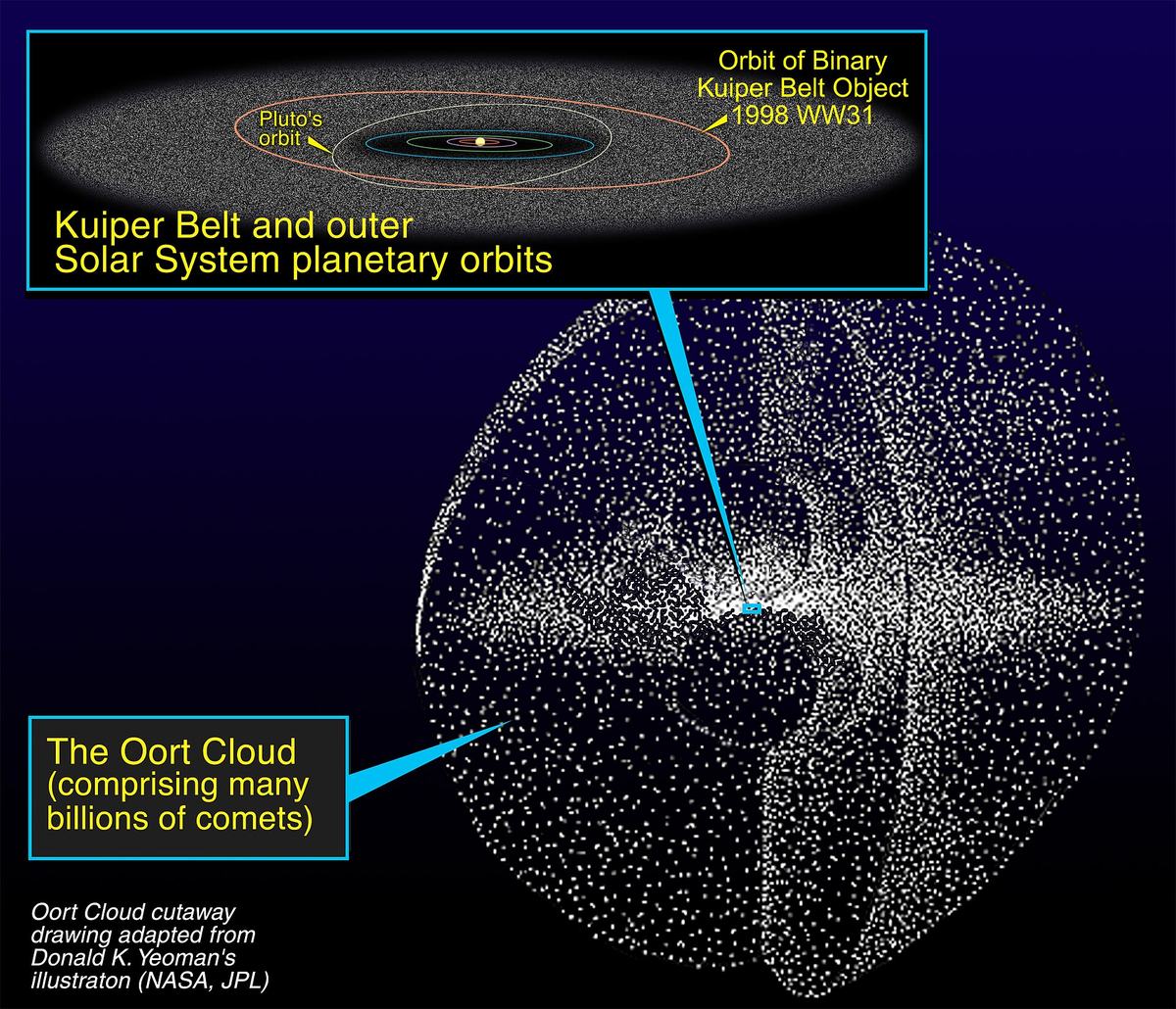
The Oort cloud is theorized to be a cloud of billions of icy planetesimals surrounding the Sun at distances ranging from 2,000 to 200,000 AU (0.03 to 3.2 light-years). Nobody has ever photographed it or flown through it; its existence is inferred entirely from the orbits of comets that appear to come from it. That makes it one of the strangest structures credited to the Solar System — a shell so vast it marks the practical edge of the Sun's influence, built almost entirely on indirect evidence.
Here is what that evidence actually says: how the idea came about, how the cloud is thought to be built, and how it connects to a handful of stranger, farther-flung objects astronomers have actually managed to find.
A Thousand Kuiper Belts Away
The innermost portion of the Oort cloud is more than a thousand times as far from the Sun as the Kuiper belt, the scattered disc and the detached objects — three nearer reservoirs of trans-Neptunian objects that themselves lie well beyond Neptune. Anything that qualifies as "nearby" in the outer Solar System is still, relatively speaking, next door to the Sun compared with where the Oort cloud begins.
That gap is the whole reason the cloud has never been directly observed. Objects out there are small, icy and reflect almost no sunlight at a distance where sunlight itself has grown too faint to reveal much of anything. Every mission capable of reaching those distances has been built to fly past something else entirely on its way out.
Two Regions, One Enormous Shell
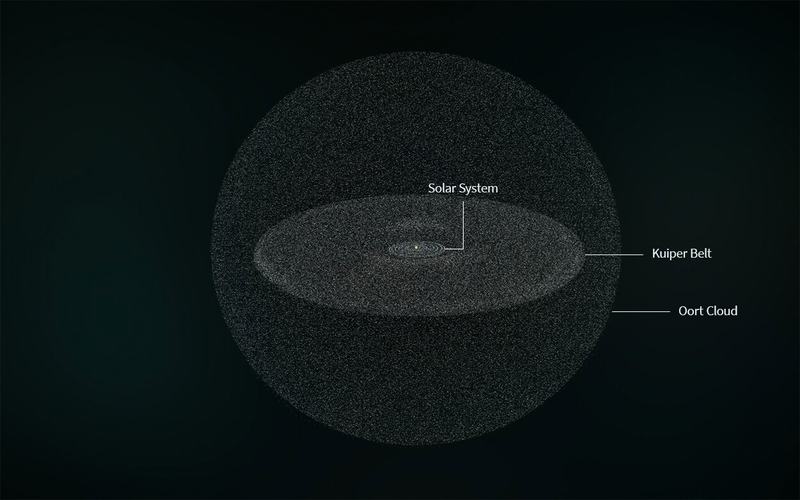
The cloud is thought to encompass two regions: a disc-shaped inner Oort cloud approximately aligned with the solar ecliptic, also called the Hills cloud, and a spherical outer Oort cloud. The two are not the same shape, orbit the same way, or, according to some estimates, hold anywhere near the same number of objects.
.jpg)
The spherical outer Oort cloud has a radius of some 20,000-50,000 AU (0.32-0.79 light-years), while the torus-shaped inner Oort cloud has a radius of 2,000-20,000 AU (0.03-0.32 light-years). In other words, the inner cloud alone spans a range of distances wider than the entire orbit of many planets combined, and it is still the closer of the two regions to the Sun.
Two Astronomers, Decades Apart
In 1932, the Estonian astronomer Ernst Öpik proposed a reservoir of long-period comets in the form of an orbiting cloud at the outermost edge of the Solar System. The idea attracted little attention at the time. Its existence was proposed again, independently, in 1950 by the Dutch astronomer Jan Oort, in whose honor the idea was later named — not Öpik's, even though he got there first.
Oort wasn't chasing an abstract question. He was trying to explain something that didn't add up about the comets astronomers already knew about, and the reservoir he proposed became the version of the idea that stuck.
Why Astronomers Think It's Out There at All
Oort proposed that the bodies in this cloud replenish and keep constant the number of long-period comets entering the inner Solar System, where they are eventually consumed and destroyed during close approaches to the Sun. Without a reservoir like it, long-period comets should have run out ages ago, since every close pass to the Sun erodes them a little more.
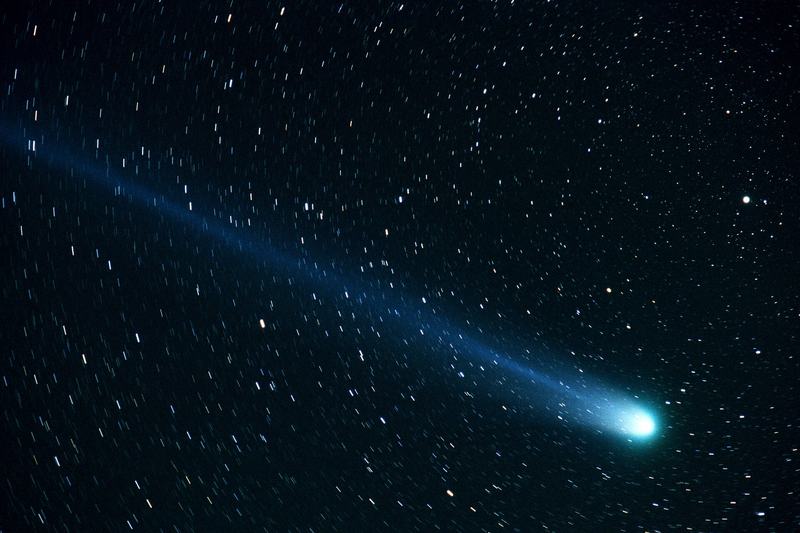

Long-period comets are thought to originate in the Oort cloud, a spherical cloud of icy bodies extending from outside the Kuiper belt to halfway to the nearest star. That second detail is easy to skip past, but it means the Oort cloud isn't just a Solar System feature tucked past Neptune — by some estimates it reaches roughly halfway to whatever star is nearest the Sun, blurring the line between "our system" and interstellar space.
Trillions of Icy Bodies, Give or Take
The outer Oort cloud may have trillions of objects larger than 1 km (0.6 mi), and billions of objects with diameters of 20 km (12 mi). Even the smaller of those two figures is difficult to picture; billions of objects the size of a small city, individually too faint to see, spread across trillions of AU of empty space.
The inner Hills cloud is thought to be even more crowded. Most estimates place the population of the Hills cloud at about 20 trillion, roughly five to ten times that of the outer Oort cloud, though the number could be ten times greater still. If those estimates hold, most of the Sun's cometary material was never in the more distant, better-known outer cloud at all — it's packed into the closer, denser inner shelf.
A Denser Inner Shelf With a Violent Origin Story
Many scientists think the Hills cloud formed from a close, roughly 800 AU, encounter between the Sun and another star within the first 800 million years of the Solar System, which could help explain the eccentric orbit of the dwarf planet Sedna. Sedna's orbit has puzzled astronomers precisely because nothing about it fits: it's too far out for Neptune's gravity to have shaped it, and too far from any planet at all.
A single ancient stellar encounter would solve both problems at once — it would explain why the inner cloud is packed as densely as it appears to be, and why an object like Sedna ended up on such a stretched-out path in the first place.
Nudged by Passing Stars and the Galaxy Itself
Comets don't just drift out of the Oort cloud on their own. Cumulatively, up to 90% of all comets originating from the Oort cloud may be the result of the galactic tide — the gentle but persistent gravitational pull of the Milky Way itself, tugging at objects so weakly bound to the Sun that even that faint force can dislodge them.
Passing stars add occasional shoves of their own. It is hypothesized that 70,000 years ago Scholz's Star passed through the outer Oort cloud, though its low mass and high relative velocity limited its effect. Looking ahead, during the next 10 million years the known star with the greatest possibility of perturbing the Oort cloud is Gliese 710 — a slow, close pass that, unlike Scholz's Star, has enough time and proximity to matter.
Detached Worlds and Interstellar Visitors
At least nine detached objects have been securely identified, of which the largest, most distant, and best known is Sedna. Detached objects sit in the gap between the well-mapped Kuiper belt and the theorized Oort cloud, and every one discovered so far has been treated as a possible clue to what the inner cloud's edge actually looks like.
Not everything that passes through the Solar System belongs to it, though. As of 2025, three interstellar objects have been discovered traveling through the Solar System: 1I/'Oumuamua in 2017, 2I/Borisov in 2019, and 3I/ATLAS in 2025. Unlike Oort cloud comets, which stay gravitationally bound to the Sun for billions of years, these three came from outside the Solar System entirely and are simply passing through — a useful reminder that not every distant visitor is evidence of the cloud itself.
The Astronomer Who Chased His Own Comet
At the age of 10, Jan Oort was with his father on the shore at Noordwijk, Netherlands, when he first saw Halley's Comet.
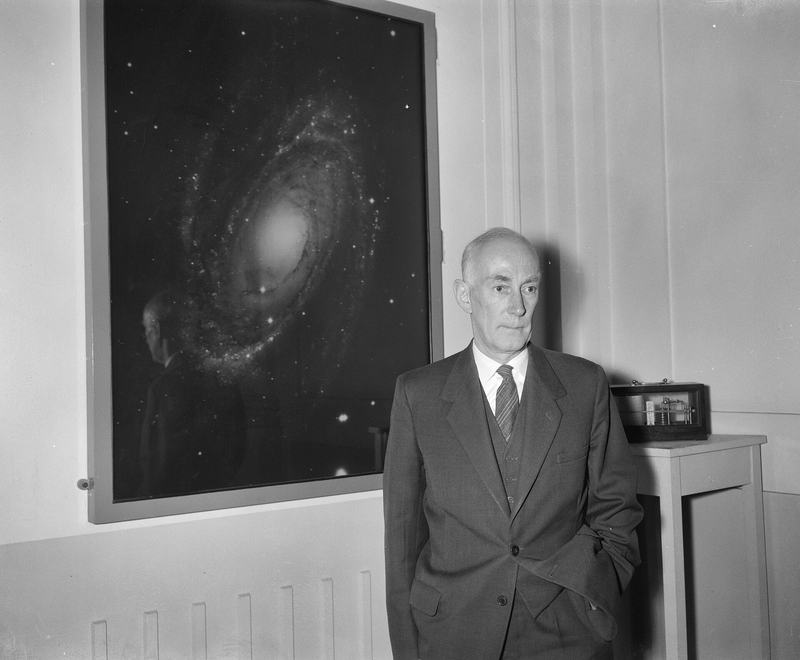

In 1986, 76 years later, he went up in a plane and was able to see the famous comet once more. By then, the reservoir of comets he had proposed decades earlier already carried his name, even though it had never been seen, and still hasn't.