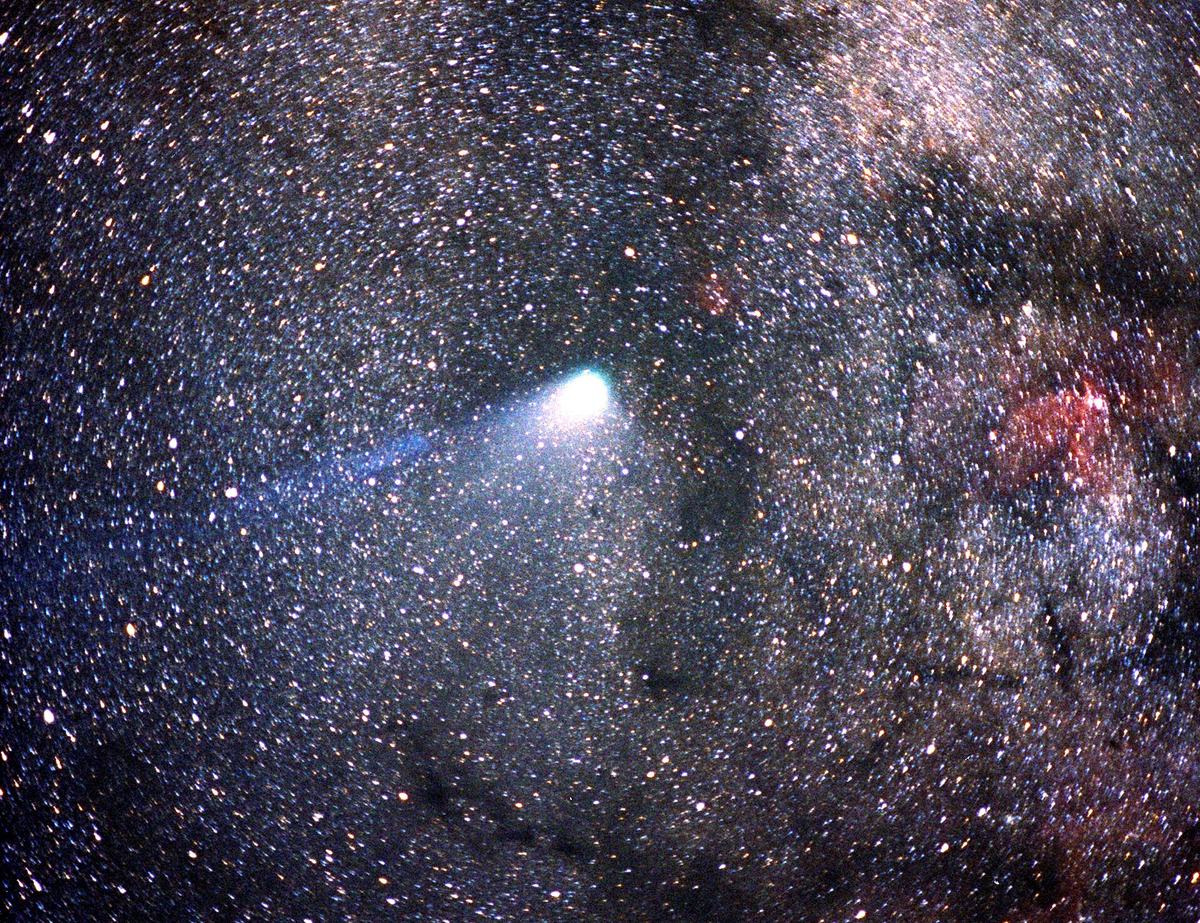
Halley's Comet is the only known short-period comet that is consistently visible to the naked eye from Earth, appearing roughly every 75-76 years, though the majority of recorded apparitions, 25 of 30, have occurred after 75-77 years. It last appeared in the inner parts of the Solar System in 1986 and will next appear in mid-2061. If you saw it as a child in 1986, 2061 is the only realistic second chance most people will get.
That predictability is exactly what makes Halley's Comet unique. Comets, as a rule, are unpredictable visitors — most swing through the inner Solar System once and vanish for millennia, or forever. Halley keeps coming back on a human-relevant schedule, close enough together that the same person can plausibly witness it twice.
Halley's periodic returns to the inner Solar System have been observed and recorded since at least 240 BC, but it was not until 1705 that Edmond Halley understood these appearances were re-appearances of the same comet. Two thousand years of sightings, treated as separate events, until one astronomer worked out they were all the same object on a long, slow loop.
The Astronomer Who Did the Math
It was Edmond Halley who, in his 1705 Synopsis of the Astronomy of Comets, used Newton's laws to calculate the gravitational effects of Jupiter and Saturn on cometary orbits, work that let him recognize the comet as periodic. Before Halley, nobody had connected the historical sightings into a single pattern — comets were assumed to be one-off events, unpredictable omens streaking past and disappearing.
Halley's calculation turned out to be more than an academic exercise. By tracing the comet's orbit backward through recorded history, he effectively gave astronomy a testable prediction: if his math was right, the same comet would return on a fixed schedule. It did, and it has been named after him ever since — a rare case of a scientist getting to see his own theory validated posthumously, decades after his death, exactly on schedule.
An Orbit That Reaches Past Pluto
Halley's orbital period has varied between 74 and 80 years since 240 BC; its orbit is highly elliptical, with an eccentricity of 0.967. On a scale from 0 (a perfect circle) to 1 (an escape trajectory), that number puts Halley's path about as stretched-out as an orbit can get while still remaining bound to the Sun.
That stretched orbit carries the comet to extremes. Halley's perihelion, its closest approach to the Sun, is 0.59 AU, closer to the Sun than Venus, while its aphelion, its farthest point, is 35 AU, roughly the orbital distance of Pluto. Over the course of one orbit, Halley swings from inside Venus's orbit all the way out past Neptune's neighborhood and back — a single object experiencing both the inner Solar System's heat and the outer Solar System's cold on a repeating, decades-long cycle.
A Tiny Core Behind a Massive Glow
.png)
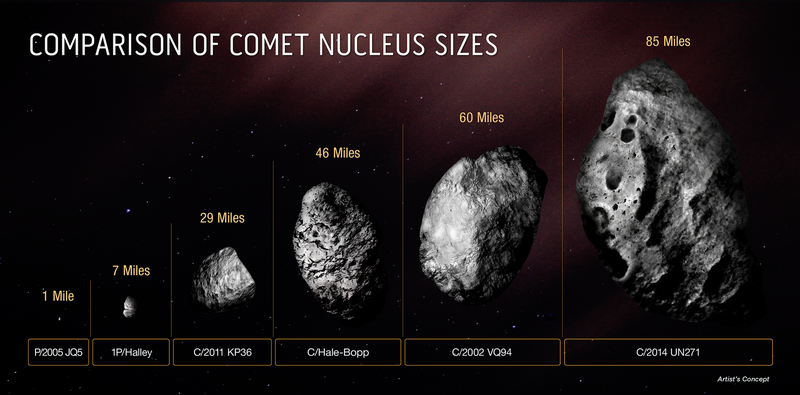
For something visible across the Solar System, Halley's actual body is surprisingly modest. Despite the vast size of its coma, Halley's nucleus is relatively small: barely 15 kilometres long, 8 kilometres wide, and perhaps 8 kilometres thick — smaller than many cities. Yet as it nears the Sun, that small nucleus produces something enormous: Halley's coma, the atmosphere that develops as the comet nears the Sun, can extend up to 230,000 km from the nucleus, while its ion tail may stretch more than 100 million km into space.
That scale isn't unique to Halley among comets, either. A comet's coma may grow up to 15 times Earth's diameter, and its tail may stretch beyond one astronomical unit; long-period comets are thought to originate in the Oort cloud, a spherical cloud of icy bodies extending from outside the Kuiper belt to halfway to the nearest star. Halley itself is a short-period comet, but the same physics that builds its coma and tail governs every comet that has ever streaked past the Sun.
Written Into Human History for Over Two Thousand Years
Few astronomical objects have as long a documented history as Halley's Comet. The first certain appearance of Halley's Comet in the historical record is a description from 240 BC in the Chinese chronicle Records of the Grand Historian — a sighting recorded more than two millennia before anyone understood what they were looking at.
.png)
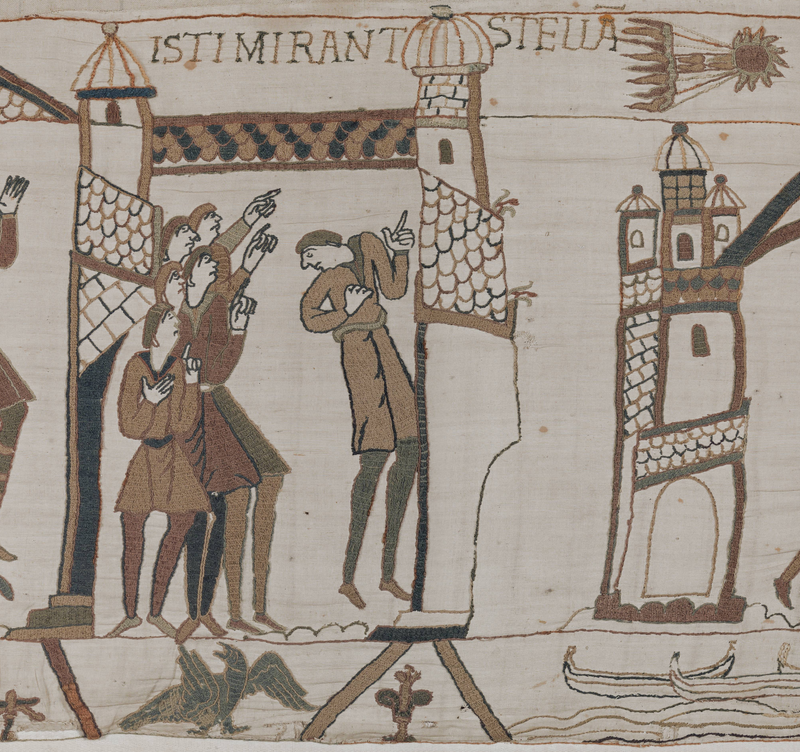
The comet has a habit of showing up at consequential moments. In 1066, the comet was seen in England and thought to be an omen: later that year Harold II of England died at the Battle of Hastings and William the Conqueror claimed the throne. Halley came within 0.10 AU of Earth at that time — a strikingly close pass, and one that fed the sense among observers that the comet was a portent of something significant.
Centuries later, the comet was still shaping how people understood the world around them. According to legend, Genghis Khan was inspired to turn his conquests toward Europe by the westward-seeming trajectory of Halley's 1222 apparition — whether or not the story is literally true, it reflects how seriously a comet's path could be read as a sign in the medieval world.
The Century Science Finally Caught Up
By the 20th century, Halley's returns had become a matter of instruments rather than omens. The comet's 1910 approach was the first for which photographs and spectroscopic data exist, and on May 19 of that year, Earth actually passed through the comet's tail — an entire planet physically moving through the wispy material trailing behind the comet's nucleus.
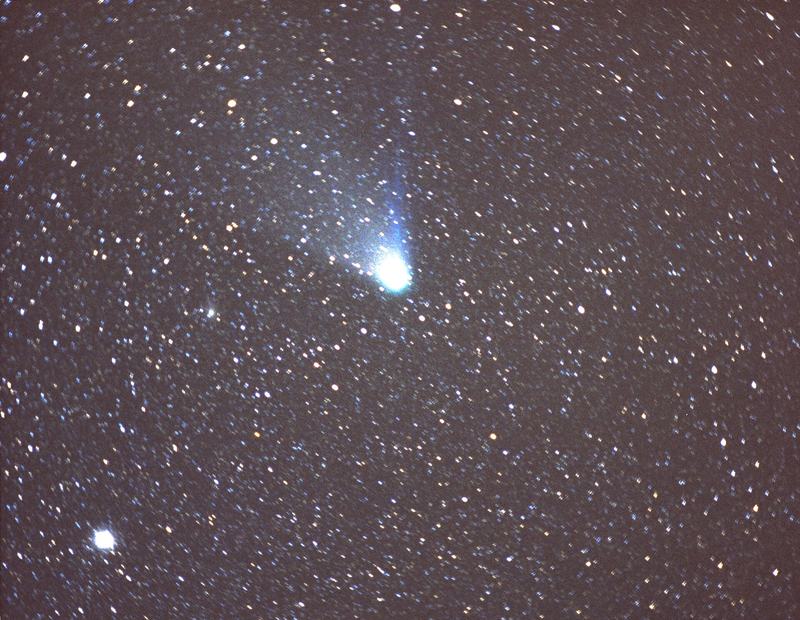

The 1986 return was less dramatic to watch but more revealing to study. The 1986 apparition of Halley's Comet was the least favourable on record; in February 1986 the comet and Earth were on opposite sides of the Sun, creating the worst possible viewing conditions for Earth observers in the previous 2,000 years. What Earth-based observers lost in visibility, spacecraft made up for in proximity: the Giotto spacecraft became the first spacecraft to make close-up observations of a comet, approaching Halley's nucleus at a distance of 596 km on March 13, 1986 — humanity's first close look at a comet's actual surface.
Even after that flyby, Halley kept surprising astronomers. In February 1991, at a distance of 14.3 AU from the Sun, Halley displayed an outburst lasting several months, brightening from about magnitude 25 to 19, unusual because comets rarely show outburst activity beyond 5 AU from the Sun. Five years after its closest approach to the Sun, and already far out past Saturn's orbit, the comet still had activity left to show.
What to Expect Next Time
The next perihelion of Halley's Comet is predicted for July 28, 2061, when it will be much better positioned for observation than in 1986, with an expected apparent magnitude of -0.3 compared to just +2.1 for the 1986 apparition — a dramatically brighter, easier-to-see appearance than the disappointing 1986 pass. On its way there, the comet has a busy itinerary: it will pass within 0.0543 AU of Venus on August 20, 2061, after passing within 0.98 AU of Jupiter on September 9, 2060.
Looking even further ahead, Halley will next come to perihelion on March 27, 2134, passing within 0.092 AU of Earth on May 7, 2134, with an expected apparent magnitude of -2.0 — brighter still than either the 1986 or 2061 apparitions. Anyone hoping to see Halley's Comet more than once in a lifetime has exactly one practical shot: catch it in 2061, and hope to still be around.