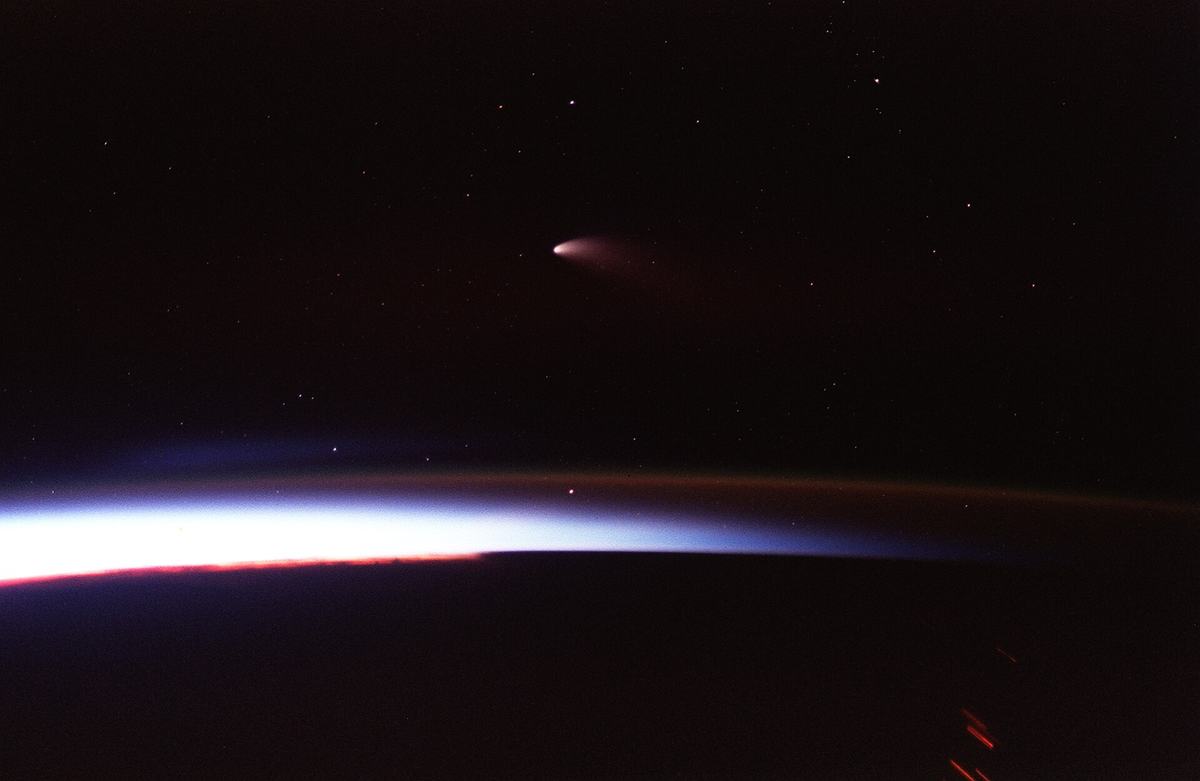
About a month after comet 17P/Holmes erupted in an outburst in October 2007, it briefly wore a dust atmosphere larger than the Sun. The comet itself, the solid chunk of ice and rock at the center of all that haze, never got any bigger than a mountain. That mismatch between a tiny frozen core and an enormous, glowing cloud is the whole story of what a comet is.
A comet is not a ball of fire streaking across the sky, whatever the name suggests to a casual observer. It is a dirty snowball a few kilometers across that spends most of its life in the cold, dark outskirts of the Solar System, and only puts on a show when it swings close enough to the Sun to start boiling off its own surface. This article looks at comets as a class of object: what they are made of, how they are classified, where they come from, and a few of the individual comets that have taught scientists the most about them.
A Rock That Grows an Atmosphere Bigger Than the Sun
The solid nucleus of a comet is generally less than 60 kilometers across, and often much smaller. Once that nucleus nears the Sun and starts releasing gas and dust, the resulting coma, the temporary atmosphere surrounding the nucleus, can span thousands or even millions of kilometers.
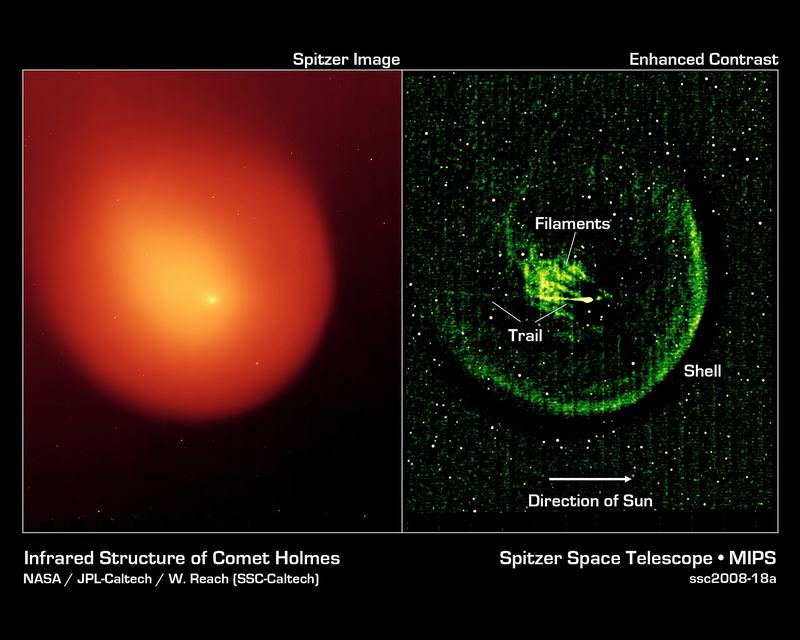

Comet 17P/Holmes is the standout example: about a month after an outburst in October 2007, it briefly had a dust atmosphere larger than the Sun, even though its nucleus stayed a modest few kilometers wide. A comet's coma can, in general, grow up to 15 times Earth's diameter, and its tail may stretch beyond one astronomical unit, the average Earth-Sun distance, into space.
None of that light comes from the nucleus glowing on its own. The outer surfaces of comet nuclei have a very low albedo, making them among the least reflective objects found in the Solar System. Nearly all the brightness a comet displays belongs to the coma and tail, not the dark little rock producing them.
Mostly Water, With a Pinch of the Ingredients for Life
Once a comet gets within 3 to 4 AU (450 to 600 million km) of the Sun, it starts to lose the ice that has kept it together for billions of years. Water makes up to 90% of the volatiles that outflow from the nucleus in that zone, which is why comets are often described as dirty snowballs rather than dusty rocks: water ice really is the dominant ingredient boiling away.
Water is not all that comets carry, though. In 2009, it was confirmed that the amino acid glycine, a basic building block of proteins, had been found in comet dust recovered by NASA's Stardust mission. That single detection is part of why researchers keep studying comets as possible delivery vehicles for the raw materials of life, not just as scenic visitors to the inner Solar System.
Short Trips, Long Trips, and One-Way Tickets Out
Comets are sorted mainly by how long they take to orbit the Sun and how tilted their orbits are. As of July 2025, astronomers have catalogued 74 known Encke-type comets, 109 Halley-type comets, and 815 Jupiter-family comets, categories built from exactly those two numbers: orbital period and inclination. Jupiter-family comets have the shortest, flattest orbits of the group; Halley-type comets swing wider and can tilt at steep angles.
Long-period comets play by different rules entirely, and the odds are brutal for them. About half of all long-period comets are ejected from the Solar System entirely on their very first pass by the Sun, flung out by the gravity of the planets they pass on the way in. A comet that has waited thousands of years in the cold for its one trip past the Sun has roughly a coin-flip's chance of ever getting a second one.
Visitors From Beyond the Solar System
Every comet discussed so far still belongs to the Sun's own family, however loosely. That is not true of all of them. As of 2025, three objects have been discovered with an eccentricity significantly greater than one, 1I/'Oumuamua, 2I/Borisov, and 3I/ATLAS, and that number is the giveaway: an eccentricity above one means an open, hyperbolic path rather than a closed orbit, indicating an origin outside the Solar System.
These interstellar comets did not form anywhere near the Sun. They were ejected from other star systems entirely, drifted through the galaxy for who knows how long, and happened to pass close enough to be noticed on their way through. Unlike homegrown comets, they will not be back.
The Comet With a Third Tail
Most comets that become visible from Earth show two tails: a straight blue gas tail pushed directly away from the Sun by the solar wind, and a curved, yellowish dust tail that lags behind along the comet's orbit. Comet Hale-Bopp, one of the most closely studied comets of the 20th century, showed scientists there could be a third kind.
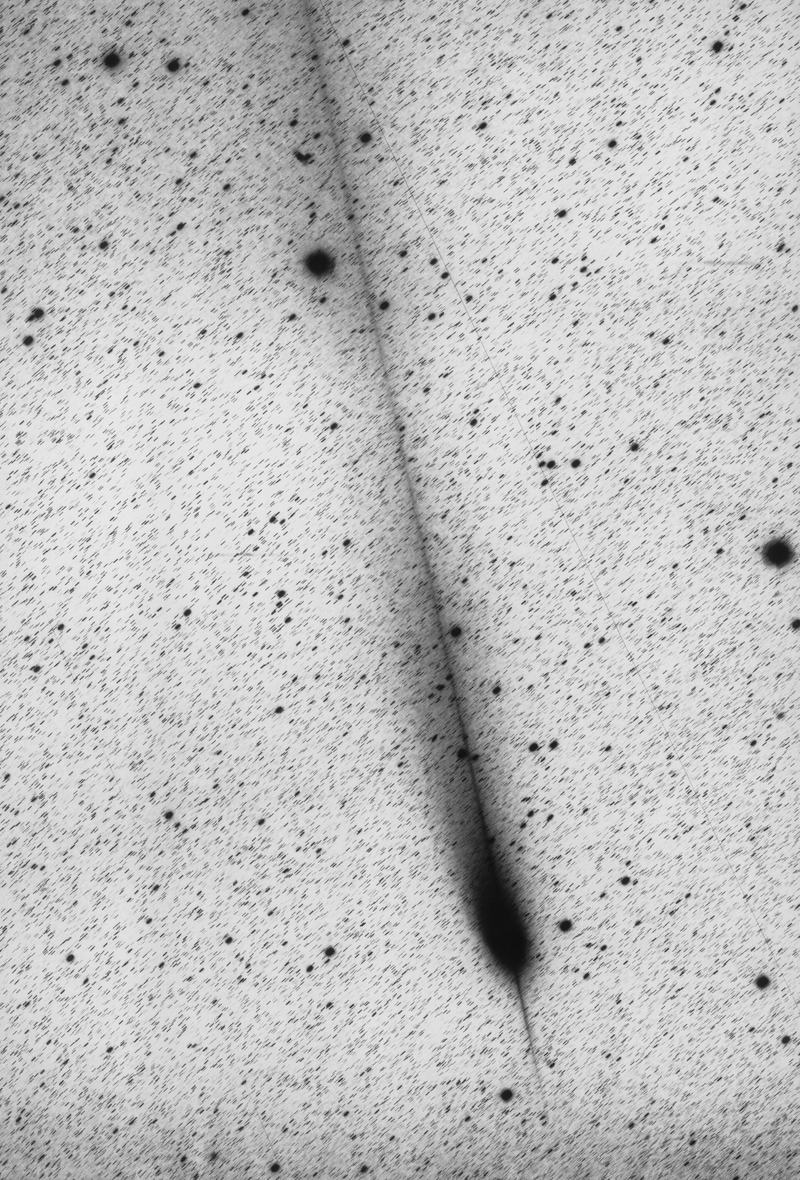

Beyond its ordinary gas and dust tails, Hale-Bopp turned out to have a third type of tail: a faint sodium tail, visible only with powerful instruments fitted with dedicated filters. Hale-Bopp's sodium tail was made of neutral atoms rather than ions, and it extended about 0.33 AU (49 million km) into space, roughly a third of the distance from the Sun to Earth. Hale-Bopp had already made history simply by being found: it was spotted by amateur astronomers while still 7.2 astronomical units from the Sun, between the orbits of Jupiter and Saturn, by far the greatest distance at which a comet had ever been found by amateurs. A sodium tail on top of that was a bonus discovery nobody had built the observing campaign around.
When a Comet Meets a Planet
Comets do not always survive their trips through the Solar System intact, and sometimes their endings are witnessed in real time. Comet Shoemaker-Levy 9 broke into pieces after a close encounter with Jupiter in July 1992. Over six days in July 1994, those pieces fell into Jupiter's atmosphere one after another, the first time astronomers had observed a collision between two objects in the Solar System.
It was a live demonstration of a fate that had always been theoretical before: Jupiter's gravity, the same force that helps define the Jupiter-family comets, can just as easily end a comet's story as shape its orbit.
Where Comets Come From, and Where One Got a Close-Up
Comets have two known homes far beyond the planets.

The Kuiper belt, one of the two reservoirs comets come from, is similar to the asteroid belt but far larger: 20 times as wide and 20 to 200 times as massive. It is the source of most short-period comets, the ones that swing back through the inner Solar System on human timescales.
Farther out still is the Oort cloud, theorized to be a cloud of billions of icy planetesimals surrounding the Sun at distances ranging from 2,000 to 200,000 AU. It was proposed in 1950 by the Dutch astronomer Jan Oort, and is named for him; it is thought to be the source of the long-period comets, the ones whose orbits take them out of the Solar System's neighborhood entirely between passes.
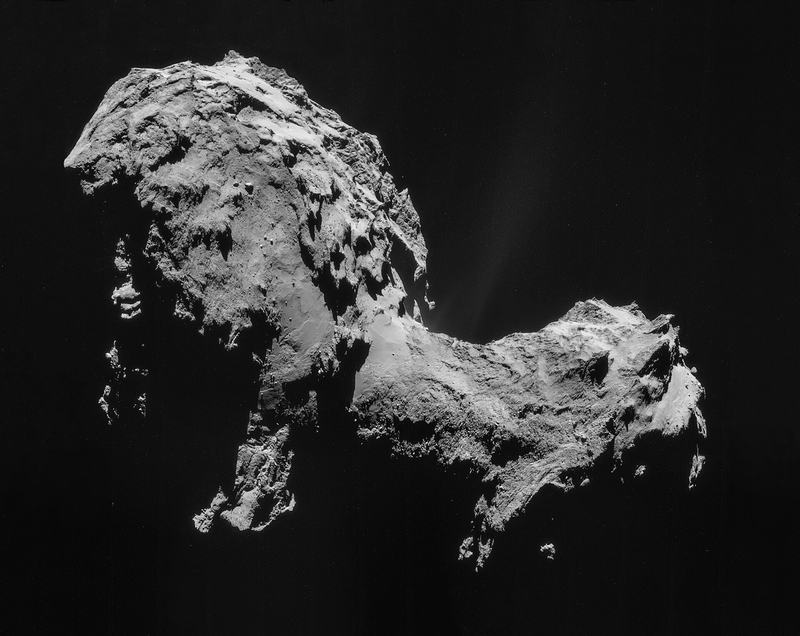
Getting an up-close look at a comet from either reservoir took decades of engineering. The Rosetta mission was the first mission to include an orbiter that accompanied a comet for several years, plus a lander that collected close-up data from the comet's surface. It launched in 2004, arrived at comet 67P in 2014, and concluded with a touchdown on the comet's surface in 2016.
Fear, Fascination, and a Yearly Fireworks Show
Long before spacecraft could visit a comet, they were unsettling enough just to look at. Spectroscopic analysis in 1910 found the toxic gas cyanogen in the tail of a comet passing near Earth, causing panicked buying of gas masks and quack "anti-comet pills" and "anti-comet umbrellas" by the public, even though Earth was never in any real danger from a tail that thin.
Comets leave a gentler mark on the sky too, one most people have watched without realizing it. The Perseid meteor shower happens every year between August 9 and 13, when Earth passes through the orbit of Comet Swift-Tuttle. Every "shooting star" in that display is a speck of debris the comet shed on a previous pass, still following roughly the same path long after the comet itself has moved on.