
On 15 February 2013, a fireball over the Russian city of Chelyabinsk briefly burned brighter than the Sun and stayed visible from up to 100 kilometers away. It was, physically, the same kind of event as an ordinary "shooting star" wished upon on a summer night, just enormously larger and closer to the ground.
A meteor is not a star at all, falling or otherwise. It is the glowing streak produced when a small body, usually a meteoroid, is heated to incandescence by colliding with air molecules high in Earth's atmosphere. The object itself is almost always tiny; the light show it produces is what gets noticed. This article is about that light: what causes it, how big and fast the objects behind it are, and what happens when one gets big enough to make headlines.
The Shooting Star That Isn't a Star
The name "meteor" is older than the science behind it. It comes from the Greek meteōrítēs, meaning "high in the air," a description ancient observers applied to any bright transient thing they saw overhead, long before anyone understood that a meteor is the visible passage of a small body burning up in the atmosphere rather than a genuine star.
That gap between the old name and the modern explanation is why "shooting star" and "meteor" describe the exact same phenomenon: a brief streak of light caused by a speck of debris, not by anything stellar at all.
Where the Show Happens
Meteors are a strictly upper-atmosphere event. They typically occur in the mesosphere, at altitudes of 76 to 100 kilometers -- far higher than commercial jets fly, and higher than most weather. More precisely, a meteoroid usually becomes visible somewhere between about 75 and 120 km above Earth and burns out again by the time it has dropped to an altitude of 50 to 95 km.
That narrow band matters because it means almost nothing about a typical meteor happens close to the ground. Whatever a viewer on Earth sees streak across the sky has already finished its show tens of kilometers above any aircraft, let alone any building.
From Sand Grain to Fireball
The size mismatch between cause and effect is the most counterintuitive part of the whole phenomenon. Most meteoroids that cause meteors are about the size of a grain of sand -- usually 1 millimeter across or smaller -- yet that speck can produce a streak bright enough to catch a stranger's eye from the ground. Meteoroids as a category run larger too, defined as objects significantly smaller than asteroids and ranging from grains up to about one meter wide; anything bigger is generally classed as an asteroid instead.
Speed does a lot of the work that size can't. The fastest meteoroids move at about 42 km/s in the vicinity of Earth's orbit, and Earth itself is moving at about 29.6 km/s around the Sun. Add those together and the numbers explain why meteors can look so violent for something so small: when a meteoroid meets the atmosphere head-on, which only happens for meteors in a retrograde orbit such as the Leonids (tied to the retrograde comet 55P/Tempel-Tuttle), the combined closing speed can reach about 71 km/s. At that velocity, a grain of sand carries enough kinetic energy to briefly outshine everything else in the sky around it.
Sporadic Meteors, and the Ones With a Schedule
Not every meteor belongs to a named event. Meteors occur either in showers, which happen when Earth passes through a stream of debris left behind by a comet, or as sporadic meteors, unconnected to any specific stream of space debris and capable of appearing on any night of the year. A shower meteor is following a path shared with countless others from the same source; a sporadic meteor is a one-off, arriving from a random direction with no other debris nearby.
Fireball, Bolide, Superbolide: A Naming Ladder
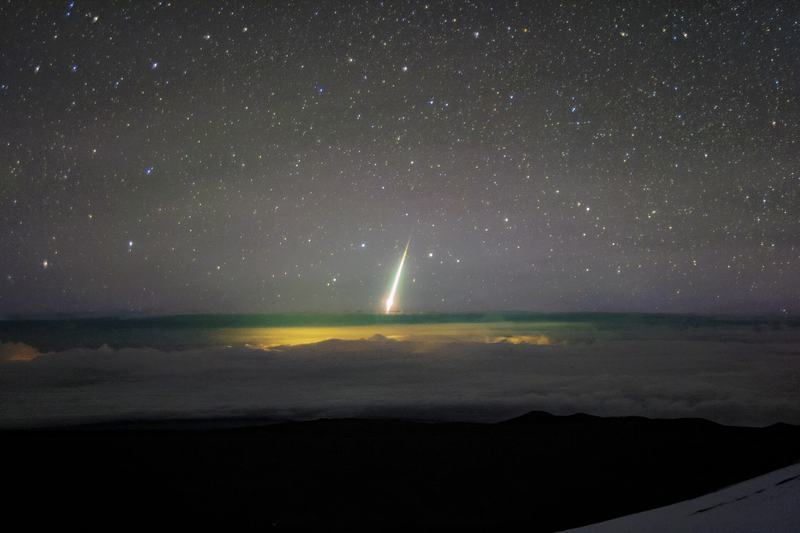
Once a meteor gets bright enough, astronomers stop calling it a meteor and start using more specific words, each with its own threshold. The International Astronomical Union defines a fireball as a meteor brighter than any of the planets, at apparent magnitude -4 or greater. Push the brightness further and the vocabulary changes again: fireballs reaching apparent magnitude -14 or brighter are called bolides, and if the magnitude reaches -17 or brighter, the event is called a superbolide.
.jpg)
The ladder isn't perfectly tidy, though. The IAU has no official definition of "bolide" at all, and generally treats it as just another word for fireball, even though in practice the term tends to get applied specifically to fireballs of magnitude -4 or brighter. In other words, "bolide" and "fireball" overlap in everyday use far more than the neat magnitude thresholds above might suggest.
The Trail a Meteor Leaves Behind
A meteor doesn't necessarily vanish the instant it stops glowing. Once a meteoroid has decelerated to roughly 2 to 4 km/s, it enters what is called dark flight: still falling, but no longer hot enough to produce visible light.
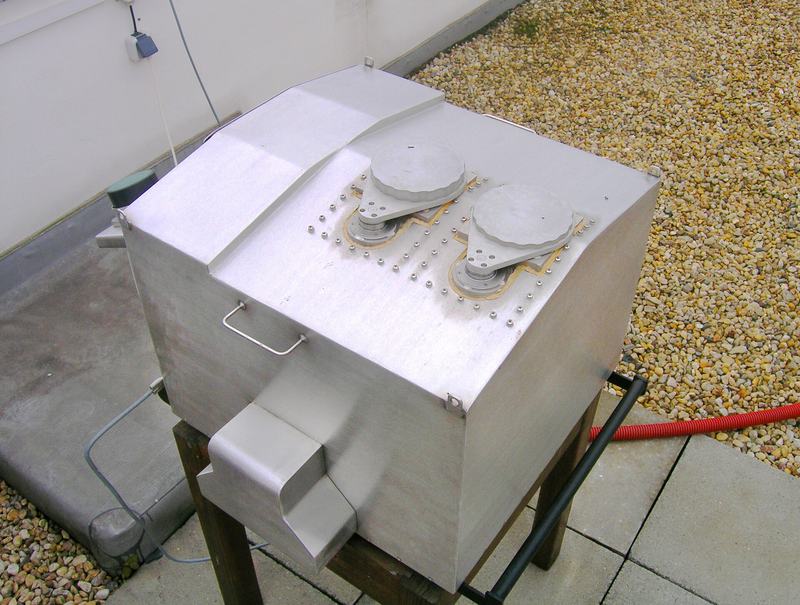

Above that point, though, a meteor can leave more than a memory. The column of ionized air it creates on the way down, its ionization trail, can persist for up to 45 minutes, long enough that radio operators and radar systems can pick up brief reflections off it well after the visible streak is gone.
Meteors can also be heard, not just seen, though the sounds involved are strange enough that scientists took a long time to trust the reports. During the Leonid meteor shower of 2001, observers described "crackling," "swishing," or "hissing" sounds occurring at the exact same instant as a meteor's flare, seemingly impossible given how far away and how high up the meteor actually was. Controlled sound recordings made in Mongolia in 1998 backed up the reports, supporting the idea that these simultaneous sounds are real rather than imagined.
Chelyabinsk: A Meteor Bright Enough to Sunburn
Most meteors are forgotten within seconds by everyone who sees them. The Chelyabinsk meteor is the exception that shows what happens when the same physics scales up. It was a superbolide that entered Earth's atmosphere over Russia's southern Ural region on 15 February 2013 at about 09:20 local time, produced by a roughly 18-meter, 9,100-tonne near-Earth asteroid that hit the atmosphere at a shallow 18-degree angle and a speed relative to Earth of about 19.2 km/s.
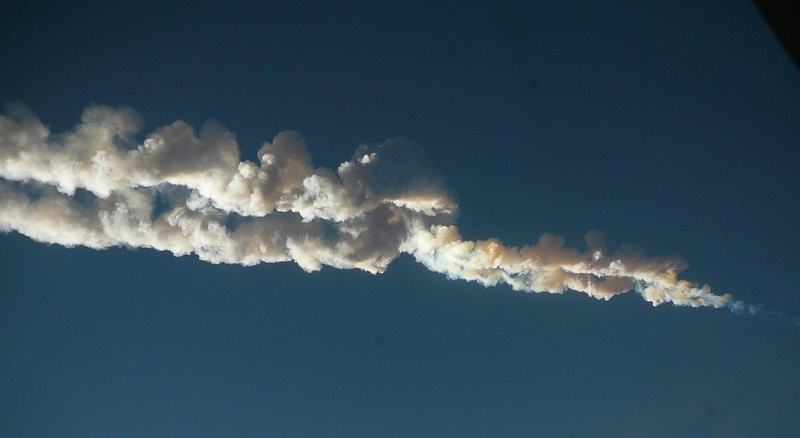

For a few seconds, the light from that meteor was brighter than the Sun and stayed visible from as far as 100 kilometers away, farther than the distance from the city itself to several surrounding towns. It is thought to be the biggest natural object to enter Earth's atmosphere since the 1908 Tunguska event, and the only one confirmed to have caused widespread injury: Russian authorities reported that 1,491 people sought medical attention in Chelyabinsk Oblast in the following days, and 112 were hospitalized.
Chelyabinsk is a reminder that a meteor is not always a harmless streak for wishing on. Almost all of them are; this one was a rare exception, and it is the scale of the object involved, not anything different about the underlying physics, that made the difference.