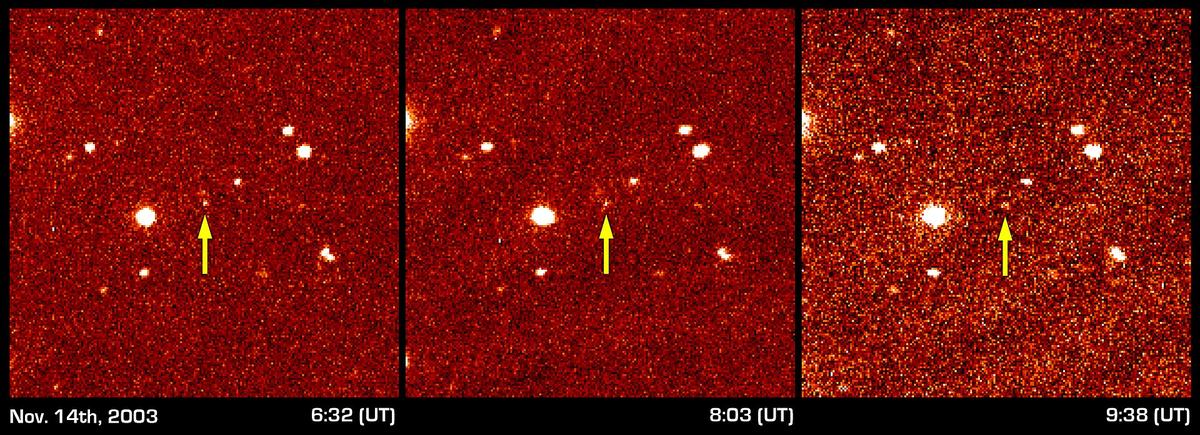
Sedna takes about 11,400 years to complete one orbit of the Sun — the longest orbital period of any known object of its size or larger. It was discovered in 2003, and it spends nearly all of that immense year far beyond Neptune, in a region of space usually described only in theory: the inner edge of the Oort cloud.
Sedna isn't a household name like Pluto, but it forces astronomers to rethink where the Solar System actually ends. Its orbit is so stretched out, its origin so hard to explain with known physics, and its size so stubbornly uncertain that it has become one of the more debated objects ever found beyond Neptune. Here's what a fact-checked look at Sedna turns up, from the accidental way it got its name to a close approach that will not repeat for more than 11 millennia.
A Year That Outlasts Written History
At its farthest, Sedna's aphelion carries it about 937 AU from the Sun — roughly 19 times farther out than Pluto ever gets. At its closest, its perihelion is still 76.19 AU away, which already puts it well beyond Neptune. That gap between 76.19 and 937 AU is what makes Sedna's orbit so extreme, and it's also the detail that has driven a decades-long argument over how Sedna got there in the first place, since most objects on paths this stretched-out were flung outward by a planet's gravity at some point.
An orbit this long means Sedna's "year" spans roughly the entire span of recorded human civilization several times over. Whatever was watching the sky when Sedna last swung this close to the Sun left no written record at all — the object simply predates writing.
One of the Coldest Places Ever Measured
Near aphelion, Sedna is one of the coldest places in the Solar System: temperatures there never climb above -240°C (-400°F). Distance also changes what the sky looks like. Instead of a disk, the Sun becomes a point of light among the stars, and even at its brightest that point is only about 45% as bright as a full moon looks from Earth. It's still the brightest object in Sedna's sky by far, but daylight, in any familiar sense, does not exist out there.
That combination of cold and dimness is part of why Sedna went unnoticed for so long. A world this small, this far away, reflecting this little sunlight, only becomes detectable with instruments built specifically to catch faint, slow-moving light.
A Camera Built to Catch a Crawl
Sedna was discovered on 14 November 2003 by Michael Brown, Chad Trujillo and David Rabinowitz. The discovery survey used the Samuel Oschin telescope at Palomar Observatory together with Yale's 160-megapixel Palomar Quest camera, a purpose-built instrument for scanning wide patches of sky for faint, slow-drifting objects — exactly the kind of signature a body at Sedna's distance produces.
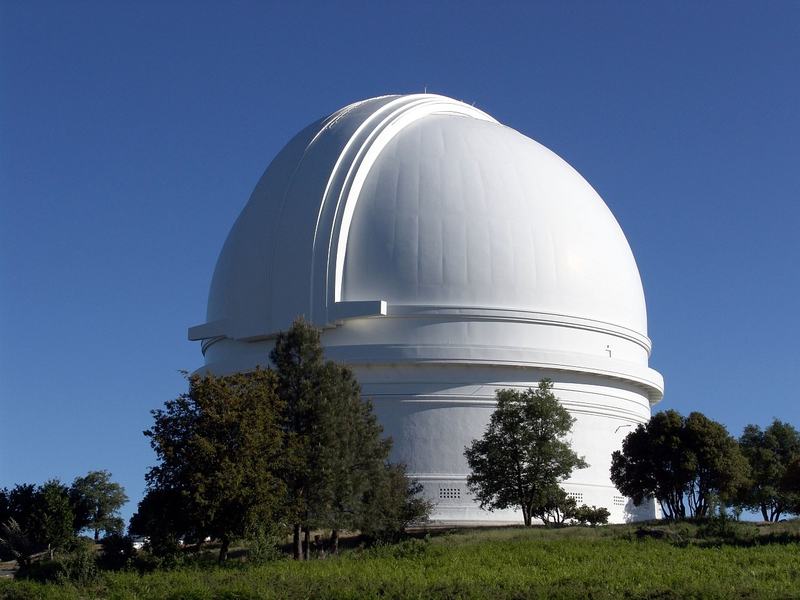

At the time of its discovery, Sedna was the brightest object found in the Solar System since Pluto in 1930. Across every planet-hunting survey run in the decades between those two discoveries, nothing brighter had turned up. It took a purpose-built, wide-field survey camera to finally catch something that had been sitting in the sky the whole time.
A Name Chosen by Mistake
Sedna is named after the Inuit goddess of the sea. Discoverer Michael Brown has said he partly chose the name because he mistakenly thought the Inuit were the polar culture closest to his home in Pasadena — a geographic assumption that turned out to be wrong, though the name stuck regardless. Its lasting appeal, by his own account, also came down to something simpler: it was easy for English speakers to pronounce, unlike some of the rival names considered for other distant objects.
It's a small reminder that even scientific naming, governed by international committees and formal nomenclature rules, still runs through very human, sometimes mistaken, reasoning.
A Size Nobody Can Quite Pin Down
Sedna's diameter has been revised more than once as instruments improved. In 2012, measurements from the Herschel Space Observatory put Sedna's diameter at 995 ± 80 km, which would make it smaller than Pluto's moon Charon. In 2013, the same team re-analyzed Sedna's thermal data and found a diameter of about 906 km, with wide error margins of +314/-258 km — a wider range of uncertainty than the earlier estimate, despite the improved model.
That persistent uncertainty comes down to a basic limitation: Sedna has no known moon. Without one to measure orbital tugs against, scientists have no direct way to weigh Sedna or pin its size down precisely, and have to infer both from how much sunlight and heat it reflects and radiates from billions of kilometers away.
Tied for the Largest Moonless Dwarf Planet
That same lack of a moon puts Sedna in an unusual tie. Within the range of measurement uncertainty, Sedna is tied with Ceres, in the asteroid belt, as the largest known dwarf planet not known to have a moon. Every other dwarf planet larger than the two of them has at least one confirmed satellite.
Maybe the First Known Visitor From the Oort Cloud
In the paper announcing its discovery, Brown and his colleagues described Sedna as the first observed body belonging to the Oort cloud. The Oort cloud is theorized to be a cloud of billions of icy planetesimals surrounding the Sun at distances ranging from 2,000 to 200,000 AU, an idea whose existence was proposed in 1950 by Dutch astronomer Jan Oort, in whose honor it was later named. No one has ever directly observed the Oort cloud itself — it's inferred from the orbits of long-period comets thought to originate there.
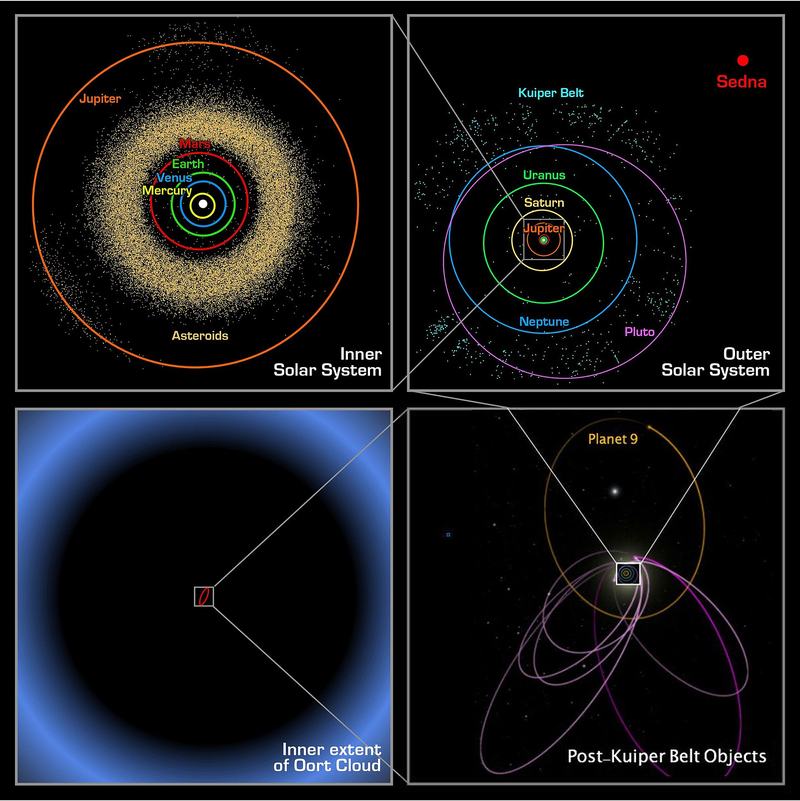

Sedna's perihelion, at 76.19 AU, is far too distant for Neptune's gravity to have flung it onto its current path, which is why Brown's team looked toward the Oort cloud's inner edge for an explanation instead of the more common scattering mechanisms that shape most distant Solar System objects.
Not the Only One Out There
Sedna isn't alone in defying the usual explanations. At least nine detached objects have been securely identified, and Sedna is the largest, most distant and best known of them. Detached objects share Sedna's basic trait: orbits too far from Neptune to have been shaped by its gravity, which is exactly the puzzle that makes them, collectively, one of the more actively studied populations in the outer Solar System.


His track record in this area goes well beyond one object. He is credited with the discovery or co-discovery of 29 minor planets, including Eris, the only trans-Neptunian object known to be more massive than Pluto, a discovery that led directly to Pluto's demotion from planet status. The same astronomer who helped end Pluto's planetary status also found the object that reopened the question of where the Solar System's boundary really lies.
A Once-in-11-Millennia Window
Sedna will come to perihelion around July 2076, and this close approach provides a window for study that will not occur again for more than 11 millennia. Compared with its usual position tens of billions of kilometers out, a 2076 perihelion still leaves Sedna far from the Sun — but it's as close as this object gets, and it's the only such opportunity anyone alive today will ever see.