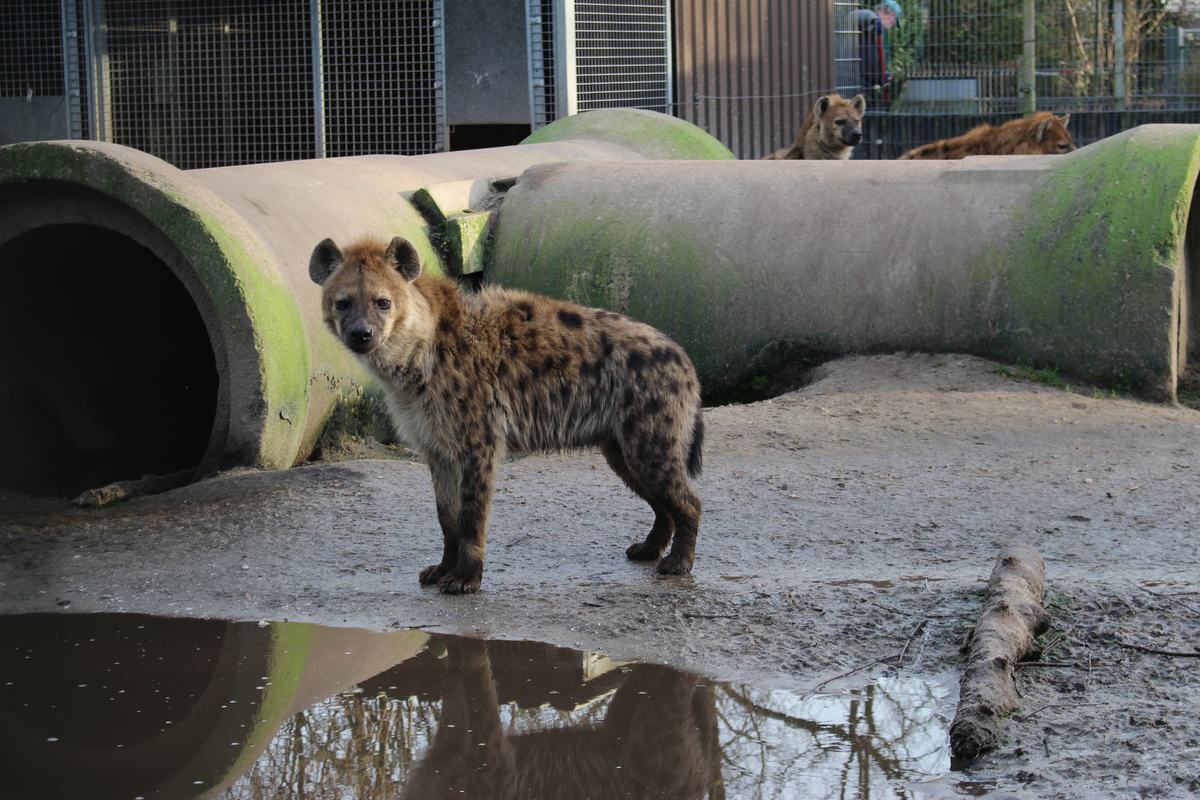
Ask most people to sort a hyena into a box, and they will file it under 'dog'. It looks a bit like one, it lives in a group, it even sort of grins. All reasonable. All wrong. Hyenas are closer to cats than to any dog, and that is only the first odd thing about them.
Not Dogs, Actually Cat Cousins
Hyenas sit on the cat side of the carnivore family tree, the feliforms, alongside mongooses and civets [1]. Dogs sit on the other branch entirely. The resemblance is a coincidence of lifestyle, not family. They evolved a doglike body because chasing and scavenging across open ground rewards long legs and stamina. So the next time someone calls a hyena a wild dog, you may correct them. Gently.
The Females Are in Charge
Spotted hyena society is run by females, and they are the bigger sex, roughly ten percent heavier than the males [1]. Every clan is a matriarchy, and even the lowest-ranking female outranks the top male [1]. Rank passes from mother to cub, rather like a hereditary title. A male who joins a new clan starts at the very bottom and has to work his way up. Which, fair enough.

That Laugh Means Something
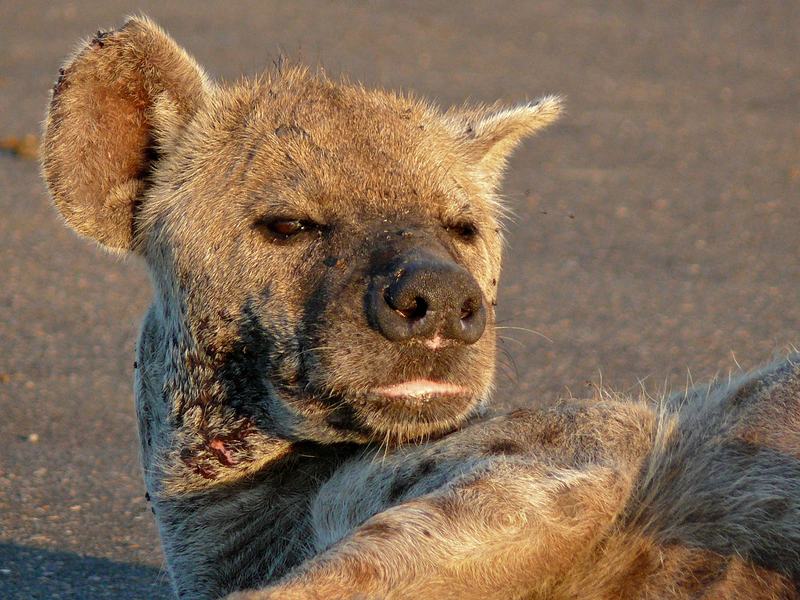
The famous hyena 'laugh' is not amusement. It is a burst of high, giggling notes that a spotted hyena makes when it is excited, nervous, or under pressure, often around food or a squabble [3]. Researchers have found the pitch and tone carry information about the animal's age and status [3]. So it is less a laugh and more a running commentary, shouted. My Year 4 class found this deeply satisfying.
Built to Crush Bone
A spotted hyena's jaw is one of the strongest of any mammal its size, powerful enough to crack open the leg bone of a giraffe [2]. Nothing goes to waste. Their stomachs digest bone, skin, and teeth, which is why their droppings often dry to a chalky white, packed with calcium [2]. As it turns out, a hyena is a walking recycling scheme. Not glamorous, but very efficient.
Hunters, Not Just Scavengers
The image of the hyena as a cowardly scavenger is mostly a slander. Spotted hyenas are skilled hunters that kill much of their own food, running down prey over long distances in coordinated groups [3]. Lions, in fact, steal from hyenas at least as often as the reverse. The two are rivals, not partners, and the theft goes both ways [3].

Four Very Different Species
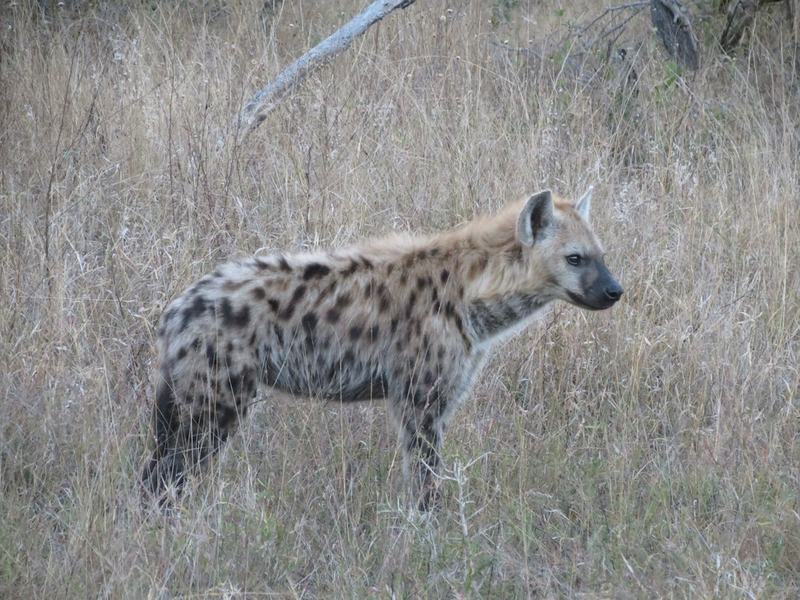
There are four species of hyena, and they are not all bone-crunching pack hunters [2]. The spotted hyena is the big social one, found across much of sub-Saharan Africa, while striped hyenas range as far as the Middle East and India [5]. The striped and brown hyenas are quieter and more solitary. And the fourth, the aardwolf, has given up meat almost entirely to eat termites, licking up hundreds of thousands in a single night [2]. Same family, wildly different dinner.
Clever in Ways That Surprise Researchers
Hyenas are properly clever. In experiments, captive spotted hyenas solved cooperative puzzles that needed two animals to pull ropes together, and in some tests they outperformed chimpanzees at working as a pair [4]. Decades of study in Kenya suggest their social intelligence rivals that of some primates, likely shaped by the demands of clan life [4]. Big brains, it seems, come from big social diaries.
Cubs Born Ready
Hyena cubs do not mess about. Spotted hyena young are born with their eyes open and their front teeth already through, unusually advanced for a carnivore [2]. Within minutes they can crawl, and siblings sometimes tussle over rank almost straight away. It is a brisk start to life. Nobody warned me about this the first time I read it.
Frequently Asked Questions
Are hyenas dogs or cats?
Neither, but they are far closer to cats. Hyenas belong to the feliform group of carnivores, alongside mongooses and civets, while dogs sit on a separate branch [1]. Their doglike shape evolved independently for a running, scavenging lifestyle rather than through any shared ancestry with dogs.
Why do hyenas laugh?
The giggling call is a sign of excitement or stress, not humour. Spotted hyenas make it around food or during conflict, and its pitch signals the animal's age and social rank [3]. It works as a genuine form of communication within the clan rather than an expression of amusement.
Do hyenas really hunt their own food?
Yes. Spotted hyenas are effective hunters that kill much of what they eat, working in coordinated groups to run down prey [3]. They also scavenge, and they lose kills to lions roughly as often as they steal them, so the rivalry runs both ways.
How strong is a hyena's bite?
Extremely strong. A spotted hyena can crush large bones that most predators cannot, and its digestive system then breaks down bone, skin, and teeth [2]. This lets it get nourishment from carcasses that other animals abandon as scraps.
Are female hyenas dominant?
In spotted hyenas, yes. Females are larger than males and outrank every male in the clan, with social rank inherited from the mother [1]. Males usually leave to join a new clan as adults and start again at the bottom of the ladder.