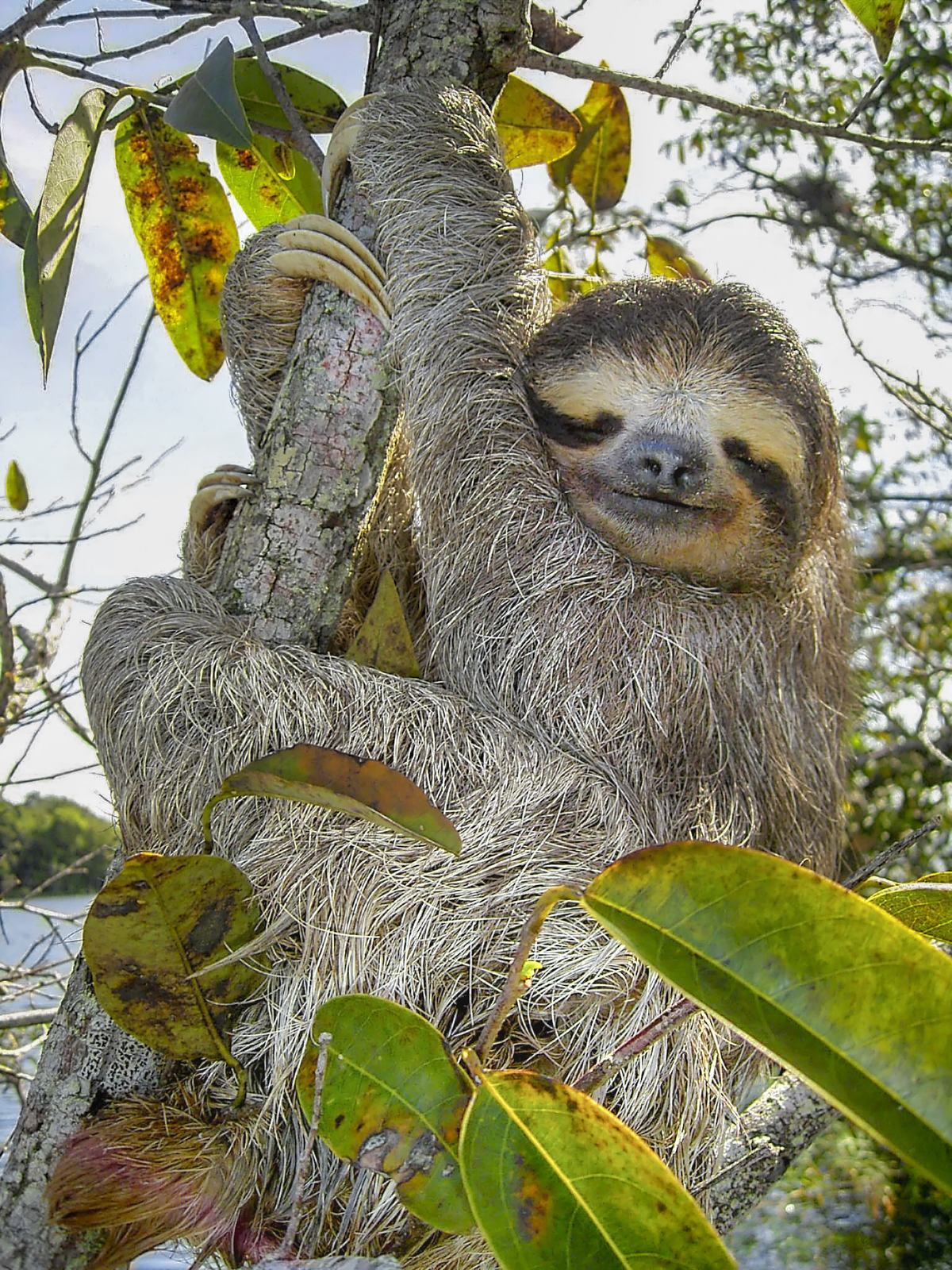
If you asked my Year 4 class to name a lazy animal, half of them would say the sloth before I finished the question. And they would be wrong, sort of. A sloth is not lazy. A sloth is running one of the most efficient energy budgets in the animal kingdom, and doing it upside down. Here is what is actually going on up in those trees.
Slow on Purpose, Not by Accident
Sloths eat mostly leaves, and leaves are a rubbish meal - low in calories and hard to digest [1]. So a sloth has done the maths. It moves as little as it can get away with, sometimes only around 40 metres in a whole day [2]. Its muscles are light, its metabolism is turned right down, and it saves energy at every turn. Slow, in other words, is the strategy. (Which, fair enough.)
The Weekly Trip to the Toilet
This is the one my class never forgets. A sloth climbs all the way down from its tree to go to the toilet, and it does this only about once a week [2]. It digs a little hole at the base, does its business, then climbs back up. Coming to the ground is the most dangerous thing a sloth does, since it cannot run from anything. Nobody has fully settled why they bother instead of just going from the branches. And yet, down they come.

Fur With Its Own Garden
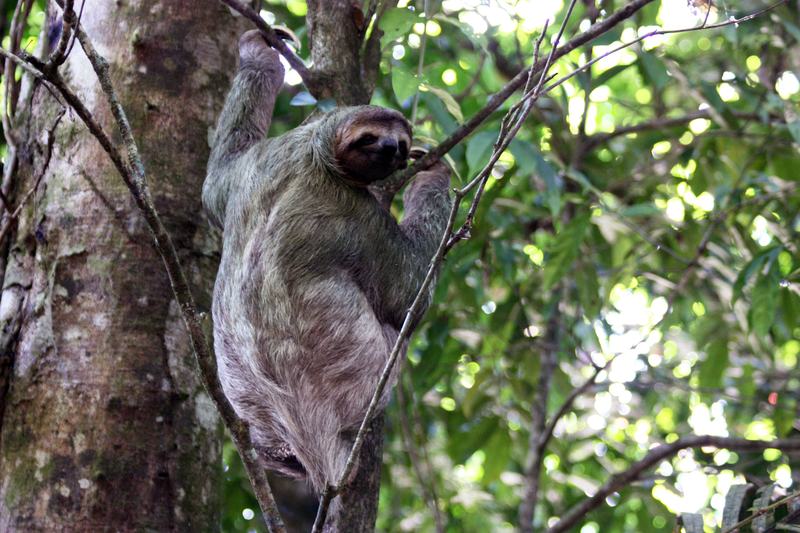
A sloth moves so slowly that algae grows in its fur, giving many wild sloths a faint green tinge [3]. That green is useful camouflage among the leaves. Better still, the fur is a whole little ecosystem: moths live in it, and their waste helps feed the algae, and the sloth may even snack on the algae for a top-up of nutrients [3]. It is, essentially, a walking (very slowly walking) garden.
Two Toes, Three Toes, Six Species
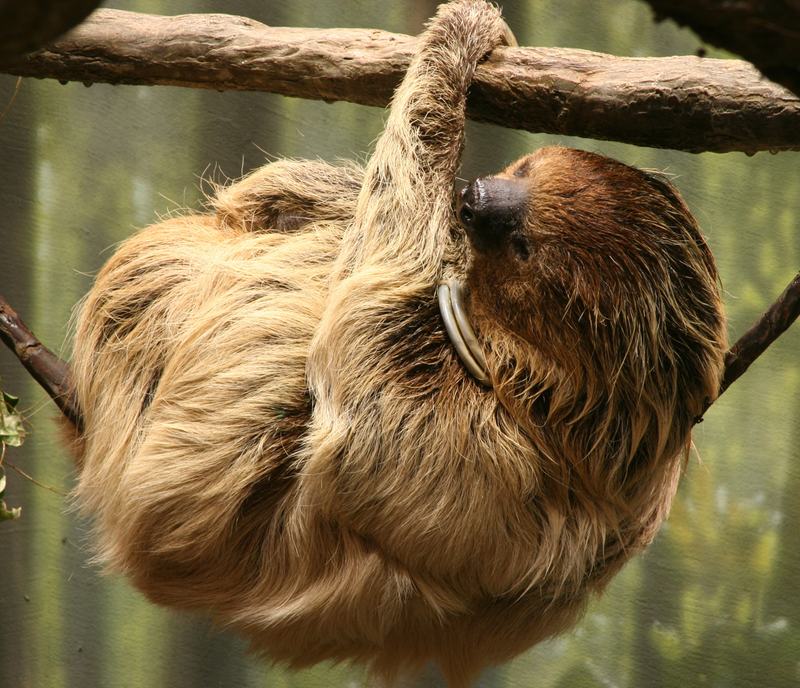
There are six living species of sloth, split into two groups: the two-toed sloths and the three-toed sloths [1]. The names are a bit of a trap, though. Every sloth has three toes on its back feet. The difference is on the front limbs, where two-toed sloths have two fingers instead of three [1]. So a "two-toed" sloth is really a two-fingered one. (Nobody warned me about this either.)
Built to Hang Upside Down
A sloth's claws are long, curved hooks, roughly 8 to 10 centimetres, and they work like coat hangers [4]. The grip is so passive that a sloth can hang from a branch while fast asleep and not fall. Their fur even grows the opposite way to most mammals, parting along the belly and running towards the back, so that rain drains off while they dangle upside down [5]. Everything about the body says: hang first, ask questions later.

Surprisingly Good in Water
Here is the fact that stops people mid-sip. Sloths are strong swimmers, far better in water than on land [2]. They can slow their heart rate to about a third of normal and hold their breath for up to 40 minutes underwater [2]. A sloth doing a slow breaststroke across a river is a genuinely odd sight, and it can move about three times faster swimming than it ever manages on a branch. Somehow.
A Neck That Turns Too Far
Most mammals, from mice to giraffes, have exactly seven neck bones. Three-toed sloths break the rule, with up to nine cervical vertebrae [1]. Those extra bones let a three-toed sloth swivel its head around roughly 270 degrees [1]. Since the rest of it barely moves, being able to look almost all the way behind without turning the body is quite handy for spotting trouble.
Digestion in Slow Motion
The slowness goes all the way down. A sloth has a large, multi-chambered stomach full of bacteria to break down tough leaves, and a single meal can take weeks, sometimes up to a month, to digest fully [4]. That slow gut is part of why they eat so little and move so rarely. It also means a sloth's stomach is often close to a third of its body weight in leaves quietly fermenting away.
They Sleep Less Than You Think
For years, sloths in zoos were clocked sleeping 15 to 20 hours a day, and the "sleepy sloth" label stuck. Then researchers put recording caps on wild sloths and found they actually sleep closer to 9.6 hours [6]. So the champion nappers of the animal world are, in the wild, getting about as much sleep as a tired teacher. The reputation was mostly built in captivity.
Frequently Asked Questions
Why do sloths move so slowly?
Sloths eat mainly leaves, which give very little energy and are slow to digest. To survive on such a poor diet, they keep their metabolism and muscle mass low and move as little as possible. Their slowness is an energy-saving adaptation, not laziness.
Do sloths really only poop once a week?
Yes. Most sloths climb down from their tree to defecate roughly once a week, digging a small hole at the base before climbing back up. Descending to the ground leaves them exposed to predators, which makes this weekly habit one of the riskiest things they do.
Are sloths related to monkeys?
No. Despite living in trees, sloths are not primates. Their closest relatives are anteaters and armadillos. All three belong to a group of mammals that first evolved in South America, and sloths have simply adapted to a life of hanging in the canopy.
How many types of sloth are there?
There are six living species, divided into two-toed and three-toed sloths. They live in the tropical forests of Central and South America. Two-toed and three-toed sloths look similar but are only distantly related, having evolved their slow, tree-hanging lifestyle separately.
Sources
- Sloth - Encyclopaedia Britannica
- Sloth Facts - National Geographic
- Sloths - Smithsonian's National Zoo and Conservation Biology Institute
- Sloth - San Diego Zoo Wildlife Alliance
- Why Are Sloths So Slow? - The Sloth Conservation Foundation
- Sleeping outside the box: electroencephalographic measures of sleep in sloths inhabiting a rainforest - Biology Letters (Rattenborg et al., 2008)