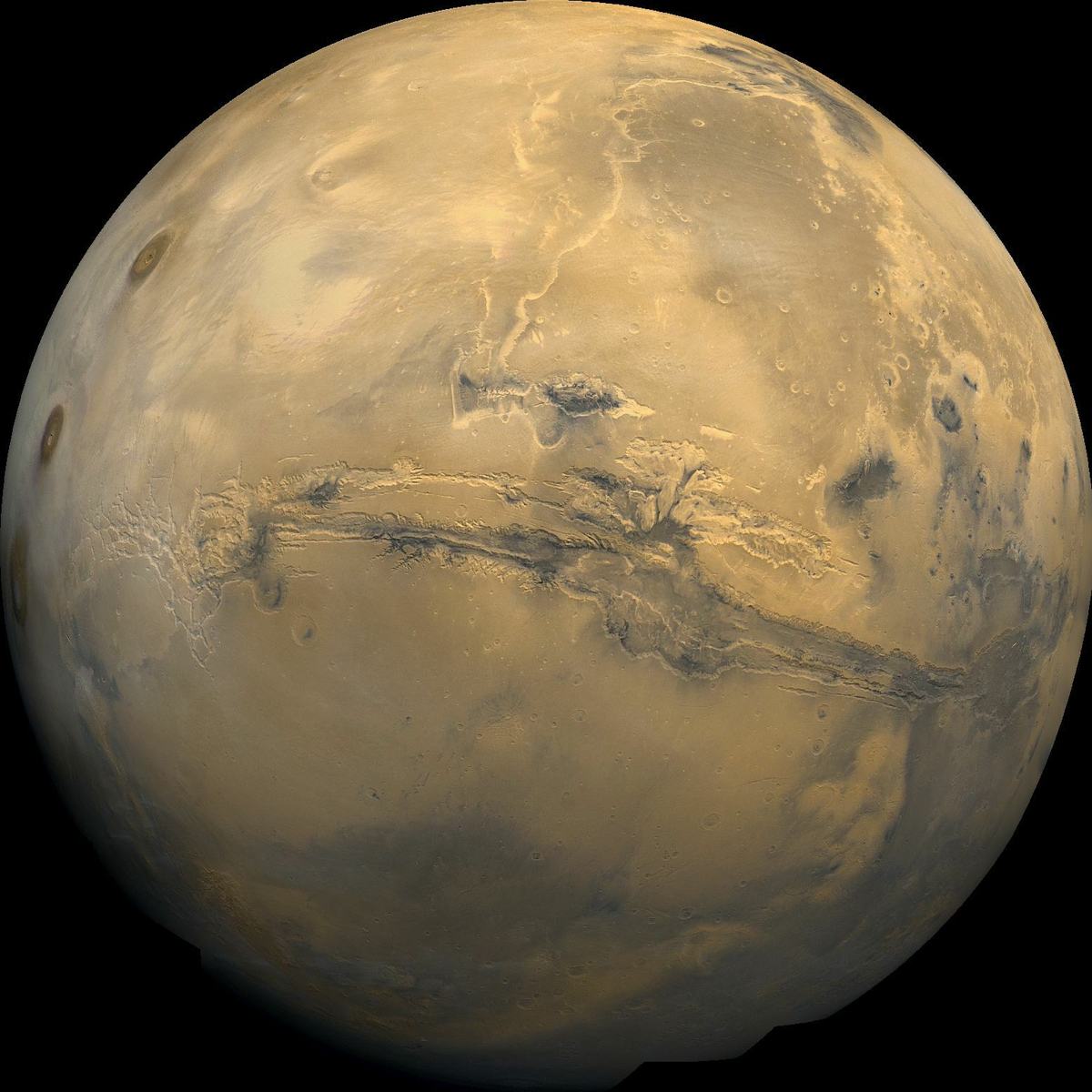
Mars is a small world with an outsized résumé. It has about 15% of Earth's volume and just 11% of its mass, which works out to roughly 38% of Earth's surface gravity. Its mean diameter of 6,779 km is about half of Earth's, or twice the Moon's — and yet, because Mars has no oceans, its surface area is about the size of all the dry land of Earth. In terms of ground you could actually walk on, Mars offers a second Earth's worth of landscape.
Time works almost familiarly there. A solar day on Mars — a "sol" — lasts 24 hours, 39 minutes, and 35.244 seconds, only slightly longer than an Earth day; your wristwatch would nearly keep up. The calendar is another matter: orbiting the Sun at an average distance of roughly 230 million km, Mars takes 687 Earth days to complete one loop, and sunlight needs 13 minutes to reach it.
What fills that landscape and those long years is what makes Mars remarkable. It holds the biggest volcano and the biggest canyon we know of, an underground reserve of ice large enough to drown the planet, and a moon so doomed that scientists can already schedule its funeral.
The Largest Volcano in the Solar System
Mars is home to the largest volcano in the Solar System: Olympus Mons. As measured by the Mars Orbiter Laser Altimeter, it stands 21.287 km high — about 2.5 times the elevation of Mount Everest above sea level. Everest, Earth's highest peak at 8,848 metres, would look like a foothill beside it.
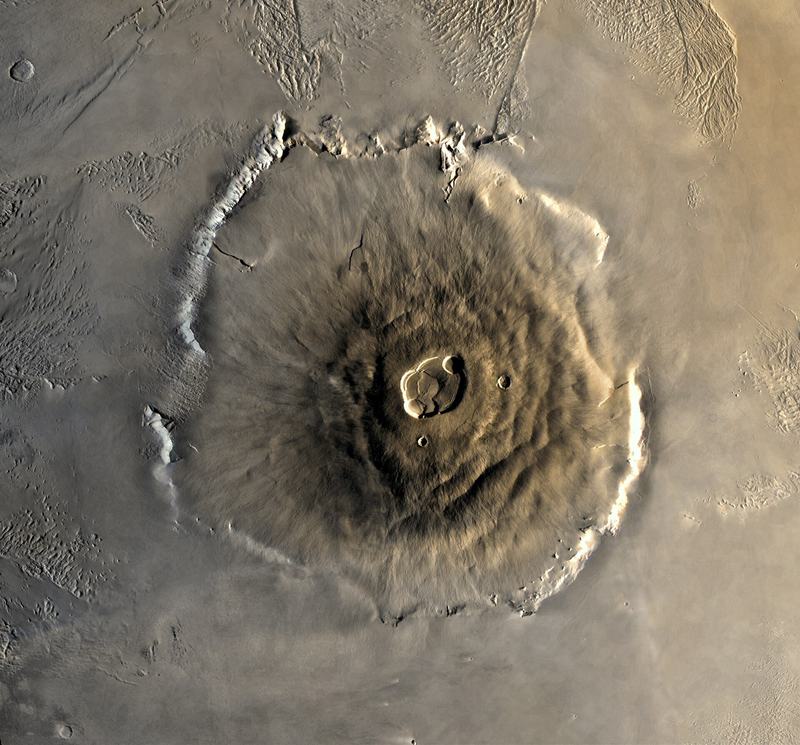

The height is only half the story. The edifice of Olympus Mons is about 600 km wide — a mountain the size of a country rather than a landmark. It is so heavy that the planet visibly sags beneath it: a moat about 2 km deep rings the volcano's base, thought to be the Martian crust bending under the structure's immense weight. On Mars, geology happens at a scale Earth simply cannot match.
And the Largest Canyon, Too
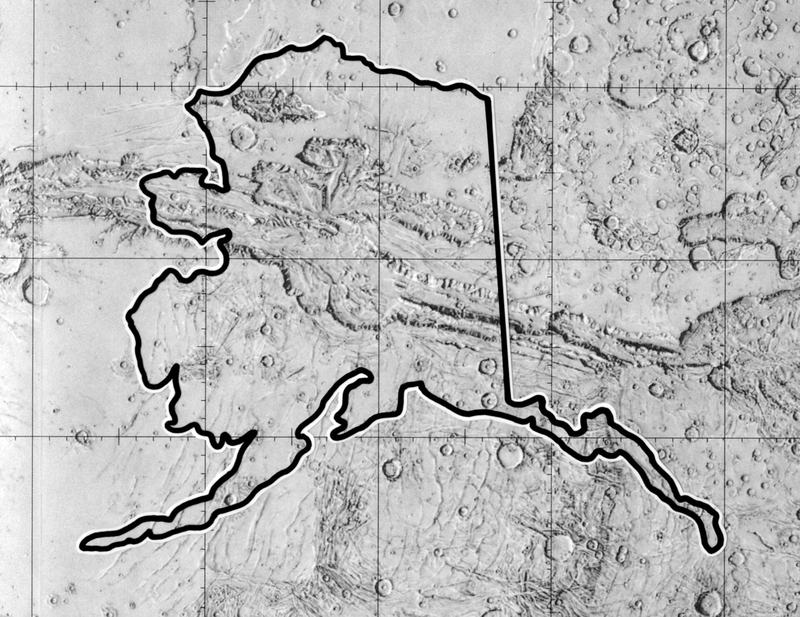
The same planet also carved the largest canyon in the Solar System. Valles Marineris stretches more than 4,000 km in length, spans 200 km across, and drops up to 7 km deep. A canyon system that long would reach across an entire continent on Earth.
.jpg)
Remarkably, nobody knew it existed until the space age. Valles Marineris is named after the Mariner 9 orbiter of 1971–72 — the spacecraft that discovered it. A chasm large enough to swallow every gorge on Earth stayed hidden until we finally sent a camera to look.
Scars the Size of Continents
Mars keeps a brutal diary of the Solar System's violent youth. The planet is scarred by 43,000 impact craters with a diameter of 5 km or greater. The largest exposed one, Hellas, is 2,300 km wide and 7,000 metres deep — so large that it is clearly visible from Earth as a bright patch on the disk of the planet.
Even Hellas may not be the record-holder. In the Northern Hemisphere, researchers have found evidence of an impact basin measuring 10,600 by 8,500 km — roughly the area of Europe, Asia, and Australia combined. If confirmed, it would be the largest impact crater in the Solar System.
All those craters need names, and the naming rules have an unexpectedly democratic streak. Craters larger than roughly 50 km honor deceased scientists, writers and others who contributed to the study of Mars. Smaller craters are named for towns and villages of the world with populations under 100,000 — meaning a village too small for most maps of Earth may already have its name permanently attached to a piece of another planet.
The Moon That Rises in the West
Mars's two moons were discovered in 1877 by the American astronomer Asaph Hall, and the larger of them, Phobos, breaks most of the rules we take for granted about moons. It is a lumpy object with a mean radius of just 11 km, and it orbits a mere 6,000 km above the Martian surface — closer to its planet than any other known natural satellite.
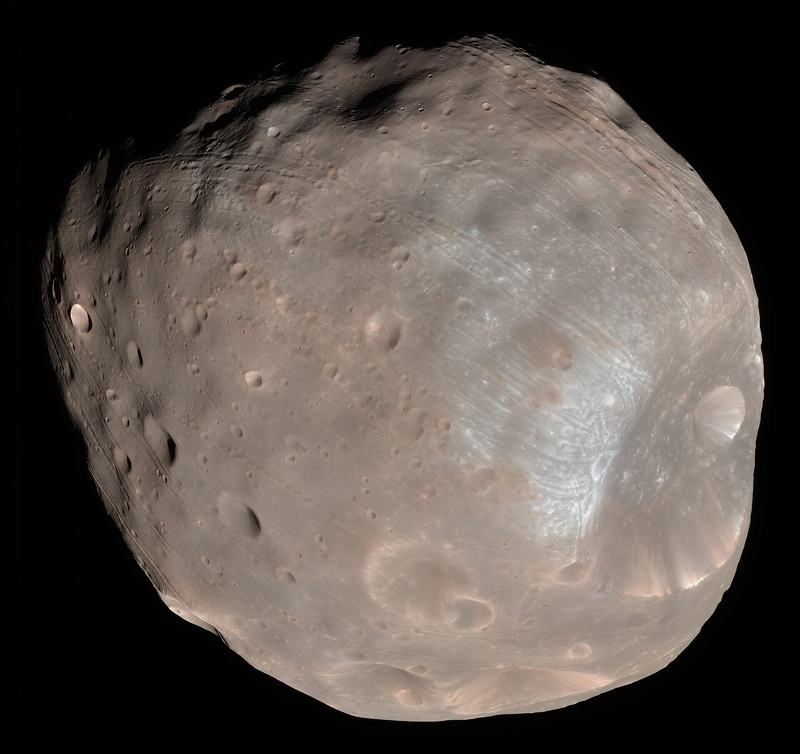

That low, fast orbit produces a sky show no other planet offers. Phobos circles Mars faster than the planet rotates, so for an observer on the surface it rises in the west, races across the sky in 4 hours 15 minutes or less, and sets in the east — roughly twice each Martian day, once every 11 hours and 6 minutes. Imagine a moon you could watch lap you twice before bedtime.
It cannot last. Tidal forces are dragging Phobos down by approximately 2 metres every 100 years, and in roughly 30–50 million years the moon will either break apart or crash into the planet. Phobos is not just a moon; it is a countdown.
Rings: Lost Long Ago — and Coming Back
That countdown points to one of the most intriguing ideas in planetary science. A 2023 study, based on the orbital inclination of the smaller moon Deimos, suggests that Mars may once have had a ring system 3.5 to 4 billion years ago — possibly formed from a moon 20 times more massive than Phobos. Phobos itself may be a remnant of that ancient ring.
And the cycle may turn again. In about 50 million years, when Phobos finally crashes into Mars or breaks apart, it could create a dusty ring around the Red Planet. If both ideas hold up, Mars is a planet caught between rings: born from one, destined to wear another. Saturn's crown, it turns out, may be a phase other planets pass through.
An Ocean of Ice Without a Single Lake
Mars looks bone-dry, but the appearance is misleading. More than 5 million cubic kilometres of ice have been detected at or near its surface — enough to cover the entire planet in water 35 metres deep. By volume of frozen water alone, Mars is closer to an ice world than a desert.
What Mars cannot do is melt any of it into ponds. The mean surface pressure is just 600 Pa — 0.6% of Earth's 101.3 kPa — ranging from a low of 30 Pa atop Olympus Mons to over 1,155 Pa down in Hellas Planitia. At less than 1% of Earth's pressure, liquid water cannot persist on the surface. The planet hoards an ocean's worth of ice, yet cannot keep a single lake.
Thin Air, Monster Storms
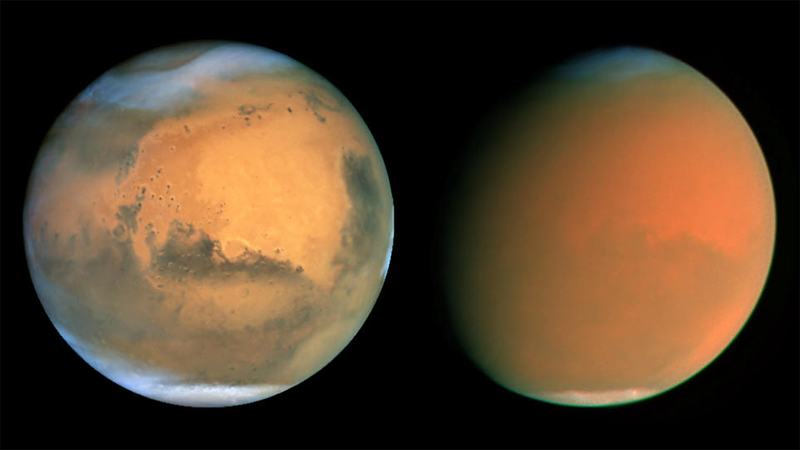
That whisper-thin atmosphere still produces the most dramatic weather in the neighborhood: Mars has the largest dust storms in the Solar System, with wind speeds of over 160 km/h. When the dust rises, it can veil the planet's famous surface features — the same features early astronomers strained to glimpse through telescopes.

It is a fitting final entry for the Martian record book. The largest volcano, the largest canyon, possibly the largest impact crater, the closest moon, the biggest dust storms — all packed onto a planet with a landscape area no bigger than Earth's continents. Mars is small, cold, and quiet. Its statistics are anything but.