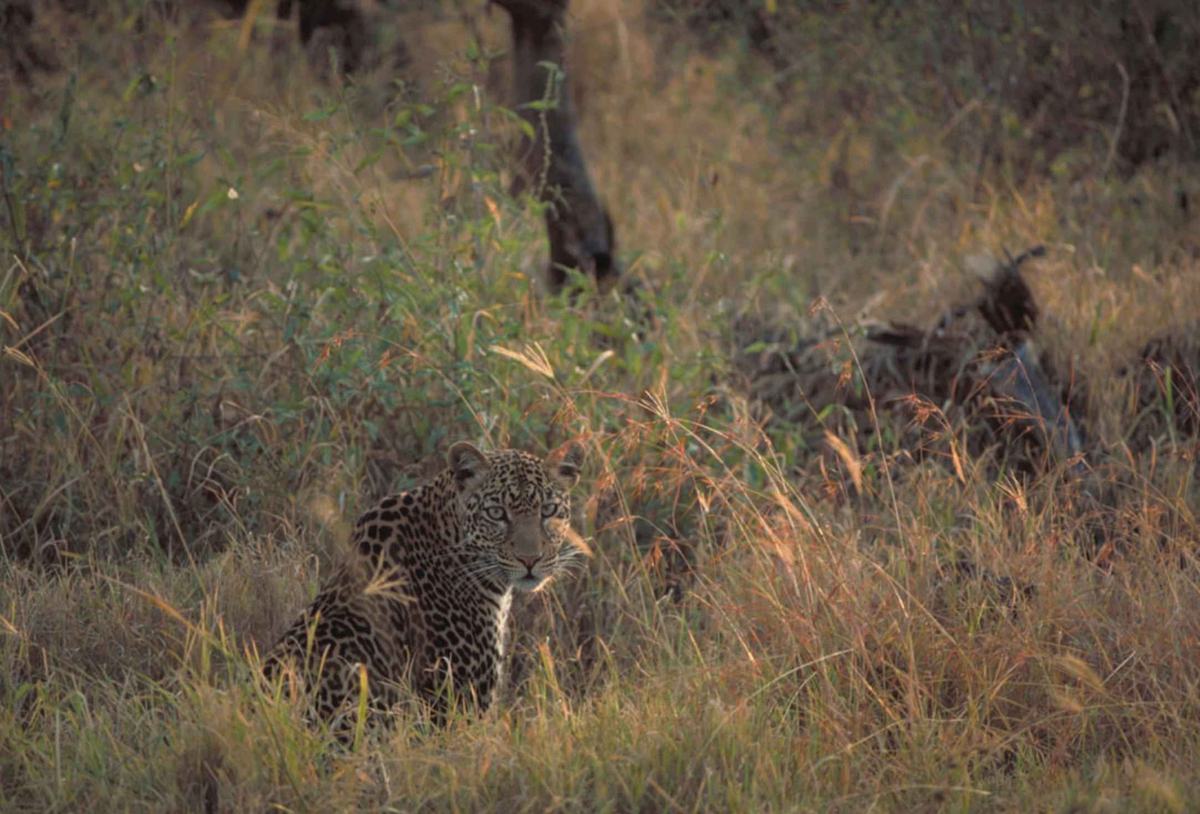
If you asked my Year 4 class which big cat is the rarest and hardest to find, they would say tiger, or maybe lion. They would be wrong on the first count and right on the second. The leopard is the one hiding in plain sight. It lives across more of the world than any other big cat, and most people who share its neighbourhood have no idea it is there. Which, fair enough. That is rather the point of a leopard.
The Most Widespread Big Cat
Leopards live across most of Africa and much of Asia, from rainforest to desert to snowy mountains [1]. No other big cat covers that much ground. They turn up on the edges of cities, in scrubland, and high in the Himalayas. Part of the trick is diet. A leopard will eat almost anything it can catch, from beetles to antelope, so it is not fussy about where it sets up home [2].
Spots That Work Like Fingerprints
Those spots are called rosettes, little rings that look a bit like a paw print. No two leopards have the same pattern, so researchers identify individuals by photographing their coats [1]. Here is a way to settle a playground argument: a leopard's rosettes are empty in the middle, while a jaguar's have a small spot inside. Same idea, different filling. (Yes, really.)
Dinner Goes Up the Tree
This is the fact my kids love. A leopard will kill something as heavy as itself, then carry the whole carcass straight up a tree trunk and drape it over a branch [2]. It does this to keep the meal away from lions and hyenas, who cannot climb after it. Hauling that much dead weight up a vertical trunk, with your teeth, is a genuinely absurd feat of strength. And yet, they do it most nights.
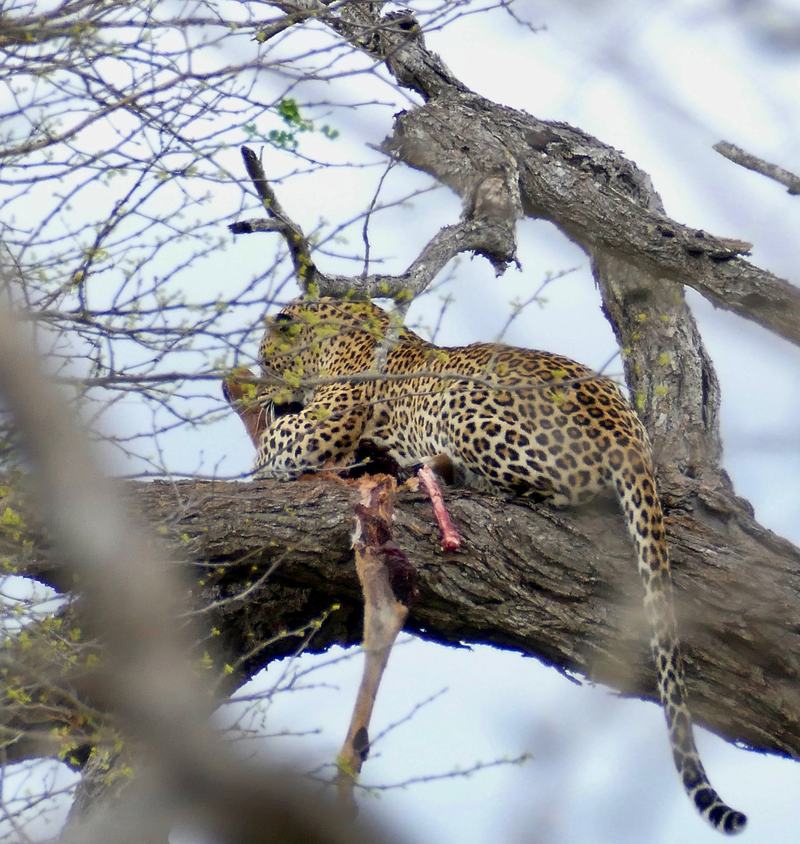
 eating an impala in a tree ... (53226590140).jpg)
Built to Vanish
Leopards are solitary and mostly active at night, which is why so few people ever see one in the wild [1]. The coat is not just for show. Broken up by rosettes, a resting leopard melts into dappled shade or long grass until it is essentially a rumour with whiskers. Guides in the bush often spot the tail first, twitching, while the rest of the cat stays invisible. Nobody warned me how good they are at simply not being seen.
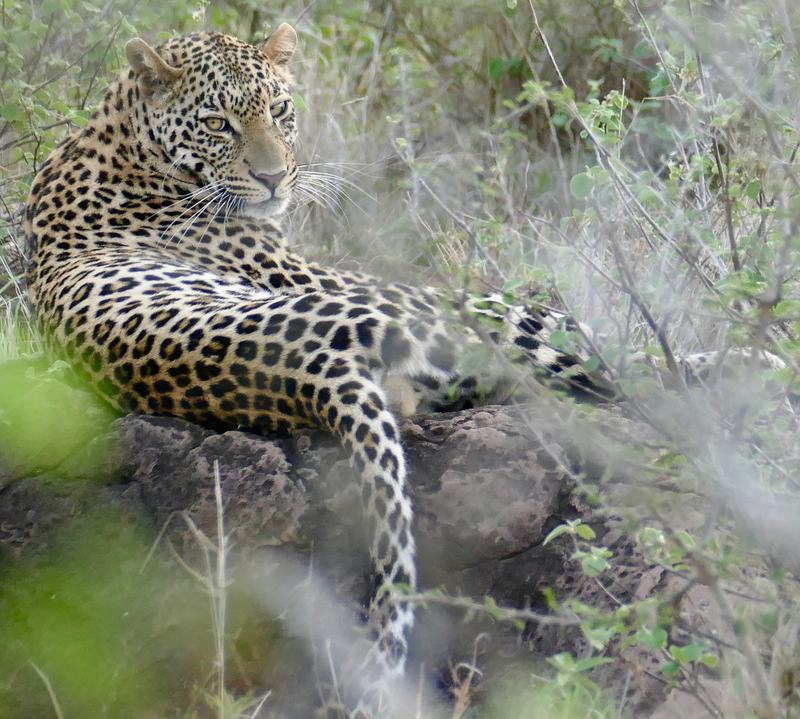
 male resting on a rock ... (53257918250).jpg)
The Black Panther Is a Leopard
Here is one that surprises people. The "black panther" is not a separate species. It is usually a leopard (or in the Americas, a jaguar) with a condition called melanism, which floods the coat with dark pigment [3]. Look closely at a black leopard in good light and you can still see the rosettes underneath, like a watermark. Same cat, darker paint job. Somehow that makes them even harder to photograph.
Faster Than You Would Guess
A leopard is not built for the marathon, but over a short burst it can reach around 58 kilometres per hour [1]. It hunts by stalking, though, not chasing. The whole plan is to creep close in silence and finish the job in one or two bounds, so the speed is a last resort rather than the strategy. A leopard that has to run far to catch dinner has already made a mistake.
A Voice Like a Saw
Leopards do not roar the way lions do, at least not often. Their signature call is a rough, rasping sound made by pulling air back and forth, and it genuinely resembles someone sawing wood [3]. Rangers call it "sawing". They also purr, and cubs make small chirping mews to their mothers. So the fearsome spotted assassin sits in a tree at dusk making noises like a tired carpenter.
The Rarest Cat of All
Not every leopard is doing well. The Amur leopard, which lives in the cold forests of far eastern Russia and northern China, is one of the rarest big cats on Earth, with only around 100 left in the wild [2]. It grows a thick pale coat for the snow and has longer legs than its African cousins. Numbers have crept upward thanks to protected reserves, which is a small, cautious piece of good news.
Vulnerable, But Hanging On
Across their whole range, leopards are listed as Vulnerable, with populations falling in many areas because of habitat loss, poaching, and conflict with people [4]. The wide range hides the trouble. A species can look common on a map while quietly vanishing region by region. The leopard's great gift, being able to live almost anywhere, is exactly what makes it easy to overlook when it starts to slip away.
Frequently Asked Questions
Why do leopards drag their prey up trees?
Leopards store kills in trees to keep them away from lions and hyenas, which cannot climb well. A leopard can haul prey as heavy as itself several metres up a trunk. Feeding in a tree lets it return to the same carcass over several days without losing it to scavengers.
Are black panthers really leopards?
Often, yes. A "black panther" is not a separate species but a leopard or jaguar with melanism, a genetic condition that darkens the coat. The rosettes are still there and become visible in bright light. Melanistic leopards are more common in dense, humid forests.
How fast can a leopard run?
A leopard can reach roughly 58 kilometres per hour in a short burst. It relies on stealth rather than speed, stalking close before attacking in one or two bounds. Sustained running is not its strength, so it uses that top speed only over very short distances.
Are leopards endangered?
Leopards as a whole are classed as Vulnerable by the IUCN, with declining numbers in many regions. Some subspecies are in far more danger. The Amur leopard is Critically Endangered, with only about 100 individuals surviving in the wild in Russia and China.