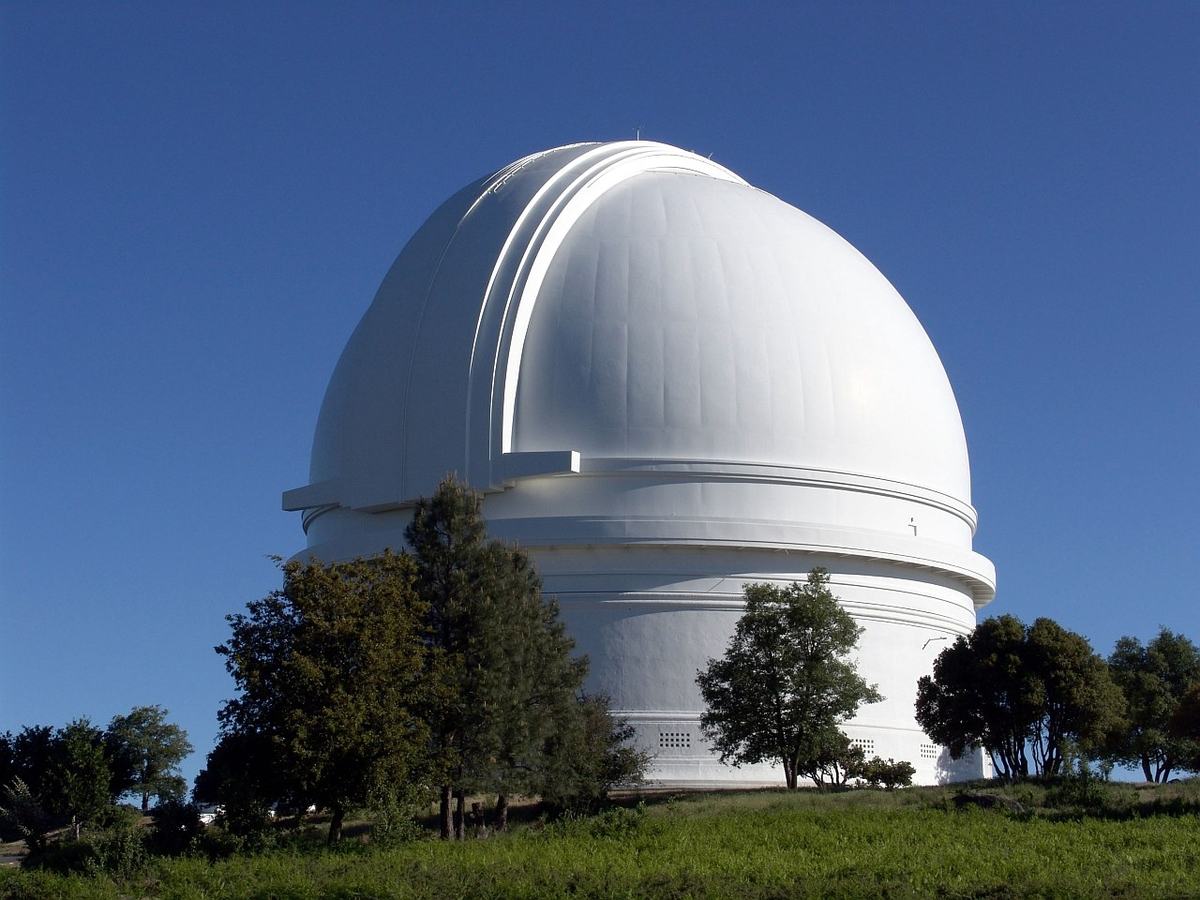
Haumea is a dwarf planet located beyond Neptune's orbit. It was discovered in 2004 by a team headed by Mike Brown at Palomar Observatory and formally announced in 2005 by a team headed by José Luis Ortiz Moreno at the Sierra Nevada Observatory in Spain. Two teams, on two continents, converging on the same distant object within months of each other — a discovery story that turned out to be more contested than most.
On September 17, 2008, Haumea was named after the Hawaiian goddess of childbirth and fertility. Nominal estimates make it the third-largest known trans-Neptunian object, after Eris and Pluto, and approximately the size of Uranus's moon Titania. That size comes with a strange asterisk, though: Haumea's mass is about one-third that of Pluto and 1/1400 that of Earth, spread across a shape unlike almost anything else we know of in the Solar System.
A Discovery Claimed by Two Teams
A team consisting of Mike Brown of Caltech, David Rabinowitz of Yale University, and Chad Trujillo of Gemini Observatory in Hawaii discovered Haumea on December 28, 2004, in images they had taken on May 6, 2004. Until it was given a permanent name, the Caltech discovery team used the nickname "Santa" among themselves, because they had discovered Haumea just after Christmas.
Before Brown's team could publish, a second team beat them to a formal claim. José Luis Ortiz Moreno's team in Spain found Haumea independently in images taken March 7-10, 2003, and emailed the Minor Planet Center about their discovery on the night of July 27, 2005. On July 29, 2005, Haumea was given the provisional designation 2003 EL61, based on the date of the Spanish discovery image. The naming rights, ultimately, went the other way: in 2008 the IAU chose the name Haumea over Ataecina, the name proposed by the Ortiz team.
A Wide, Slow Orbit Far From the Sun
Haumea has an orbital period of 284 Earth years, a perihelion of 35 AU, and an orbital inclination of 28 degrees. It passed aphelion in early 1992 and is currently more than 50 AU from the Sun — a single orbit lasting nearly three centuries, on a path tilted well away from the flat plane most planets share.
Despite that distance, Haumea isn't hard to spot with the right equipment. With a visual magnitude of 17.3, Haumea is the third-brightest object in the Kuiper belt after Pluto and Makemake, and is easily observable with a large amateur telescope — a level of visibility unusual for an object this far from the Sun.
The Fastest Spin of Any Body Its Size
Haumea's defining trait is how fast it spins. Haumea displays large fluctuations in brightness over a period of 3.9 hours, which can only be explained by a rotational period of this length — faster than any other known equilibrium body in the Solar System, and indeed faster than any other known body larger than 100 km in diameter. Nothing else of comparable size turns anywhere near this quickly.
That speed physically reshapes the object. While most rotating bodies in equilibrium are flattened into oblate spheroids, Haumea rotates so quickly that it is distorted into a triaxial ellipsoid. Calculations from Haumea's light curve are consistent with it being a Jacobi ellipsoid, with its major axis twice as long as its minor — an elongated, football-like shape rather than a sphere, stretched out by its own extreme rotation.
Dense for Its Kind, Bright as Snow
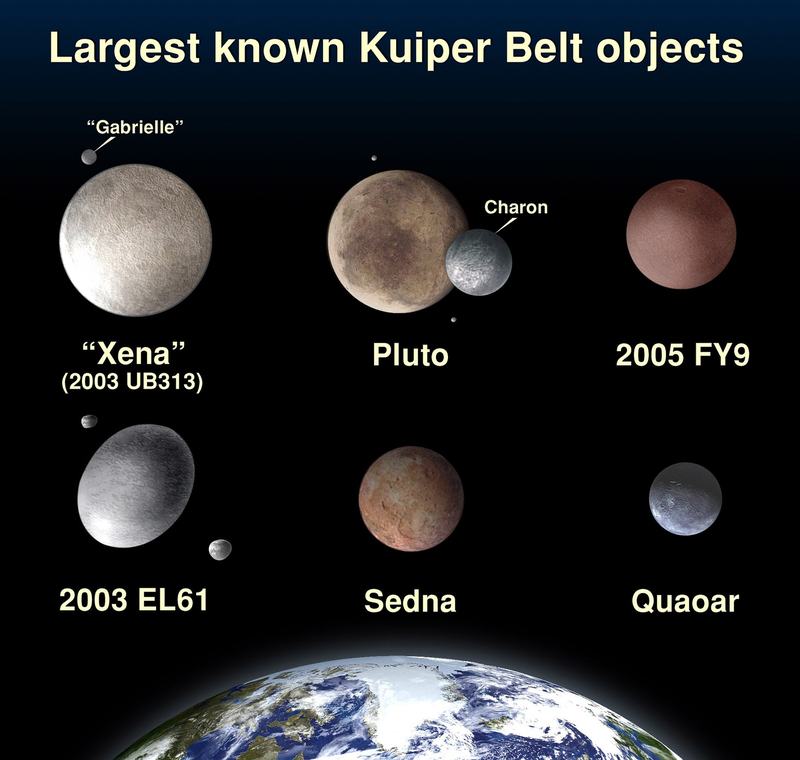

Haumea's density is constrained to a range of 2.6 to 3.3 g/cm3; by comparison, the Moon, which is rocky, has a density of 3.3 g/cm3, whereas Pluto, which is typical of icy objects in the Kuiper belt, has a density of 1.86 g/cm3. Haumea sits closer to the Moon's rocky density than to Pluto's icier one, despite orbiting in the same distant region as Pluto. Working from that density and its light curve, astronomers put Haumea's mass at 4.2x10^21 kg, 28% the mass of the Plutonian system and 6% that of the Moon.
The surface tells a different story from the interior. Haumea is as bright as snow, with an albedo in the range of 0.6 to 0.8, consistent with crystalline ice. Best-fit modeling of the surface spectra suggested that 66% to 80% of the Haumean surface appears to be pure crystalline water ice — a dense, rocky-ish interior wrapped in a shell of nearly pure, brilliantly reflective ice.
The First Ring Ever Found Around a Distant World
For years, rings were assumed to be something only giant planets had. Haumea broke that assumption. A stellar occultation observed on January 21, 2017 and described in an October 2017 Nature article revealed a ring around Haumea, the first ring system ever discovered around a trans-Neptunian object, with a radius of about 2,287 km, a width of about 70 km, and an opacity of 0.5. A small, fast-spinning, elongated dwarf planet turned out to have something previously thought exclusive to worlds like Saturn and Uranus.
Two Moons, Named for Haumea's Daughters
Two small satellites have been discovered orbiting Haumea, (136108) Haumea I, named Hi'iaka, and (136108) Haumea II, named Namaka. Darin Ragozzine and Michael Brown discovered both in 2005.
Hi'iaka, the larger, outer moon of Haumea, has a mean diameter of 370 km, making it the sixth-largest known moon of a trans-Neptunian object; it was discovered on January 26, 2005 and follows a slightly elliptical orbit around Haumea every 49.5 days, at a distance of 49,400 km. Namaka, its smaller sibling, is the inner moon of Haumea, discovered in the fall of 2005, orbiting the dwarf planet in roughly 18.3 days at an average distance of 25,500 km, on a highly tilted elliptical orbit inclined about 13 degrees to Haumea's equator. Both moons, along with the dwarf planet itself, are named after daughters of the goddess Haumea in Hawaiian mythology.
The Wreckage of an Ancient Collision
Haumea is the largest member of its collisional family, a group of astronomical objects with similar physical and orbital characteristics thought to have formed when a larger progenitor was shattered by an impact. This family is the first to be identified among trans-Neptunian objects. Because it would have taken at least a billion years for the group to have diffused as far as it has, the collision which created the Haumea family is believed to have occurred at least that long ago — meaning Haumea's extreme spin and elongated shape are likely scars from a violent event in the ancient Kuiper belt, rather than something it was simply born with.
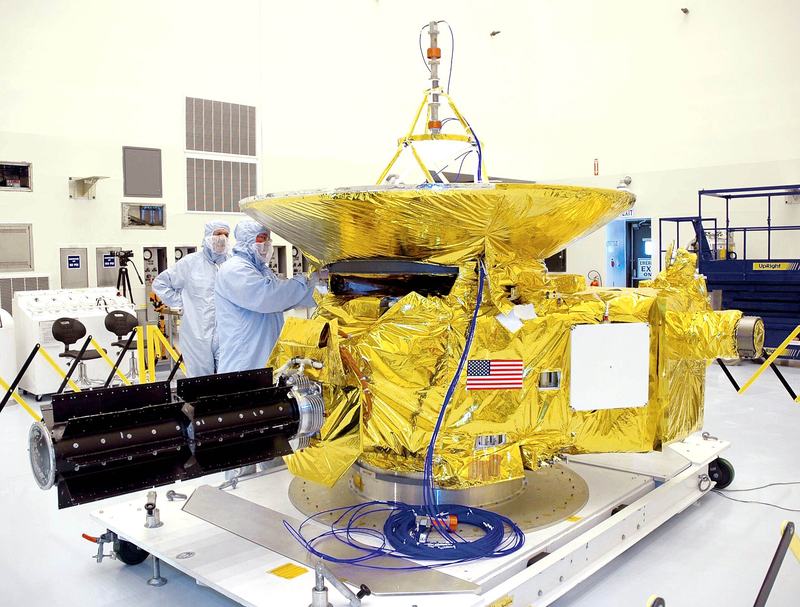
Seen From Afar, Never Visited

No spacecraft has ever traveled to Haumea, but one has looked its way. Haumea was observed from afar by the New Horizons spacecraft in October 2007, January 2017, and May 2020, from distances of 49 AU, 59 AU, and 63 AU respectively — the same probe that flew past Pluto, catching distant glimpses of Haumea on its way even further out into the Kuiper belt.