Makemake is a dwarf planet orbiting the Sun in the Kuiper belt, a disc of icy bodies beyond the orbit of Neptune. It is the fourth largest dwarf planet and trans-Neptunian object in the Solar System, having a diameter 60% that of Pluto. For most of history it was invisible to us entirely — not because it's especially small, but because it's especially far away, tucked into a region of the Solar System astronomers only started mapping in detail within the last few decades.
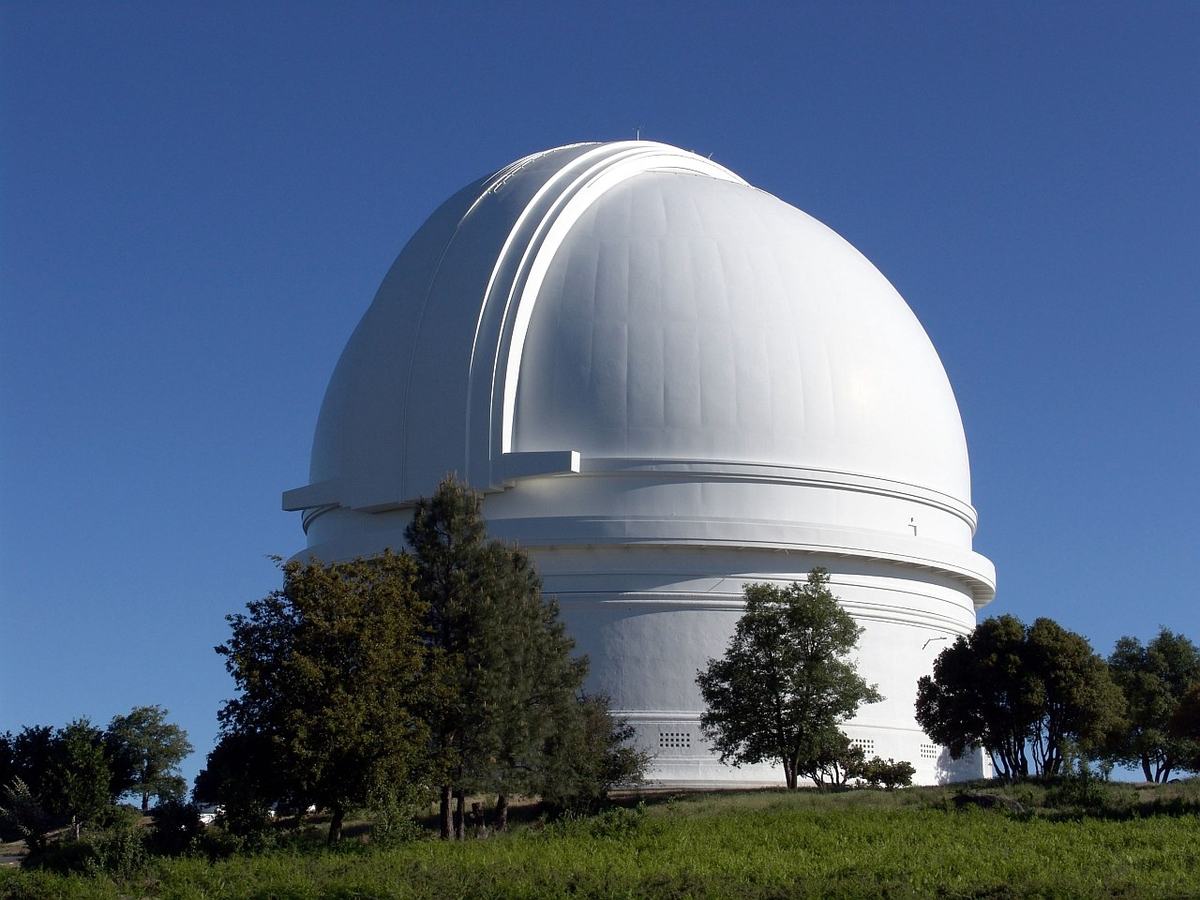
Makemake was discovered on March 31, 2005 by American astronomers Michael E. Brown, Chad Trujillo, and David Rabinowitz at Palomar Observatory. As one of the largest objects found by the team, the discovery of Makemake contributed to the reclassification of Pluto as a dwarf planet in 2006 — making Makemake, in an odd way, partly responsible for Pluto losing its planetary status. A large new world showing up in Pluto's neighborhood forced astronomers to ask a hard question: if this counts too, where do you draw the line?
Found by Accident, Named After a Holiday
The discovery images of Makemake were taken on March 31, 2005, but it was not until April 3, 2005 that Brown found the object in his inspection of the images and identified it as exceptionally bright. Before it had a real name, the object went by a placeholder that stuck for years. Before being named, Makemake was known by its provisional designation 2005 FY9 and the nickname "Easterbunny," a reference to its discovery shortly after Easter. The name Makemake was approved and announced by the IAU in July 2008 — years after the object was first spotted, and long after "Easterbunny" had already become the informal name astronomers used among themselves.
A Long, Tilted Orbit Far Beyond Neptune
Makemake orbits the Sun beyond Neptune at an average distance of 45.5 AU, following a moderately elliptical orbit that ranges from 38.2 AU at perihelion to 52.8 AU at aphelion, with a relatively high orbital inclination of 29 degrees to the ecliptic. That tilt sets Makemake apart from the flatter, more circular orbits of the classical planets — a signature common among Kuiper belt objects that formed and evolved in a much less orderly environment than the inner Solar System.
Makemake orbits within the same broad region that gives the Kuiper belt its scale. The Kuiper belt, where Makemake orbits, is similar to the asteroid belt but far larger, 20 times as wide and 20 to 200 times as massive — a vast outer reservoir of icy bodies, of which Makemake is one of the largest known residents.
Fourth in Line, But Still a Heavyweight
Makemake is a nearly spherical object with an average diameter of around 1,430 km, about 60% the diameter of Pluto or 11% the diameter of Earth, making it the fourth-largest known dwarf planet and trans-Neptunian object in the Solar System, after Pluto, Eris, and Haumea. It ranks similarly on mass: Makemake has a mass of between approximately 2.5x10^21 and 2.9x10^21 kg, determined from the orbital period and distance of its moon, making it the fourth-most massive known dwarf planet and trans-Neptunian object, again after Eris, Pluto, and Haumea.
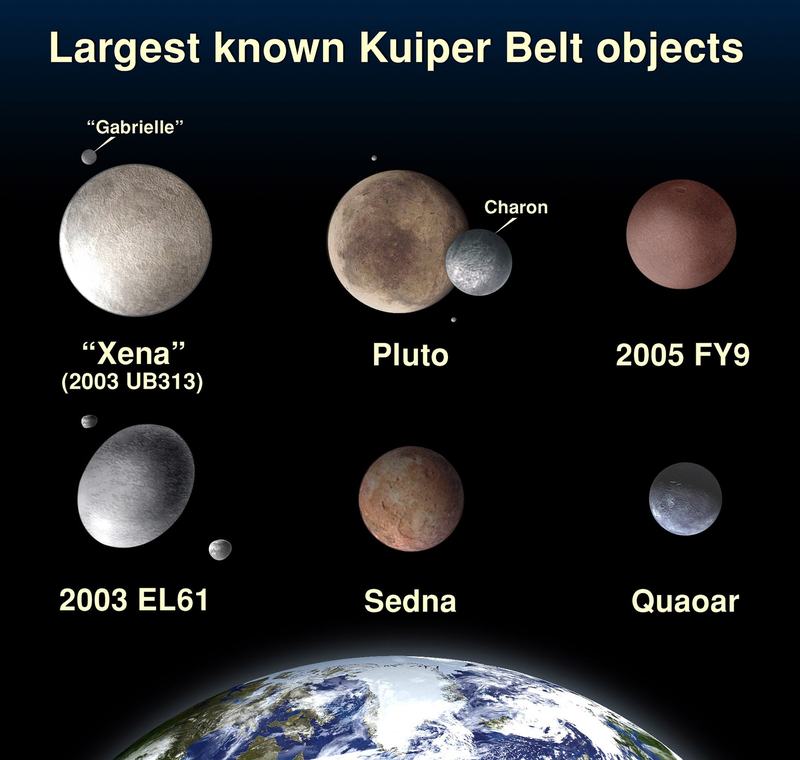

Makemake's overall structure also fits a known pattern among distant icy worlds. Makemake has a bulk density of about 1.76 g/cm3, similar to the trans-Neptunian dwarf planets Pluto, Gonggong, and Quaoar — a rough compositional family resemblance shared across several of the largest known Kuiper belt objects.
Frozen, Reflective, and Slow to Spin
Because of its great distance from the Sun, Makemake's surface has an extremely low temperature of 30 to 40 K, cold enough for methane to exist as solid ice. That same methane makes the surface unusually bright: in visible light Makemake's surface has a geometric albedo of 82%, making it more reflective than Pluto. James Webb Space Telescope observations found that Makemake's surface contains less than 3% nitrogen and less than 1 part per million of carbon monoxide, a composition dominated overwhelmingly by methane rather than the nitrogen ice common on some other distant worlds.
Working out how fast Makemake spins has proven surprisingly difficult. The rotation period of Makemake is uncertain, with measurements giving either 11.4 or 22.8 hours as of 2025; the dwarf planet exhibits very little variation in brightness, just 0.03 magnitudes, which makes its rotation period difficult for telescopes to measure. And whatever its exact spin turns out to be, its surface is remarkably uniform: Makemake is not expected to have mountains taller than 10 km, a notably flat landscape for a world with active geology elsewhere in its structure.
A Puzzle in the Infrared
Makemake keeps producing measurements that don't fully add up. Makemake emits an unusually high amount of mid-infrared radiation compared to far-infrared, a signature first reported by the Spitzer Space Telescope in 2008. In 2025, astronomer Csaba Kiss and collaborators proposed that Makemake's excess mid-infrared emission could be caused by either a cryovolcanic hotspot reaching about 150 K, or an orbiting ring of tiny carbonaceous dust grains — two very different explanations, and neither one confirmed yet.
.jpg)
There's also the matter of a thin, theoretical atmosphere. If Makemake's detected methane gas is entirely contained in a gravitationally bound atmosphere, its surface atmospheric pressure would be roughly 10 picobars, about 100 billion times less than Earth's atmospheric pressure and 1 million times less than Pluto's — technically an atmosphere, but one so thin it barely counts as one by any everyday definition of the word.
One Small, Dark Moon Named "MK 2"
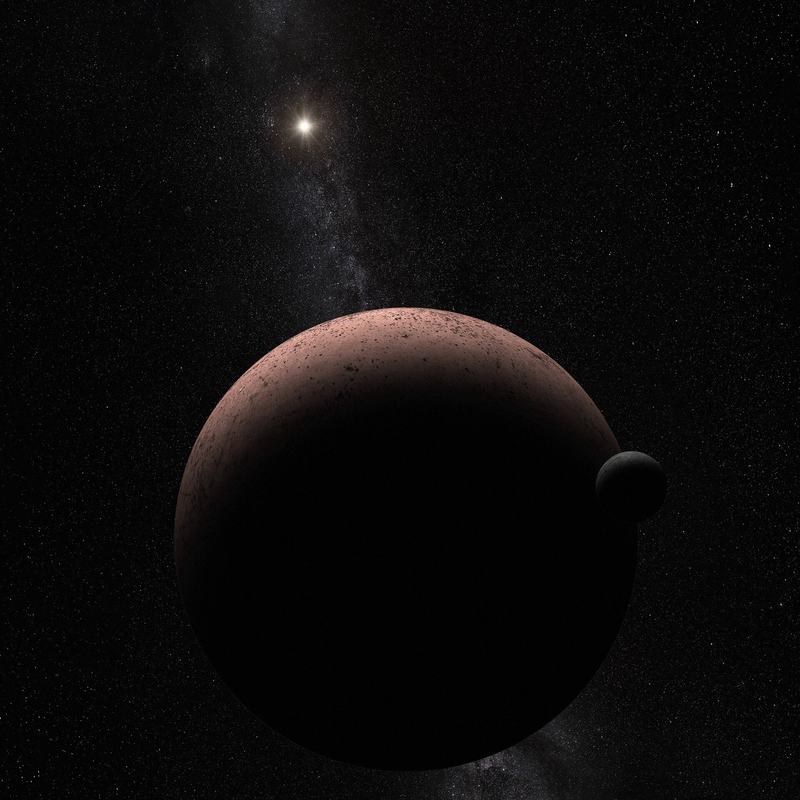
Makemake has only one known moon, provisionally designated S/2015 (136472) 1 and nicknamed "MK 2," discovered in Hubble Space Telescope images taken April 27, 2015 and announced April 26, 2016. Finding it took over a decade of searching after Makemake itself was discovered, mostly because of how the moon's orbit happens to be angled relative to Earth.
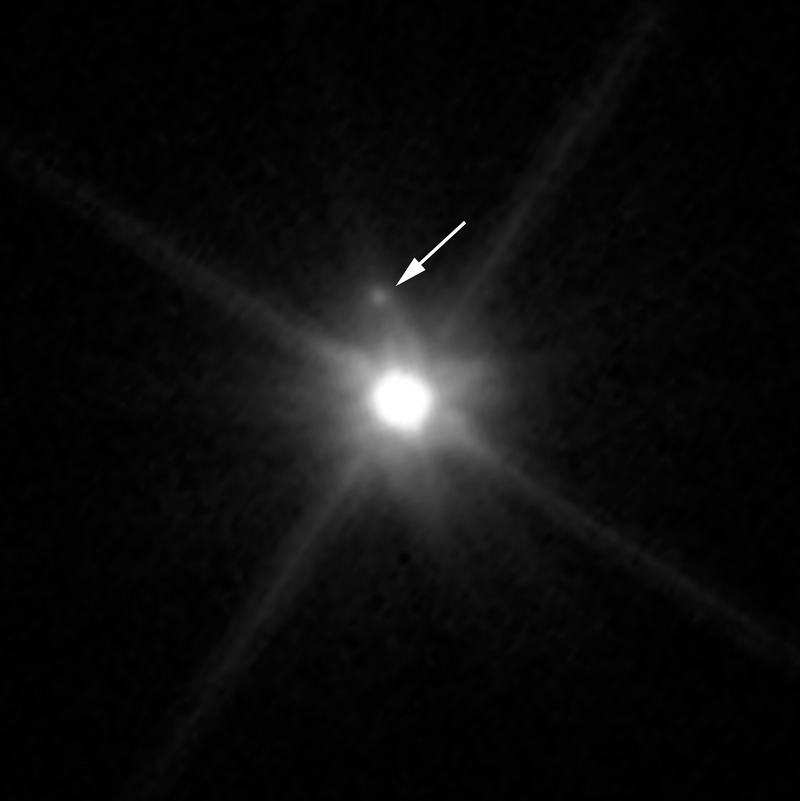

Makemake's moon, S/2015 (136472) 1, is a dark object about 175 km in diameter, orbiting 22,250 km from Makemake with an orbital period of 18 days, and is about 1,300 times fainter than Makemake in visible light. That extreme faintness is part of what makes the moon scientifically useful: its unusually dark surface, next to Makemake's unusually bright one, may help explain some of the mid-infrared puzzle described above. Hubble Space Telescope imaging shows Makemake has no additional moons brighter than apparent magnitude 26.9 at distances beyond 30,000 km, so as far as anyone can tell, MK 2 is the only companion Makemake has.
An Ancient World With a Violent Past
Like other dwarf planets in the Kuiper belt, Makemake is believed to have formed early in the Solar System's history, about 4.5 billion years ago. It has also been hypothesized that a massive collision with another body may have formed its moon — meaning that even out at the frozen edge of the Solar System, Makemake's history may include the same kind of violent impact events that shaped planets and moons much closer to the Sun.