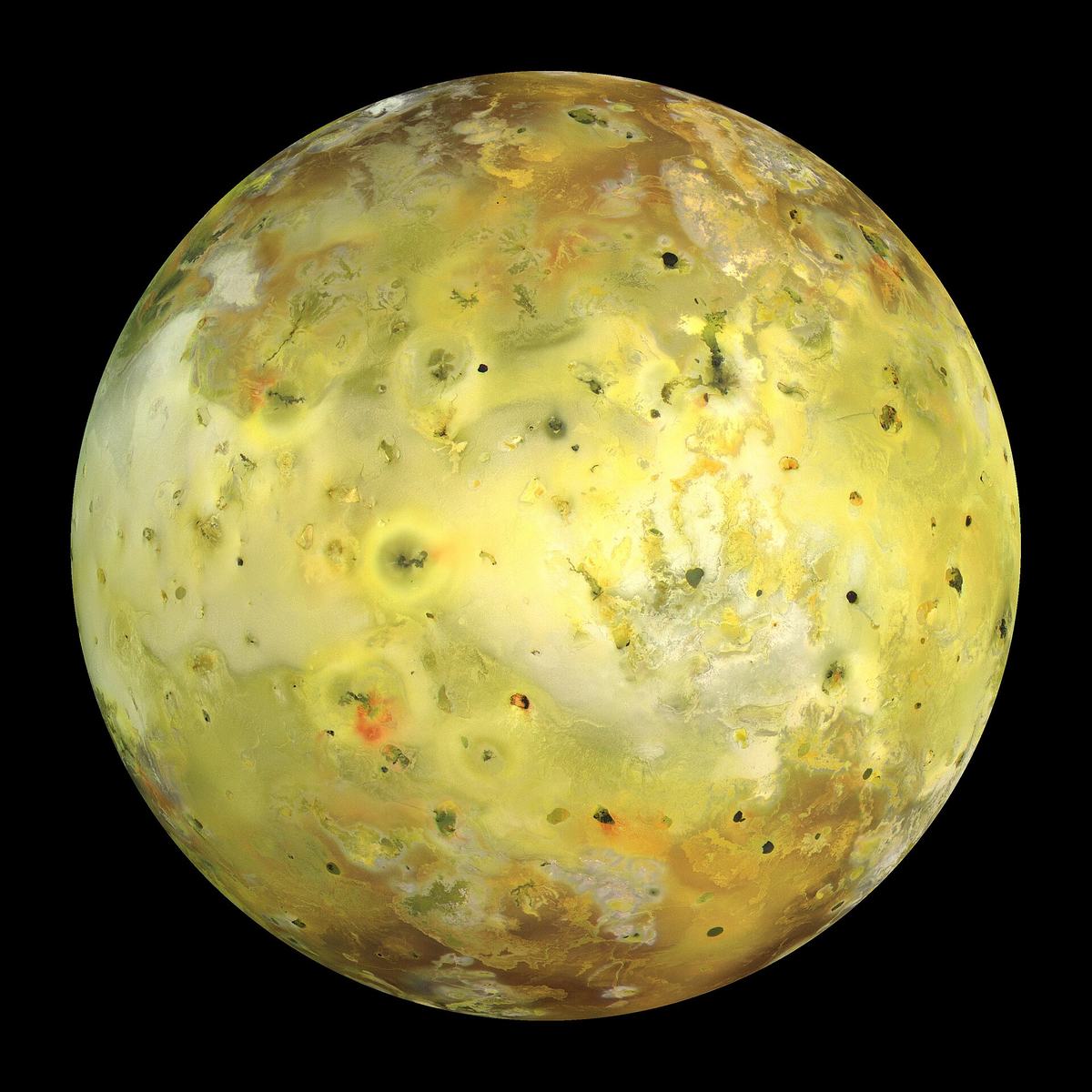
Io is the innermost and second smallest of the four Galilean moons of Jupiter. Slightly larger than Earth's Moon, it is the fourth-largest natural satellite in the Solar System, has the highest density and strongest surface gravity of any natural satellite, and holds the lowest amount of water by atomic ratio of any known astronomical object in the Solar System. It is, in other words, a world of superlatives before you even get to what makes it famous.
That fame comes from underneath: with over 400 active volcanoes, Io is the most geologically active object in the Solar System. Several of its volcanoes fire plumes of sulfur and sulfur dioxide as high as 500 km above the surface. Its surface is also dotted with more than 100 mountains uplifted by extensive compression at the base of its silicate crust, and some of these peaks are taller than Mount Everest.
Io got this way by being caught in a gravitational vise between Jupiter and its neighboring moons — a squeeze that never lets up, and that has turned an otherwise ordinary rocky moon into the most violently active world we know of.
First Sighted Four Centuries Ago, First Understood in 1979
The first reported observation of Io was made by Galileo Galilei on January 7, 1610; Io and Europa were seen as separate bodies the following day, January 8, 1610, the date now used by the IAU as Io's official discovery date. For centuries afterward, Io was simply a point of light — nobody suspected what was happening on its surface.
That changed abruptly in 1979. Volcanic activity on Io was first discovered that year by Linda Morabito, an imaging scientist working on Voyager 1, who spotted an unmistakable plume rising off the moon's limb in one of the spacecraft's images. It was the first time active volcanism had been confirmed anywhere beyond Earth. Since then, observations by spacecraft and Earth-based astronomers have revealed more than 150 active volcanoes on Io, with up to 400 predicted to exist as of 2024 — a body barely larger than Earth's Moon that may be more volcanically active than Earth itself.
A World Being Kneaded by Gravity
Io's volcanism isn't a coincidence of internal chemistry; it's forced. The tidal forces experienced by Io are about 20,000 times stronger than the tidal forces Earth experiences from the Moon, and the vertical difference in Io's tidal bulge between the near and far points of its orbit can be as much as 100 metres — the entire moon physically flexes as it swings around Jupiter. That flexing generates heat directly, and the tidal heating that results produces up to 200 times more energy than radioactive decay alone would generate, which is the mechanism that keeps most rocky worlds warm inside.
That heat has to escape somehow, and volcanism is how it does it. The largest volcanic depression on Io is Loki Patera, 202 km across, and it is consistently the strongest volcano on the moon, contributing on average 25% of Io's global heat output all by itself — a single volcanic feature responsible for a quarter of an entire world's internal heat loss.

Tvashtar: Io's Most-Watched Volcano
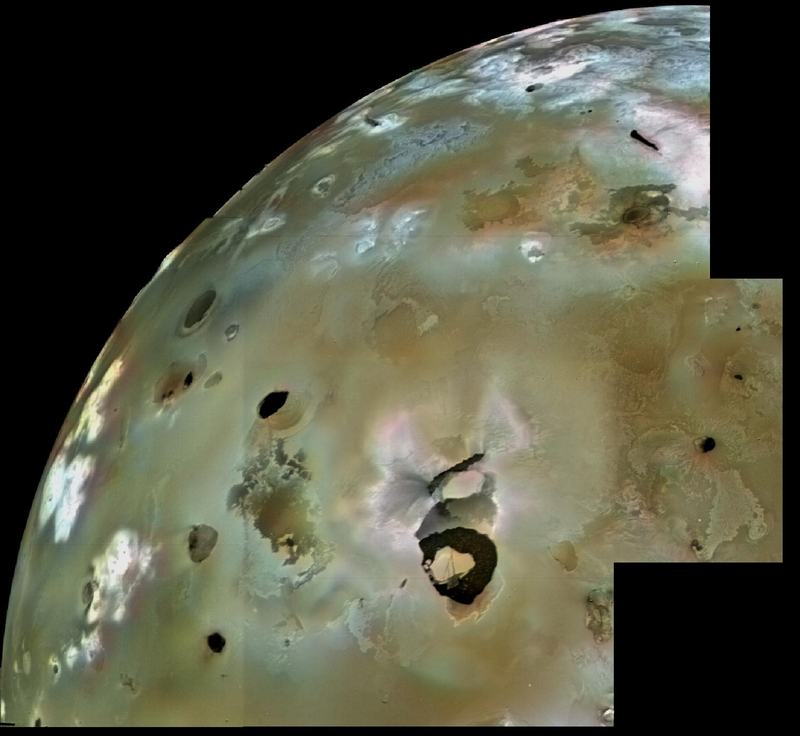
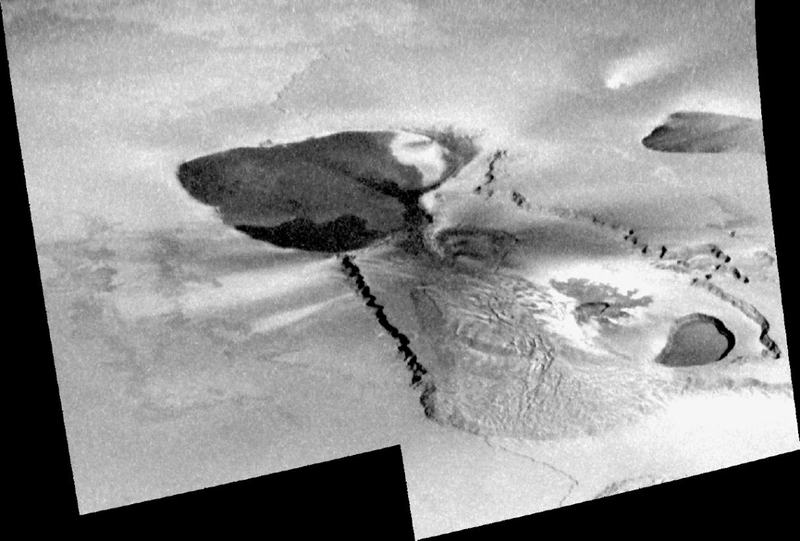
In 1999, a curtain of lava roughly 25 km long and 1 to 2 km high was seen erupting from a patera at the volcano Tvashtar — a single eruptive event large enough to be tracked from Earth-based telescopes. Years later, the New Horizons spacecraft flew by Io on February 28, 2007, capturing images of a large plume at that same Tvashtar region, providing the first detailed observations of the largest class of Ionian volcanic plume since Pele's plume was observed back in 1979.

An Iron Heart Beneath a Sulfur Skin
Io's violence traces down into its structure. It has a density of 3.5275 g/cm3, the highest of any regular moon in the Solar System — significantly higher than fellow Galilean moons Ganymede and Callisto, whose densities sit around 1.9 g/cm3, and slightly higher than Earth's own Moon at 3.344 g/cm3. That density comes from what Io is made of: rock and metal, essentially no ice, with a metallic core making up approximately 20% of its total mass.
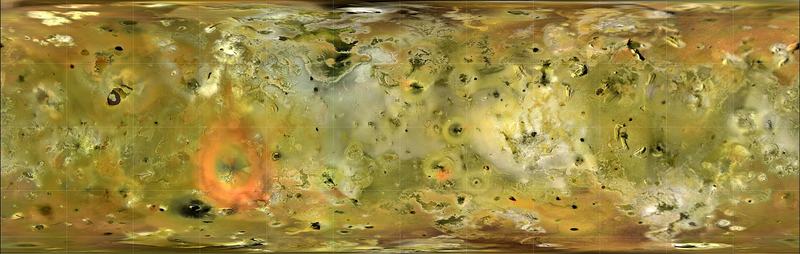

That same internal compression pushes material upward as well as out through volcanoes. Io's mountains average 6 km in height and reach a maximum of about 17.5 km at South Boösaule Montes, built not by volcanic construction but by the same crustal compression that squeezes lava to the surface elsewhere on the moon.
A Moon That Powers Jupiter's Own Magnetic Field
Io's influence doesn't stop at its own surface. It acts as an electric generator within Jupiter's magnetosphere, developing 400,000 volts across itself and creating an electric current of 3 million amperes, releasing ions that inflate Jupiter's magnetic field to more than twice the size it would otherwise have. A single moon, in other words, meaningfully reshapes the magnetic environment of the largest planet in the Solar System.
Jupiter's magnetosphere returns the favor by stripping material away: it sweeps up gases and dust from Io's thin atmosphere at a rate of about 1 tonne per second, feeding a vast cloud of particles that trails through the Jovian system. Io is simultaneously shaping Jupiter's magnetic field and slowly being eroded by it.
Studied by Spacecraft, Radiation and All
Reaching Io up close has never been easy. The Galileo spacecraft arrived at Jupiter in 1995 after a six-year journey from Earth, and though no images were taken during its close flyby of Io on December 7, 1995 — the moon sits inside one of Jupiter's most intense radiation belts — the encounter still yielded a major result: the discovery of a large iron core, similar to that found on the rocky planets of the inner Solar System.
Loki Patera itself keeps surprising researchers even from a distance. On March 8, 2015, a rare orbital alignment between Io and Europa allowed researchers to determine that Loki Patera undergoes two separate waves of resurfacing lava, explaining why its brightness changes roughly every 400 to 600 days — a volcanic rhythm discovered not by landing on Io, but by watching how its light changed as another moon briefly passed in front of it.