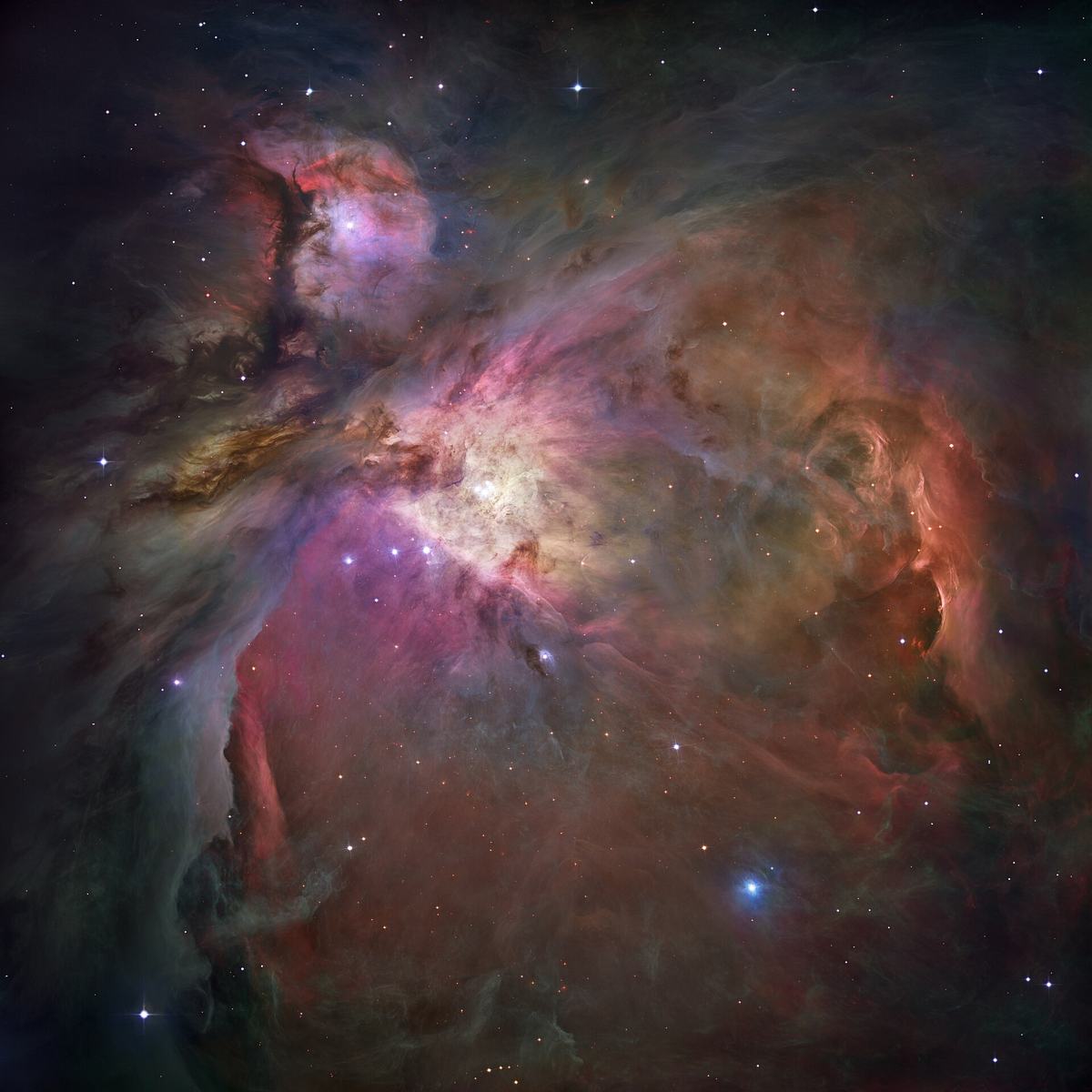
The Orion Nebula is 1,267 light-years from Earth, and you can still see it without a telescope. That combination is what makes it unusual: it is the closest region of massive star formation to our planet, close enough that its glow reaches naked-eye brightness across more than a thousand light-years of space.
Cataloged as Messier 42 or M42, the nebula sits in the middle of the "sword" hanging from Orion's Belt. It isn't just visible — it is one of the most photographed and most intensely studied objects in the night sky, because it lets astronomers watch star and planet formation happen in real time, close enough to resolve individual stars and disks rather than just an anonymous glow.
This article looks at what makes the Orion Nebula itself worth that attention: its scale, the crowded star cluster inside it, the raw number of infant planetary systems astronomers have found there, and its place inside a far larger, mostly invisible cloud complex.
A Star Nursery 1,267 Light-Years Away
The Orion Nebula is 1,267 light-years away, making it the closest region of massive star formation to Earth. That proximity is precisely why it has become the go-to laboratory for studying how stars are born — nowhere else can astronomers get this close to a nursery this large and still see it clearly.
M42 is estimated to be 25 light-years across, which gives it an apparent size from Earth of roughly 1 degree. The nebula also carries real mass to go with that size: about 2,000 times the mass of the Sun, tied up in gas, dust, and the stars condensing out of it.
Bright Enough to See, But Overlooked for Centuries
The Orion Nebula is one of the brightest nebulae in the sky and is visible to the naked eye, with an apparent magnitude of 4.0. On a clear, dark night, you can pick it out as a fuzzy patch in Orion's sword without any optical aid at all.
Given that brightness, its history is oddly late. Neither Ptolemy's Almagest nor al-Sufi's Book of Fixed Stars recorded it, even though both catalogs listed other patches of nebulosity in the sky, and Galileo did not mention it either, despite pointing his telescope at that exact patch of sky in 1610 and 1617. The nebula's diffuse, cloud-like nature was first recorded on November 26, 1610, by French astronomer Nicolas-Claude Fabri de Peiresc, using a refracting telescope purchased by his patron, Guillaume du Vair. A naked-eye object took over a millennium of organized skywatching to be correctly identified as a cloud rather than a star.
The Trapezium: Four Stars Running the Nursery
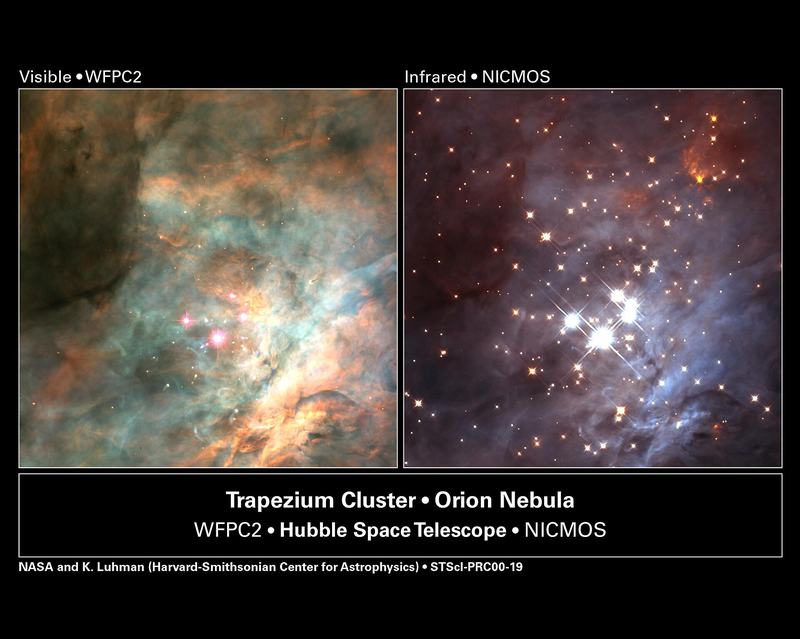
At the heart of the Orion Nebula is a very young open cluster known as the Trapezium Cluster, named for the asterism formed by its four brightest stars, packed within a diameter of just 1.5 light-years. That tight grouping is what floods the surrounding gas with enough ultraviolet light to make the whole nebula glow.
.jpg)
The Trapezium is only the dense core of something bigger: it's a component of the much larger Orion Nebula Cluster, an association of about 2,800 stars spread across a 20-light-year diameter. That's a lot of young, gravitationally interacting stars packed into a comparatively small volume of space, which sets up the dynamics behind the nebula's more chaotic behavior.
Runaway Stars and a Possible Black Hole
That crowding has consequences. Two million years ago, the Orion Nebula Cluster may have been the home of the runaway stars AE Aurigae, 53 Arietis, and Mu Columbae, which are now racing away from the nebula at speeds greater than 100 km/s (62 mi/s). The leading explanation is a close gravitational encounter inside the cluster violent enough to fling stars out at those speeds — a reminder that a "nursery" this crowded is not a gentle place.
There may be something even more massive hiding in the mix. A 2012 paper suggested that an intermediate-mass black hole, more than 100 times the mass of the Sun, could be present within the Trapezium — a proposal made specifically to explain the unusually large velocity dispersion measured among the cluster's stars. If confirmed, it would mean the extreme stellar speeds in the region aren't only about individual close encounters, but also about a hidden, heavy object stirring the whole cluster.
Nearly 700 Stars Still Being Born
Zoom out from the Trapezium and the nebula as a whole is even busier: observations have revealed approximately 700 stars in various stages of formation within the Orion Nebula. That number is why the nebula functions less like a single object and more like a stellar delivery room, with new stars appearing at every stage from collapsing gas to fully formed young stars.
That delivery room won't stay open forever. The youngest and brightest stars visible in the Orion Nebula today are thought to be less than 300,000 years old, and the brightest of them may be only 10,000 years old — a blink of an eye by stellar standards. Within about 100,000 years, most of the nebula's gas and dust will be ejected, which means the glowing cloud we see now is a temporary phase, not a permanent fixture of the sky.
Proplyds: Planetary Systems Caught Mid-Formation
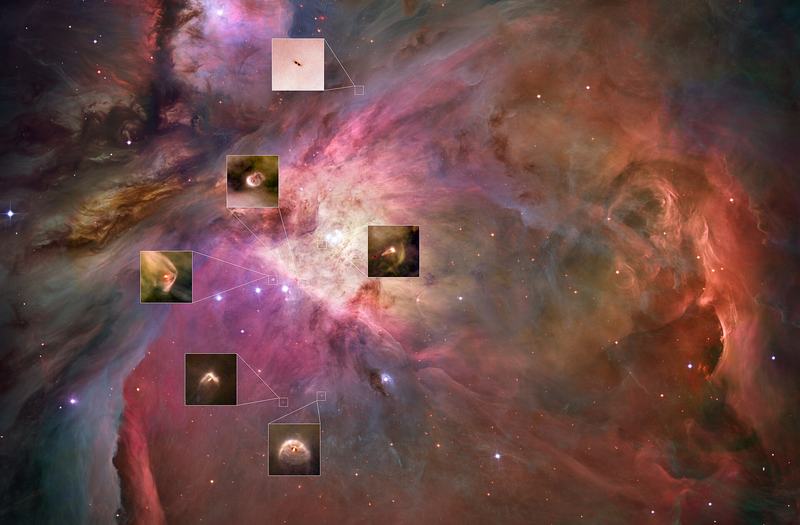
In 1993, observations with the Hubble Space Telescope delivered the first major confirmation of protoplanetary disks within the Orion Nebula — disks of gas and dust around young stars that have since been nicknamed proplyds. They are considered systems in the earliest stages of planet formation, effectively solar systems caught in the act of assembling themselves.
.jpg)
Since that first confirmation, the count has climbed: nearly 180 proplyds have been discovered in the Orion Nebula. Images of proplyds in other star-forming regions are rare, and Orion remains the only region with a large known sample, simply because it is close enough to Earth to resolve them in detail. The next-best site isn't close — NGC 1977 has the largest number of proplyds found outside the Orion Nebula, and that total is just 7 confirmed. Almost everything astronomers know about proplyds as a population, rather than as isolated curiosities, comes from this one nebula.
One Nebula Inside a Much Bigger Cloud Complex
As spectacular as it is, the Orion Nebula is only the brightest, most visible fragment of something much larger. It is part of a much larger nebula known as the Orion molecular cloud complex, which extends throughout the constellation of Orion and includes Barnard's Loop, the Horsehead Nebula, M43, M78, and the Flame Nebula. The complex as a whole is a star-forming region with stellar ages ranging up to 12 million years, and it stretches for hundreds of light-years — the Orion Nebula itself is just the part lit up brightly enough for us to notice from Earth.
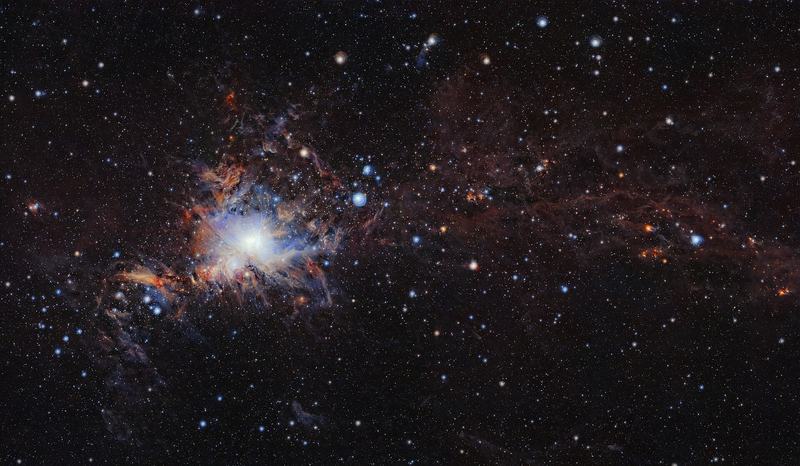

Much of that hidden activity happens in Orion A, the giant molecular cloud that contains the Orion Nebula and is the most active star-forming region in the Sun's local neighborhood. In the last few million years, about 3,000 young stellar objects have formed there, including about 190 protostars and about 2,600 pre-main-sequence stars. The Orion Nebula, brilliant as it is, represents only a fraction of that total — the visible tip of a far larger, mostly dark nursery.