By January 2020, something strange was happening to the star marking Orion's shoulder. Betelgeuse had dropped in brightness by a factor of about 2.5, and within weeks it slipped to a magnitude of +1.614 — its dimmest, coolest reading in 25 years of tracking. For a few months, astronomers seriously debated whether the Hunter's shoulder was about to detonate.
Orion did not need a fading star to earn its fame. It is one of the 88 constellations recognized by modern astronomers, and it was already familiar to sky-watchers when the 2nd-century astronomer Ptolemy included it among his original list of 48. Few star patterns are easier to find: three stars in a tidy row, flanked by a handful of supergiants bright enough to punch through city light pollution.
What follows is a tour of the numbers behind that famous outline — how Orion is measured and mapped, what makes its brightest stars unusual, and how a wide-field photograph of the region captures far more than the eye alone ever could.
Mapping the Hunter in the Sky
Orion covers 594 square degrees of the celestial sphere, which ranks it 26th by size among the 88 modern constellations — a respectable patch of sky, though nowhere near the largest. Its outline feels ancient, but the precise border is a comparatively recent invention: in 1930, Belgian astronomer Eugene Delporte drew Orion's official boundary as a polygon with 26 sides, part of a project that gave every constellation a fixed, non-overlapping edge on the sky map.
That formal boundary is what lets astronomers say with certainty which stars belong to Orion and which belong to a neighbor, even though the constellation itself is just a human pattern drawn over stars that have no real connection to one another.

A View Almost Nowhere on Earth Escapes
Orion sits close enough to the celestial equator that it turns up from nearly every inhabited latitude, and even the most extreme vantage point cannot fully hide it. Observers at the Amundsen-Scott South Pole Station can catch Rigel climbing just 8 degrees above their horizon, with Orion's Belt sweeping along that same low line. It is a fleeting, skimming view rather than a proper rise — but it means a constellation named for a Greek hunter shows up briefly even at the bottom of the world.
Betelgeuse: A Star Living Fast
Betelgeuse is barely middle-aged by stellar standards, at less than 10 million years old, yet its enormous mass has pushed it through its life cycle unusually quickly. Astronomers expect that rapid evolution to end in a supernova within the next 100,000 years — a blink of an eye on cosmic timescales, though almost certainly not within any living person's lifetime.
Even without an explosion, Betelgeuse rarely sits still. Under normal conditions it holds down 11th place among the sky's brightest stars, yet by the end of 2019 that rank had swung anywhere from 10th to 23rd, a wobble unusual enough that professional and amateur observers alike started paying close attention.

The Winter the Shoulder Faded
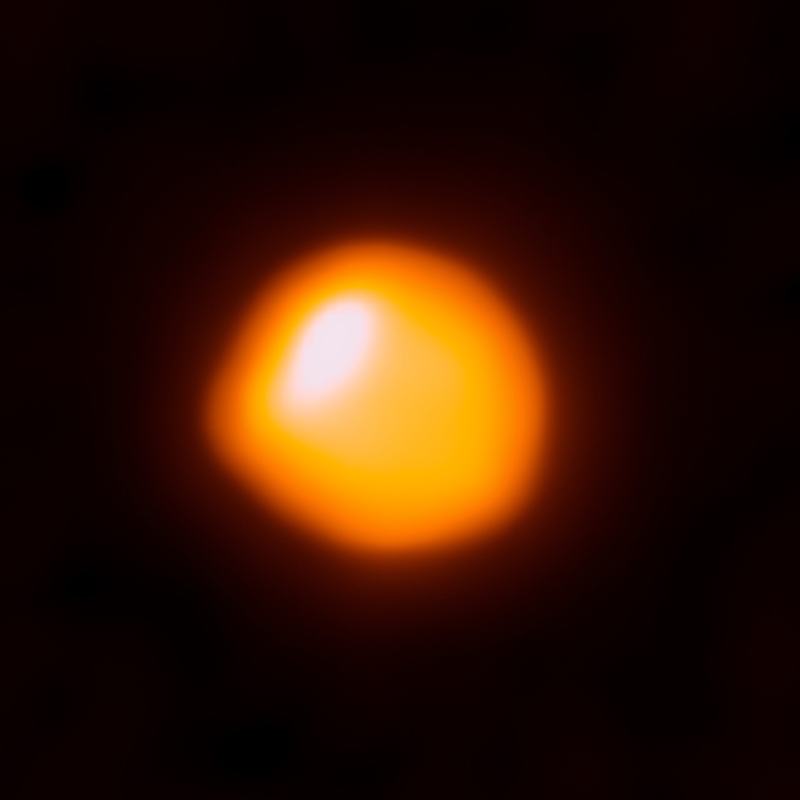
That attention paid off. Betelgeuse's brightness fell to roughly 2.5 times fainter than usual within weeks, and by February 2020 it had settled at a record-faint magnitude of +1.614 — its least luminous, coolest state in 25 years of monitoring. News outlets ran headlines about an imminent supernova, though the dimming eventually reversed and the star brightened back to something closer to normal.
Astronomers already had a head start on understanding a star that strange. Back in 1995, a camera aboard Hubble built for faint objects had produced an ultraviolet picture of Betelgeuse's disk sharper than anything ground-based interferometers could manage — the first time any ordinary telescope had directly pictured the surface of a star other than the Sun. That baseline made the 2020 dimming event something researchers could measure against, rather than a mystery starting from zero.
Rigel: One Point of Light, At Least Four Stars
Across the constellation from Betelgeuse sits Rigel, marking Orion's foot. To the naked eye it looks like a single blue-white point, but it is really the brightest and most massive member of a system made up of at least 4 stars bound together. What looks like simplicity from Earth is, up close, a small crowd.
Rigel's companion wasn't obvious for centuries. William Herschel only spotted it, confirming Rigel as a double star, on 1 October 1781 and logged the find in his Catalogue of Double Stars. It took a telescope, careful measurement, and Herschel's trained eye to split what naked-eye observers had treated as one star for millennia.

The Belt: Alnitak, Mintaka, and Alnilam
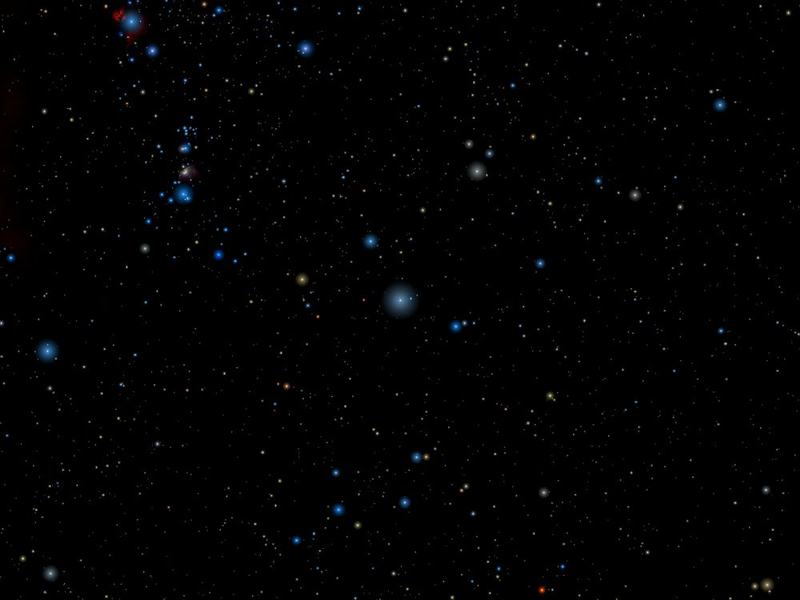
The three stars of Orion's Belt are its most recognizable feature, and each has its own personality. Alnitak sits around 800 light-years away and shines at magnitude 1.8, putting out 100,000 times the Sun's luminosity — though so much of that energy leaves as ultraviolet light that the human eye only catches a fraction of its true output. Mintaka, the westernmost of the three, lies farther out at 915 light-years and glows at magnitude 2.21.
Alnilam, the Belt's middle star, carries a name with real history behind it: designated Epsilon Orionis, it takes its name from an Arabic phrase meaning "string of pearls" — a fitting description for a star that sits neatly between its two neighbors in that famous three-star line.

One Photograph, an Entire Stellar Nursery
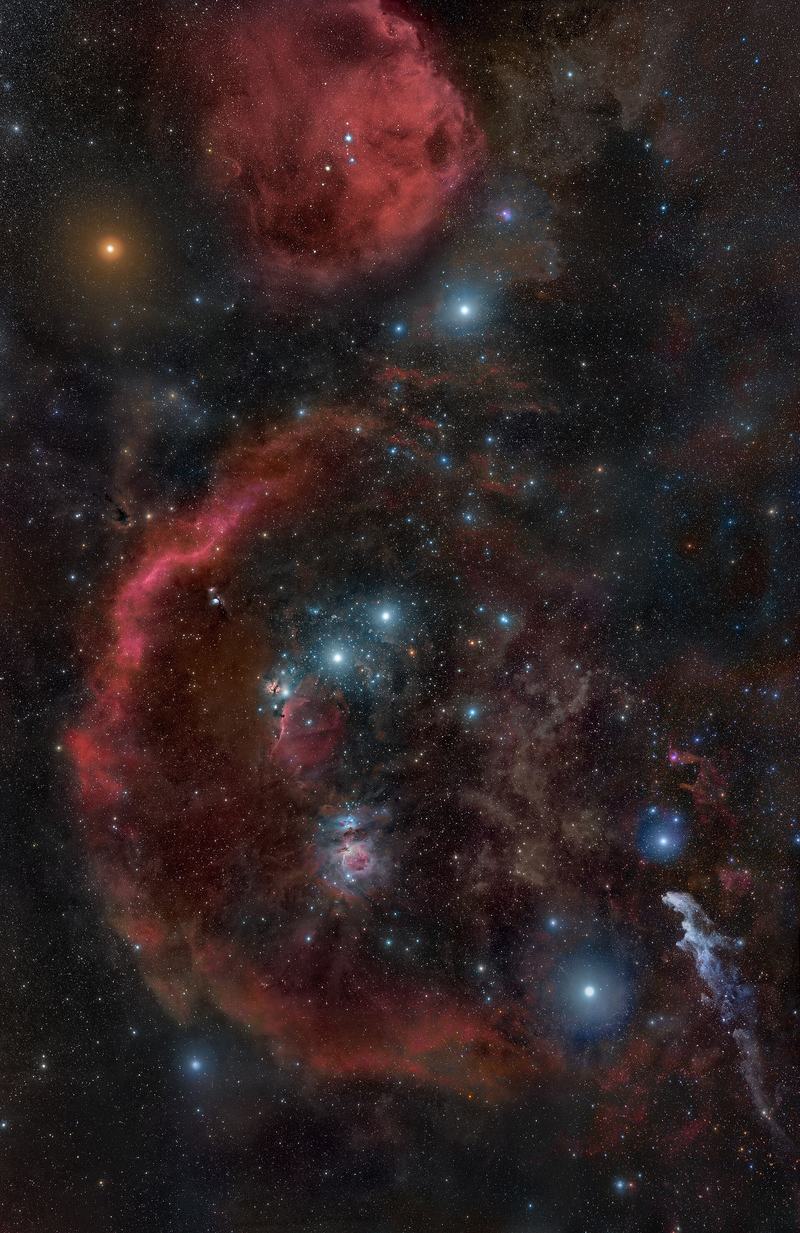
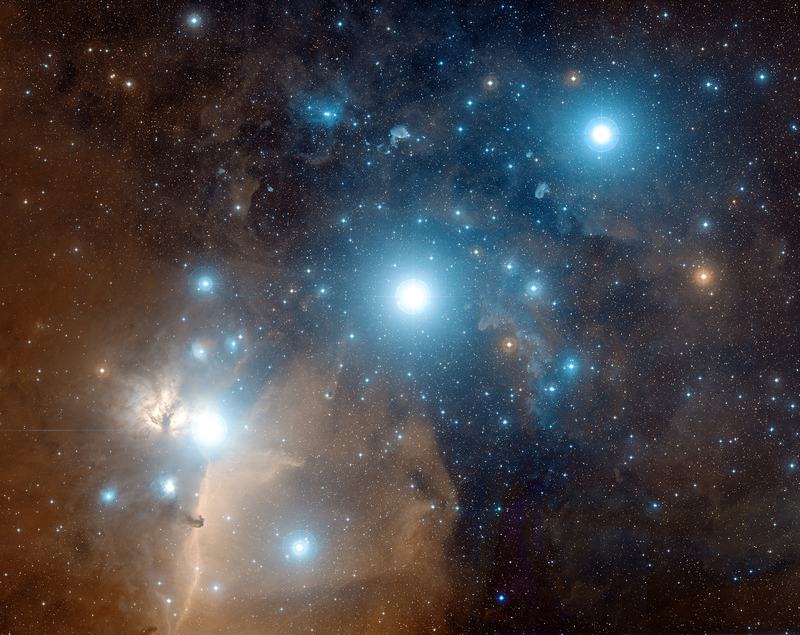
A single wide-field astrophotograph of Orion can span nearly 25 degrees of sky, wide enough to capture the constellation from head to toe in one frame. That kind of image does more than record familiar stars — the same view also picks up the Horsehead Nebula, the diffuse glow of M78, and the full line of Orion's Belt stars in context with each other.
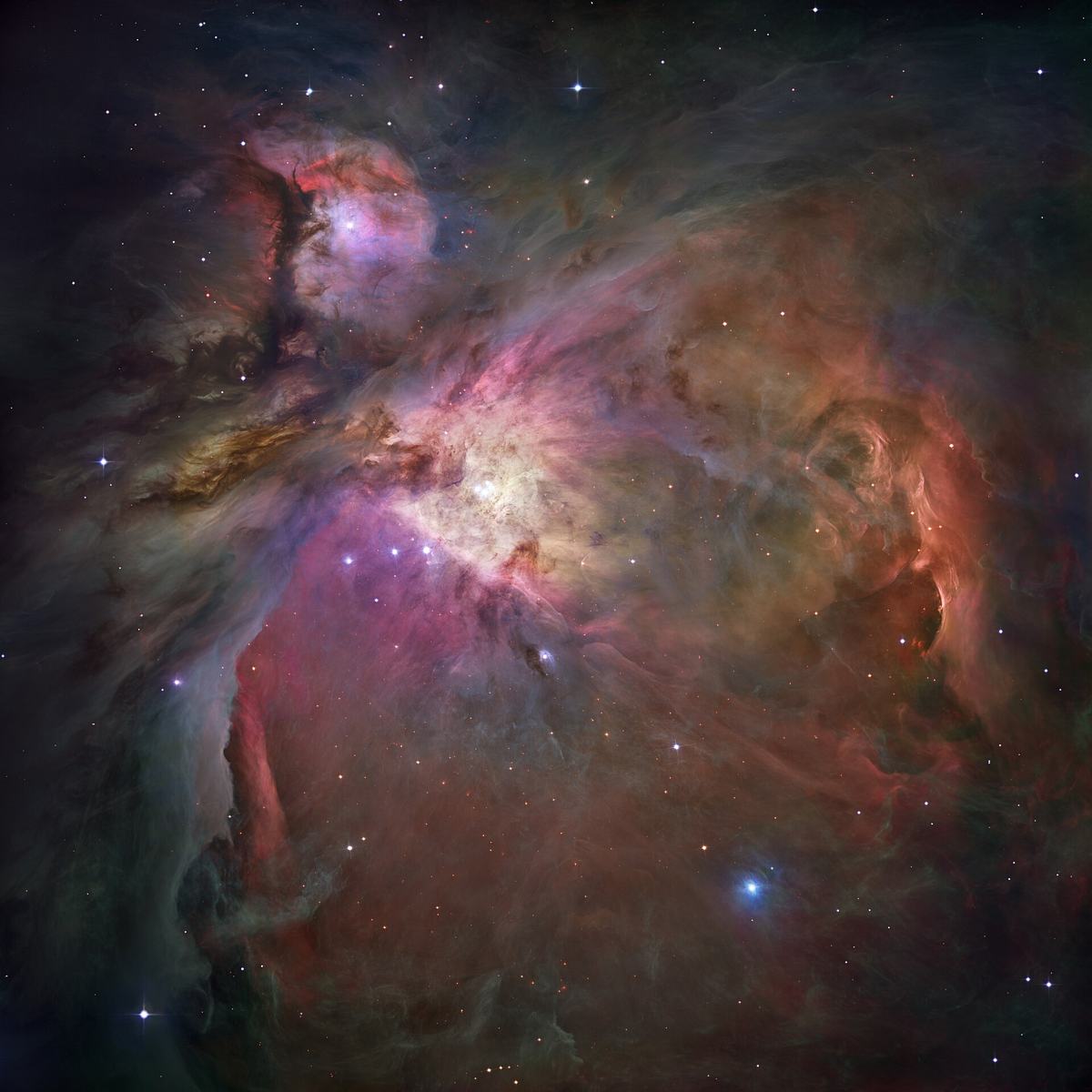
The region owes that richness to what lies behind the stars: nurseries where new stars form, cradled in cosmic dust and glowing hydrogen, positioned on the near edge of a molecular cloud roughly 1,500 light-years from us. The Orion Nebula and the constellation's brightest stars are easy enough to spot with nothing but your eyes, but the fainter dust clouds and interstellar gas that surround them are far harder to record — they need long exposures and sensitive equipment to show up at all.
Recalibrating the Distances We Rely On
Every light-year figure attached to a star in this article — Alnitak's 800, Mintaka's 915, the nebula's 1,500 — depends on distance-measuring missions that get refined over time. A new reduction of the Hipparcos satellite's astrometric data improved measurement precision by a factor of 2.2 over the catalogue published in 1997, sharpening the stellar-luminosity and galactic-motion figures that astronomers across the field now build on.
It is a reminder that a constellation's numbers are not carved in stone. The shapes stay the same from year to year, but the measurements behind them keep getting sharper — which is exactly how a star like Betelgeuse can go from a background curiosity to a headline-making dimming event almost overnight.